
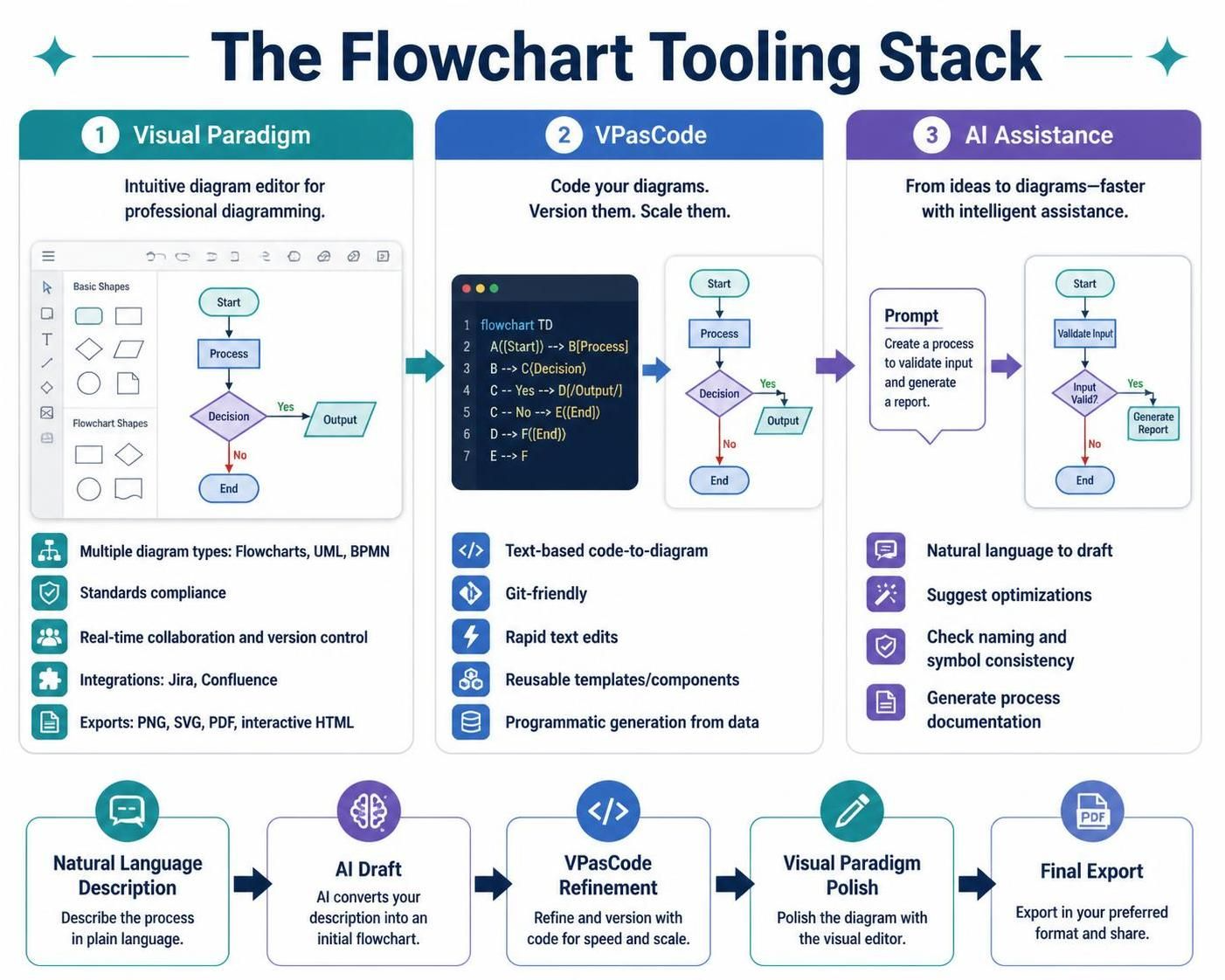
In the rapidly evolving landscape of software architecture and business process management, the traditional method of manually dragging and dropping shapes onto a canvas is often too slow for complex systems and difficult to maintain over time. A new paradigm has emerged, combining the robustness of enterprise modeling with the agility of code-based definitions and the speed of generative AI. This tutorial explores the “Flowchart Tooling Stack,” a three-pillar architecture designed to streamline the creation, versioning, and optimization of process diagrams.
1. The Foundation: Visual Paradigm as the Enterprise Standard
At the core of this workflow lies Visual Paradigm, a comprehensive modeling tool that serves as the authoritative source for all diagrams. Unlike lightweight sketching tools, Visual Paradigm is built for enterprise-grade compliance and integration.
The primary advantage of this tool is its adherence to strict standards. Whether you are drawing standard UML (Unified Modeling Language) diagrams, BPMN (Business Process Model and Notation) for business analysts, or custom Flowcharts, the tool ensures that every symbol, line style, and connector follows ISO and industry norms. This guarantees that your diagrams are not just visual aids, but standardized technical documentation that can be understood by developers, stakeholders, and auditors alike.
Beyond the visual editor, the tool acts as a central hub for collaboration. It supports real-time editing, allowing multiple architects to work on a system simultaneously, and integrates seamlessly with productivity ecosystems like Jira and Confluence. The final output is versatile, supporting high-quality exports in PNG, SVG, PDF, and even interactive HTML formats for web publishing.
2. The Engine: VPasCode for Code-Based Diagramming
While the visual editor is powerful, it can be cumbersome for large-scale systems. This is where VPasCode comes in. VPasCode is the code-to-diagram engine embedded within Visual Paradigm. It allows you to define complex flowcharts using a text-based syntax, similar to the popular PlantUML or Mermaid libraries.
This approach transforms diagramming into a software development task. Instead of manually adjusting the size of a box or the length of an arrow, you simply edit the text. This offers three distinct advantages:
- Version Control Friendly: Since diagrams are stored as text files, they can be committed to Git repositories. You can track changes, compare versions, and resolve conflicts just like you would with source code.
- Rapid Iteration: You can make sweeping changes to a process flow by editing a few lines of text rather than re-arranging dozens of shapes.
- Automation & Reusability: You can create reusable templates and generate diagrams programmatically from data sources, enabling massive scalability.
3. The Accelerator: AI-Assisted Generation
The third pillar of this stack is the integration of Artificial Intelligence. Modern AI tools have evolved from simple chatbots into active co-pilots for system design. They accelerate the flowchart creation process by bridging the gap between abstract ideas and concrete models.
AI assistance operates on several levels:
- Natural Language to Diagram: You can provide a high-level process description in plain English, and the AI can generate an initial draft flowchart structure.
- Optimization Suggestions: The AI can analyze the logic of your diagram to identify redundant steps, missing decision points, or circular dependencies.
- Consistency Checks: It ensures that naming conventions are followed and that symbols adhere to the selected standard.
- Documentation: AI can auto-generate the accompanying text documentation that describes the logic within the diagram.
The Workflow: From Idea to Export
By combining these three elements, you create a seamless “Orchestrated Workflow” that maximizes efficiency:
- Natural Language Description: The process begins with a plain language description of the business logic.
- AI Draft: The AI converts this description into an initial, logical flowchart draft.
- VPasCode Refinement: The architect refines the draft by converting it into VPasCode syntax, allowing for rapid edits and version control integration.
- Visual Paradigm Polish: The code is rendered in the Visual Paradigm editor for final aesthetic adjustments and standard compliance checks.
- Final Export: The completed diagram is exported in the required format (PDF, SVG, or HTML) for stakeholder review.
Step-by-Step: Implementing the Workflow
To illustrate how this stack functions in practice, let us walk through the creation of a standard “Order Processing” flowchart. We will start by defining the logic in code (VPasCode), which is then rendered and polished.
First, you define the structure using the VPasCode syntax. This text-based definition ensures your logic is clear and versionable:
flowchart TD
    %% Define the Start and End nodes
    Start([Start Process])
    End([End Process])

    %% Define the Input node
    Input[/Input Order/]

    %% Define the Validation Decision
    Validate{Validate Data?}

    %% Define the Output node
    Output[/Generate Report/]

    %% Define the Error Handling node
    Error[/Handle Error/]

    %% Define the connections
    Start --> Input
    Input --> Validate

    %% Decision branches
    Validate -- Yes --> Output
    Validate -- No --> Error
    Error --> Input

    Output --> End
Once the code is rendered in Visual Paradigm, you can apply the final “Polish” phase. This involves ensuring that the diamond shape for Validate matches the ISO standard, or that the flow lines are routed cleanly. The AI Assistant can then review this generated diagram, suggesting that the “Handle Error” loop should perhaps have a limit to prevent infinite loops, thereby adding a layer of architectural intelligence to the design.