
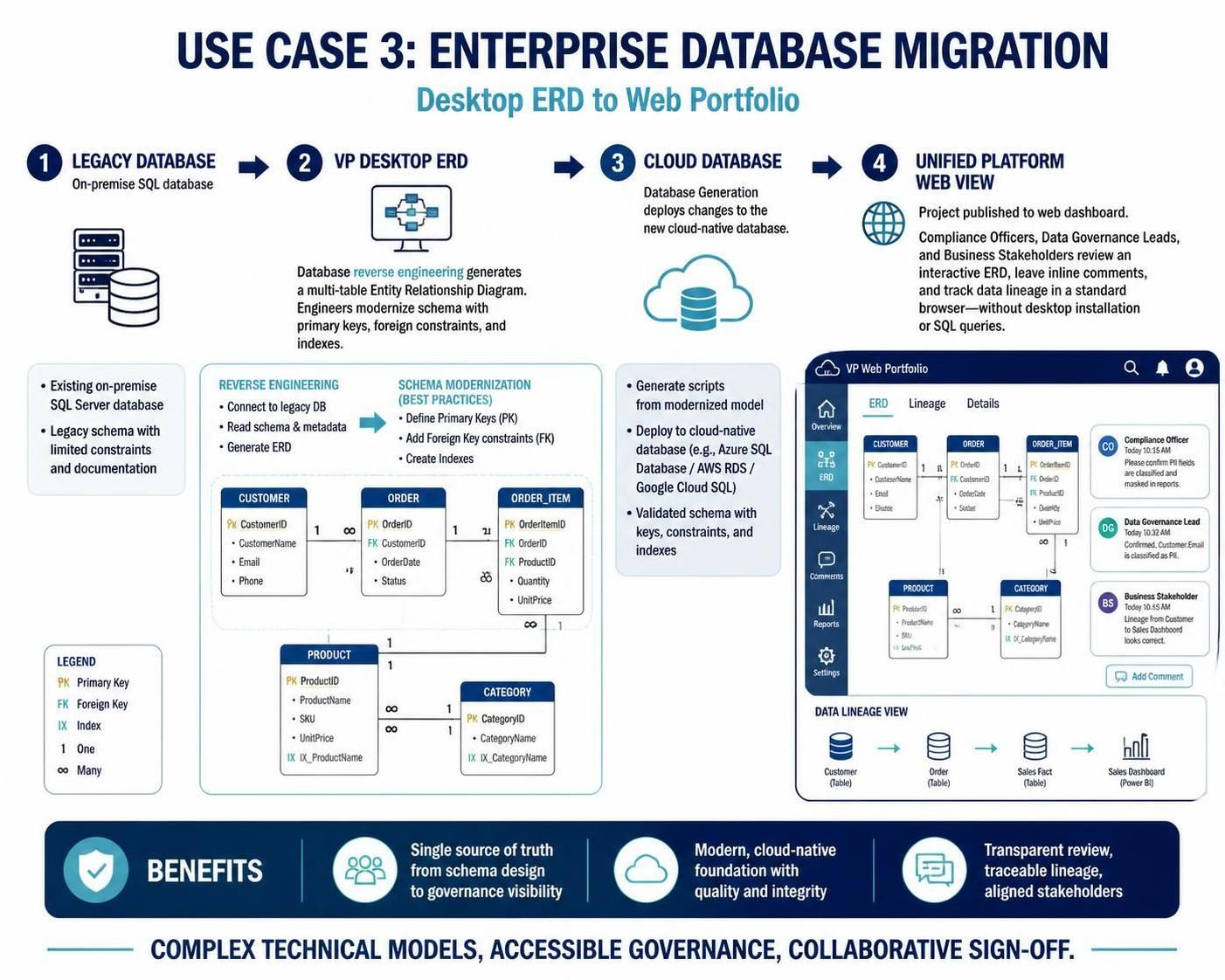
In the modern landscape of enterprise architecture, the ability to migrate legacy systems to cloud-native environments is a critical skill. However, the challenge often lies not just in the technical execution of the migration, but in the governance and approval process involving stakeholders who lack deep technical expertise. This tutorial explores Use Case 3: Enterprise Database Migration, demonstrating how to leverage the Visual Paradigm (VP) ecosystem to bridge the gap between complex engineering tasks and business compliance.
1. The System Architecture: A Four-Stage Workflow
The architecture described in the scenario follows a linear yet collaborative workflow designed to modernize data infrastructure while maintaining strict audit trails. The process moves from an on-premise legacy environment to a web-based collaborative dashboard.
- Stage 1: The Legacy Source
The journey begins with an existing on-premise SQL database. These systems often suffer from “schema debt”—missing documentation, limited constraints, and inefficient structures. The goal here is to extract the current reality of the data.
- Stage 2: VP Desktop & Reverse Engineering
Engineers utilize the VP Desktop application to perform reverse engineering. By connecting directly to the legacy database, the software generates a visual Entity Relationship Diagram (ERD). This transforms raw SQL metadata into a human-readable model.
- Stage 3: Modernization & Cloud Deployment
Inside the desktop environment, engineers modernize the schema. This involves defining Primary Keys (PK), adding Foreign Key (FK) constraints for data integrity, and creating indexes for performance. Once the design is finalized, the Database Generation tool executes the changes against the target cloud database (e.g., Azure SQL, AWS RDS).
- Stage 4: The Unified Platform (Web View)
The final stage democratizes access. The project is published to the Unified Platform. Stakeholders—such as Compliance Officers and Data Governance Leads—access the model via a standard web browser. They can review the interactive ERD, leave inline comments, and track data lineage without needing to install complex modeling software.
2. Deep Dive: Schema Modernization Concepts
During the transition from Stage 2 to Stage 3, the core technical work involves “Schema Modernization.” This is not merely copying tables; it is an exercise in database normalization and integrity enforcement.
Understanding the Data Model
Consider the sample ERD shown in the scenario. It depicts a classic relational structure involving Customers, Orders, Order Items, Products, and Categories.
Here is a breakdown of the specific modeling elements being defined:
- Primary Keys (PK):
Example:
CustomerIDin theCUSTOMERtable. This ensures every record is unique and serves as the anchor for relationships. - Foreign Keys (FK):
Example:
CustomerIDin theORDERtable. This constraint enforces referential integrity, ensuring that an order cannot exist without a valid customer. - Indexes (IX):
Example:
IX_ProductName. This is a performance optimization that allows the database to search for products faster without scanning the entire table.
The Power of the Unified Platform
Once the model is deployed, the “Unified Platform” acts as a Single Source of Truth. The diagram illustrates a Data Lineage View, which is crucial for compliance. It visually traces how data moves from the source tables (Customer, Order) through to analytical reports (Sales Dashboard).
This visibility allows non-technical users to verify that sensitive data (like PII – Personally Identifiable Information) is being handled correctly throughout the pipeline.
3. Key Benefits of This Architecture
By integrating Desktop and Web capabilities, organizations achieve several strategic advantages:
- Democratized Access: Complex technical artifacts (ERDs) are no longer locked behind software installations. A standard browser is sufficient for high-level review.
- Collaborative Governance: Inline comments and task tracking allow for real-time feedback loops between engineers and compliance officers.
- Reduced Risk: Automated schema generation minimizes the risk of human error during manual SQL scripting.
In conclusion, this workflow demonstrates how modern modeling tools can facilitate a seamless transition from legacy infrastructure to a secure, cloud-native, and governable data architecture.