
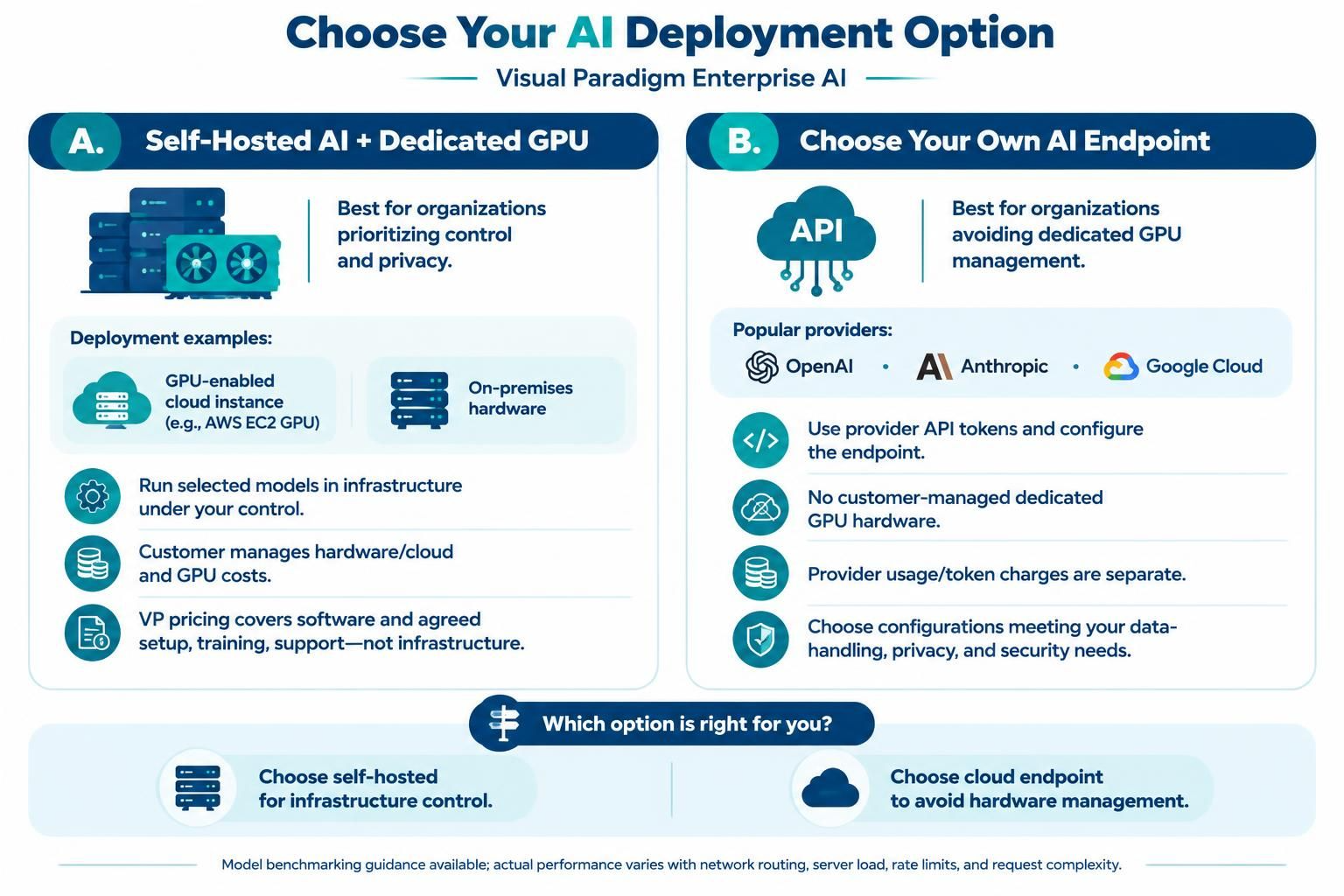
In the rapidly evolving landscape of enterprise AI, there is no longer a “one-size-fits-all” approach to deployment. Organizations face a critical decision: do you maintain full control over your data and compute resources, or do you prefer the agility of consuming AI services as a utility? Visual Paradigm has addressed this dichotomy by designing an ecosystem that supports two distinct architectural patterns: Self-Hosted AI and Choose Your Own AI Endpoint.
This tutorial provides a high-level architectural overview of how these two deployment models function within the Visual Paradigm ecosystem, guiding you through the trade-offs between infrastructure ownership and operational convenience.
The Visual Paradigm AI Ecosystem Architecture
The core philosophy behind the Visual Paradigm Enterprise AI solution is modularity. By decoupling the Application Layer (the Visual Paradigm tools) from the Compute Layer (the AI Models and Hardware), the solution allows businesses to select the infrastructure strategy that aligns with their specific compliance, budget, and operational requirements.
At a high level, the ecosystem consists of three critical components:
- The Integrated Modeling Interface: The user-facing tools within Visual Paradigm that allow for model generation, knowledge management, and visual analysis.
- The AI Core Components: The backend processing units that handle Large Language Model (LLM) inference. Depending on the option chosen, these reside either locally or in a public cloud.
- The Deployment Bridge: The configuration layer that connects the interface to the chosen AI core, whether that be a private GPU server or a public API.
Option A: The Self-Hosted Architecture (Zero-Trust & Control)
Option A represents the “Bring Your Own Infrastructure” (BYOI) model. This architecture is designed for organizations where data sovereignty, privacy, and security are the paramount concerns. In this setup, the AI compute power is physically or logically isolated from the public internet.
Key Architectural Components
- Dedicated GPU Infrastructure: The organization provisions the hardware. This can be on-premises hardware (local servers) or a private cloud instance (such as AWS EC2 GPU instances).
- Private Endpoint: The AI models are hosted within an environment under the customer’s direct control. The Visual Paradigm application suite connects to this private endpoint.
- Model Selection: The customer selects and runs the specific AI models that best fit their security profile.
Cost & Responsibility Model
In the Self-Hosted model, the responsibility is split clearly between the software vendor and the customer:
- Customer Responsibility: The organization manages the underlying hardware, cloud infrastructure, and GPU consumption costs. They are also responsible for the maintenance of the environment.
- Visual Paradigm Responsibility: Visual Paradigm provides the software tools, the agreed-upon setup, training, and support services. The pricing covers the intellectual property and service layer, not the raw compute resources.
Option B: The Cloud Endpoint Architecture (SaaS & Agility)
Option B represents the “Consume-as-a-Service” model. This approach is ideal for organizations that want to leverage the power of state-of-the-art AI models without the overhead of managing physical hardware or complex GPU clusters.
Key Architectural Components
- Public API Integration: Instead of running models locally, the Visual Paradigm application is configured to point to external AI providers. Popular providers include OpenAI, Anthropic, and Google Cloud.
- API Token Management: Businesses purchase API tokens directly from these providers and configure the Visual Paradigm application to utilize these endpoints.
- Managed Infrastructure: The infrastructure, scaling, and maintenance of the AI models are handled entirely by the third-party providers.
Cost & Responsibility Model
This model shifts the operational burden to the cloud providers:
- Customer Responsibility: The organization pays for the API usage and token charges directly to the provider. They are responsible for ensuring their endpoint configuration meets their data privacy needs (e.g., ensuring the provider does not train on customer data).
- Visual Paradigm Responsibility: Similar to Option A, Visual Paradigm provides the software tools, setup, and support. The pricing for the solution does not include the external API token costs.
Architectural Comparison & Decision Matrix
To visualize the decision process for selecting the right deployment architecture, consider the following decision logic used by system architects.
IF (Data Privacy & Control is Priority) THEN
    Select Option A: Self-Hosted AI + Dedicated GPU
    // Best for: Strict confidentiality, existing private cloud strategy
ELSE IF (Speed to Market & Hardware Avoidance is Priority) THEN
    Select Option B: Choose Your Own AI Endpoint
    // Best for: Quick start, avoiding dedicated GPU management
ELSE
    Consult Visual Paradigm team for hybrid or benchmarking guidance
Performance Considerations
Regardless of the architecture chosen, it is important to note that actual performance depends on several dynamic factors:
- Network Routing: Latency can vary based on the distance between the user and the endpoint.
- Server Load: In cloud endpoints, performance may fluctuate based on the provider’s global server load.
- Rate Limits: API providers often enforce rate limits on token usage, which can impact throughput.
- Request Complexity: Complex generation tasks will naturally take longer to process than simple queries.
Conclusion
The Visual Paradigm ecosystem offers a flexible foundation for AI integration. By supporting both self-hosted and cloud endpoint models, it ensures that whether an organization requires the fortress-like security of private infrastructure or the agility of public cloud APIs, there is a deployment path that fits their unique business context.