
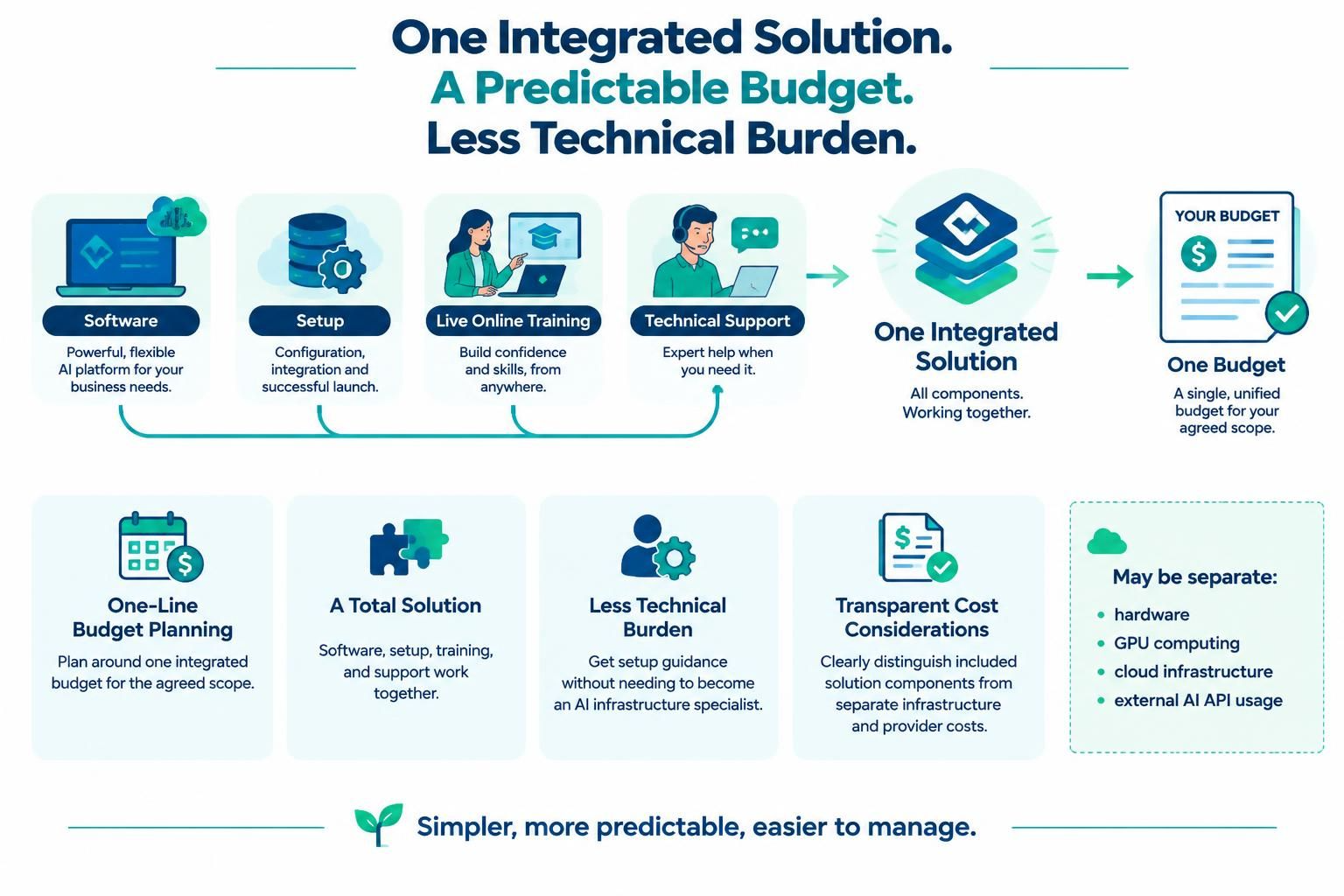
Modern enterprises are often paralyzed by the complexity of adopting Artificial Intelligence. The fear of the unknown—specifically the technical hurdles of infrastructure and the financial unpredictability of disparate vendors—often stalls innovation before it begins. Visual Paradigm addresses this challenge with a structured, “One Integrated Solution” framework designed to bridge the gap between high-level business strategy and technical execution.
This tutorial breaks down the ecosystem architecture presented in the Visual Paradigm AI framework. We will explore how this model unifies software, services, and support into a predictable budget, simplifies the technical burden for non-specialists, and ensures transparent cost management.
1. The Core Architecture: The Four Pillars of Integration
At the heart of this ecosystem is a shift from purchasing disconnected services to acquiring a cohesive solution. The framework identifies four foundational pillars that must work in harmony to deliver value to an organization.
Pillar 1: The Software Foundation
The journey begins with the core platform. Visual Paradigm provides a powerful, flexible AI platform. In the context of an SME to Enterprise environment, this is not just a tool; it is the operating system for your AI initiatives. It handles the logic for visual modeling, knowledge management, and AI core components.
Pillar 2: Configuration and Setup
Software alone is rarely enough. The “Setup” component refers to the critical phase of configuration, integration, and launch. This involves:
- Integrating the AI tools with existing enterprise data sources.
- Configuring the visual modeling environments to match organizational standards.
- Ensuring the “AI Core Components” are correctly tuned for business logic.
Pillar 3: Live Online Training
Adoption fails when users do not understand the tools. The framework mandates “Live Online Training” to build confidence and skills. This is not just a video library; it is an interactive process where teams learn how to apply the tools to actual business activities, transforming abstract AI concepts into practical workflows.
Pillar 4: Technical Support
Finally, the architecture includes a dedicated support layer. This ensures that when technical questions arise, the team has expert help available. This support acts as the safety net, allowing the business to focus on innovation rather than troubleshooting.
2. The Strategic Advantage: Predictable Budgeting
One of the most significant friction points in IT projects is budget fragmentation. The Visual Paradigm framework solves this by offering a One-Line Budget Planning approach.
From Disconnected to Unified
Traditionally, a business would source software from one vendor, hiring consultants for setup, contracting a training firm, and paying support fees to a third party. This creates a “Total Solution” that is actually a collection of disconnected services.
By consolidating these into a single commercial offering, the framework allows for:
- Agreed Scope: The budget is calculated based on the full scope of the engagement.
- Simplified Procurement: Instead of managing multiple contracts, the business manages one integrated agreement.
- Financial Clarity: A single budget line item makes it easier for CFOs and stakeholders to approve projects.
3. Reducing Technical Hardship: The “No-Code” Philosophy
The framework explicitly states a goal: Less Technical Burden. This is achieved by decoupling the user from the infrastructure complexity.
Historically, to use AI, an organization needed to become an AI infrastructure specialist. This required hiring expensive data scientists to manage GPU clusters, cloud configurations, and security protocols. The Visual Paradigm approach removes this barrier.
How it works:
- Visual Paradigm handles the heavy lifting: They manage the technical setup and guidance.
- The team focuses on application: Your staff focuses on learning how to use the tools and applying them to business logic.
- High-Level Discussion: The architecture is designed so that teams can discuss AI implementation at a conceptual level without getting bogged down in code.
4. Transparent Cost Considerations
While the core solution is integrated, the framework maintains transparency regarding infrastructure costs. It is crucial to understand the distinction between the software solution and the infrastructure requirements.
What is Included?
The integrated pricing covers the software tools, setup services, training, and support. This is the “guaranteed” cost.
What is Separate?
Depending on the deployment option (e.g., Cloud vs. On-Premise), certain infrastructure costs are separate. These typically include:
- Hardware: Physical servers or workstations.
- GPU Computing: High-performance computing resources required for AI processing.
- Cloud Infrastructure: Hosting fees for cloud environments.
- External AI API Usage: Charges for connecting to third-party AI providers.
Conclusion: A Simpler Path to AI
The Visual Paradigm ecosystem represents a shift towards maturity in AI adoption. By packaging software, setup, training, and support into a single unit, it removes the guesswork from the adoption process. The result is a system that is simpler to manage, more predictable in cost, and less burdensome technically, allowing businesses to focus on what matters most: delivering value through AI.