
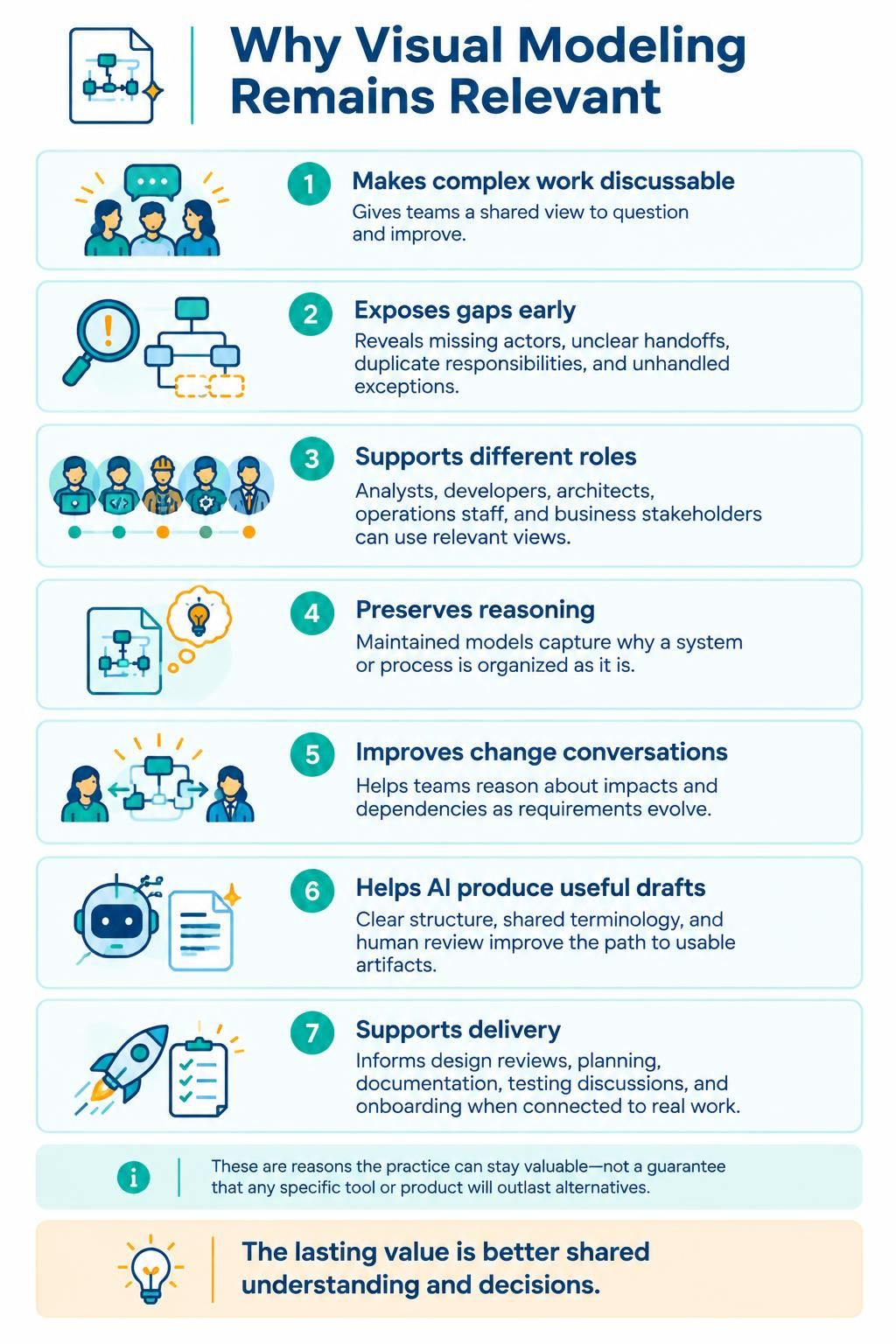
In an era where code generation is becoming increasingly automated, one might wonder if the discipline of visual modeling is becoming obsolete. However, the core value of visual modeling lies not in the drawing tool itself, but in its ability to structure complex thought processes. Using tools like Visual Paradigm (VP) allows teams to move beyond simple diagramming into comprehensive system architecture.
This tutorial explores the seven critical pillars of why visual modeling remains a cornerstone of successful software engineering and system design. We will explore how these concepts translate into practical architecture work, leveraging the power of visual representation to drive better decisions.
1. Making Complex Work Discussable
Complex systems are often abstract. When described solely through text or code, different stakeholders may visualize the system differently. A shared visual view provides a concrete artifact—a “single source of truth”—that a team can point to, question, and improve.
Visual Paradigm facilitates this by allowing you to create Context Diagrams (Level 0 Data Flow Diagrams) that summarize the entire system’s interaction with its environment. Instead of arguing over paragraphs of requirements, the team can look at the diagram and ask, “Why does the User talk to the Billing System directly?”
2. Exposing Gaps Early
One of the most significant risks in software development is “scope creep” or missing requirements. Visual modeling exposes these gaps before a single line of code is written.
- Missing Actors: If you draw the flow but forget an external system (e.g., a Payment Gateway), the diagram will show a dead end.
- Unclear Handoffs: Data Flow Diagrams (DFDs) clearly show where data moves. If a data packet has no destination, you have identified a gap.
- Unhandled Exceptions: Flowcharts allow you to map out “What if” scenarios. If you can’t draw a path for an error state, the system design is incomplete.
3. Supporting Different Roles
A monolithic document rarely serves everyone. Visual modeling allows for abstraction. Visual Paradigm excels at creating different “views” of the same system tailored to specific audiences:
- Business Stakeholders: Benefit from high-level Use Case Diagrams or Business Process Models (BPMN) that explain the “What” and “Why.”
- Architects: Require Component Diagrams or Deployment Diagrams to understand the structural integrity and technology stack.
- Developers: Need Sequence Diagrams and Class Diagrams to understand the “How” and the object interactions.
- Operations: Focus on Deployment Diagrams to understand server topology and load balancing.
4. Preserving Reasoning
Code is often written with a specific rationale in mind, but that rationale is rarely preserved in the code comments. This is known as “tribal knowledge”—knowledge that exists only in the minds of the original developers.
A maintained model captures the design rationale. If a system is restructured years later, the diagram serves as a map explaining why the system is organized the way it is. Visual Paradigm allows you to link requirements directly to architectural elements, preserving the “Why” alongside the “What.”
5. Improving Change Conversations
Requirements evolve. When a new requirement is introduced, teams often struggle to predict the impact. Visual models support “Impact Analysis.”
By using the Traceability Matrix features in Visual Paradigm, you can instantly see which components, database tables, or test cases are affected by a specific change in the context diagram. This transforms change management from a guessing game into a calculated discussion.
6. Helping AI Produce Useful Work
You might assume that AI coding agents replace the need for diagrams. However, the most effective AI workflows actually require diagrams. AI generates code based on context.
Providing the AI with a clear, structured PlantUML or Mermaid diagram (which can be generated within Visual Paradigm) gives the AI a concrete schema. Clear structure and agreed-upon terminology in the model give the AI-generated drafts a much better path toward usable project artifacts. The model acts as the “prompt” that grounds the AI’s generation.
7. Supporting Practical Delivery
Finally, models must support delivery. A diagram that sits in a repository and is never touched is a waste of time. Visual Paradigm bridges the gap between design and delivery through:
- Design Reviews: Using the diagrams as the agenda for architectural reviews.
- Onboarding: New hires can read the architecture diagrams to understand the system faster than reading code.
- Documentation: Generating API documentation or user manuals directly from the model.
Conclusion
The lasting value of visual modeling comes from using models to improve shared understanding and decisions. Whether you are a business analyst, a developer, or an AI engineer, a shared visual language remains the most efficient way to navigate complex system architectures.