
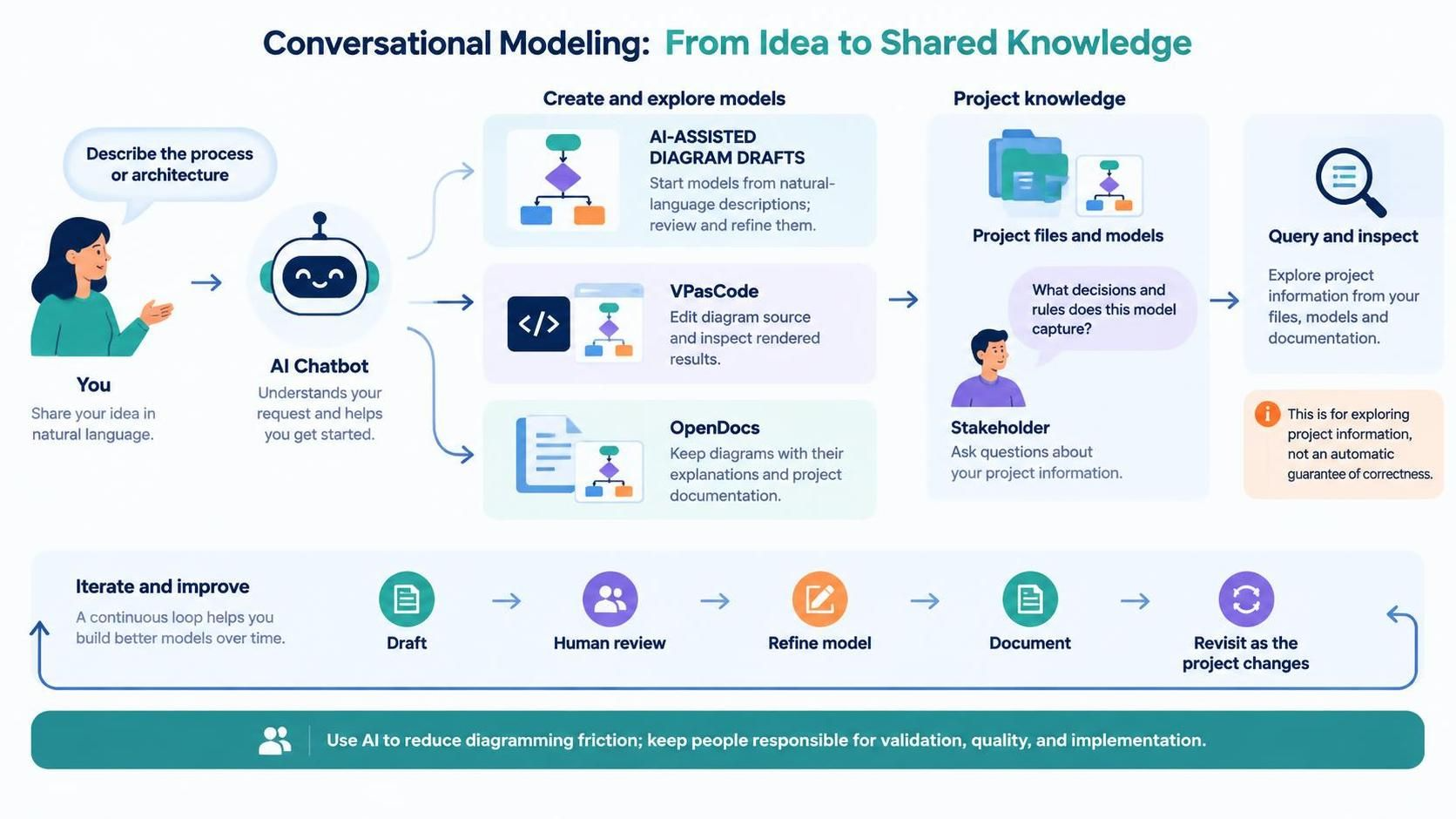
In the rapidly evolving landscape of software engineering and business process management, the traditional barrier between human intent and machine implementation has historically been the labor-intensive act of diagramming. Visual Paradigm’s AI Chatbot Ecosystem, particularly as introduced in version 18.1, fundamentally shifts this paradigm. By integrating natural language processing with robust modeling tools, it transforms the creation of architectural models from a manual drafting exercise into an interactive, conversational workflow.
1. The Core Architecture: Three Pillars of Modeling
The ecosystem is not merely a chatbot that draws pictures; it is a cohesive suite of tools designed to handle the entire lifecycle of a model. The system is built upon three distinct but interconnected pillars:
1.1 AI-Assisted Diagram Drafts (The Generator)
This is the entry point for most users. Instead of dragging and dropping boxes onto a canvas, the user provides a natural language description of their intent. The AI interprets this request and generates a draft model. This “AI-Assisted” approach allows for rapid prototyping where the focus remains on the logic and flow of the process rather than the mechanics of drawing.
1.2 VPasCode (The Editor)
For users who require precision, the ecosystem includes VPasCode. This tool provides a code-level interface for editing diagram source code. It allows for a “Model-Driven Development” (MDD) approach where the visual representation is the rendered result of a textual script. This is crucial for inspecting the underlying structure of the model and ensuring that the AI-generated drafts meet specific architectural constraints.
1.3 OpenDocs (The Documenter)
A common failure in software projects is the drift between the code and the documentation. OpenDocs bridges this gap by keeping diagrams synchronized with their explanations. It ensures that as a model evolves, the accompanying documentation updates automatically, maintaining a single source of truth for the project’s logic.
2. The Conversational Workflow: Step-by-Step
The image illustrates a seamless loop of interaction. Here is how a user moves from a raw idea to a validated, shared knowledge base.
- Share Your Idea (Natural Language): The process begins with the user (You) describing a process or architecture in plain text. For example, “Create a sequence diagram for a user logging into a system.”
- AI Chatbot Interpretation: The AI Chatbot understands the request. It does not just output an image; it constructs a structured representation of the request within the Visual Paradigm environment.
- Iterate and Improve: The system enters a continuous loop:
- Draft: The AI generates the initial model.
- Human Review: The user reviews the draft for accuracy and completeness.
- Refine Model: If changes are needed, the user can command the AI to modify specific parts or switch to VPasCode for granular edits.
- Document: OpenDocs generates or updates the documentation for the revised model.
- Query and Inspect: Once the model is stable, it becomes a knowledge base. Stakeholders can query the project files to extract insights, validate business logic, and understand architectural decisions without manually navigating complex diagrams.
3. Technical Concepts: Model-Driven Development (MDD)
The integration of VPasCode represents a significant step toward Model-Driven Development. In this context, the model is not just a drawing; it is a program. The diagram is the output of executing code. This allows for:
- Version Control: Since the model is stored as code (VPasCode), it can be managed using standard version control systems.
- Automation: Changes can be scripted. If a user wants to update a specific element across multiple diagrams, this can be done via code rather than manual editing.
- Standard Compliance: The AI and VPasCode ensure that models adhere to industry standards (such as UML or BPMN) by enforcing syntax rules at the code level.
4. The Strategic Advantage: Shared Knowledge
The ultimate goal of the AI Chatbot ecosystem is to turn static project files into Interactive Knowledge Bases. In the past, a diagram was a dead artifact—something you looked at once and then ignored. With the AI-driven query capabilities introduced in Visual Paradigm 18.1:
- Architects can ask the system to validate business logic against the model.
- Stakeholders can query the project to understand “What decisions and rules does this model capture?” without needing to be an expert in diagramming tools.
- Teams reduce technical debt by ensuring that documentation is never out of sync with the design.
By embracing this conversational modeling paradigm, organizations can focus less on the mechanics of drawing and more on the logic of solving complex problems, ensuring that their models remain living, breathing assets throughout the project lifecycle.