
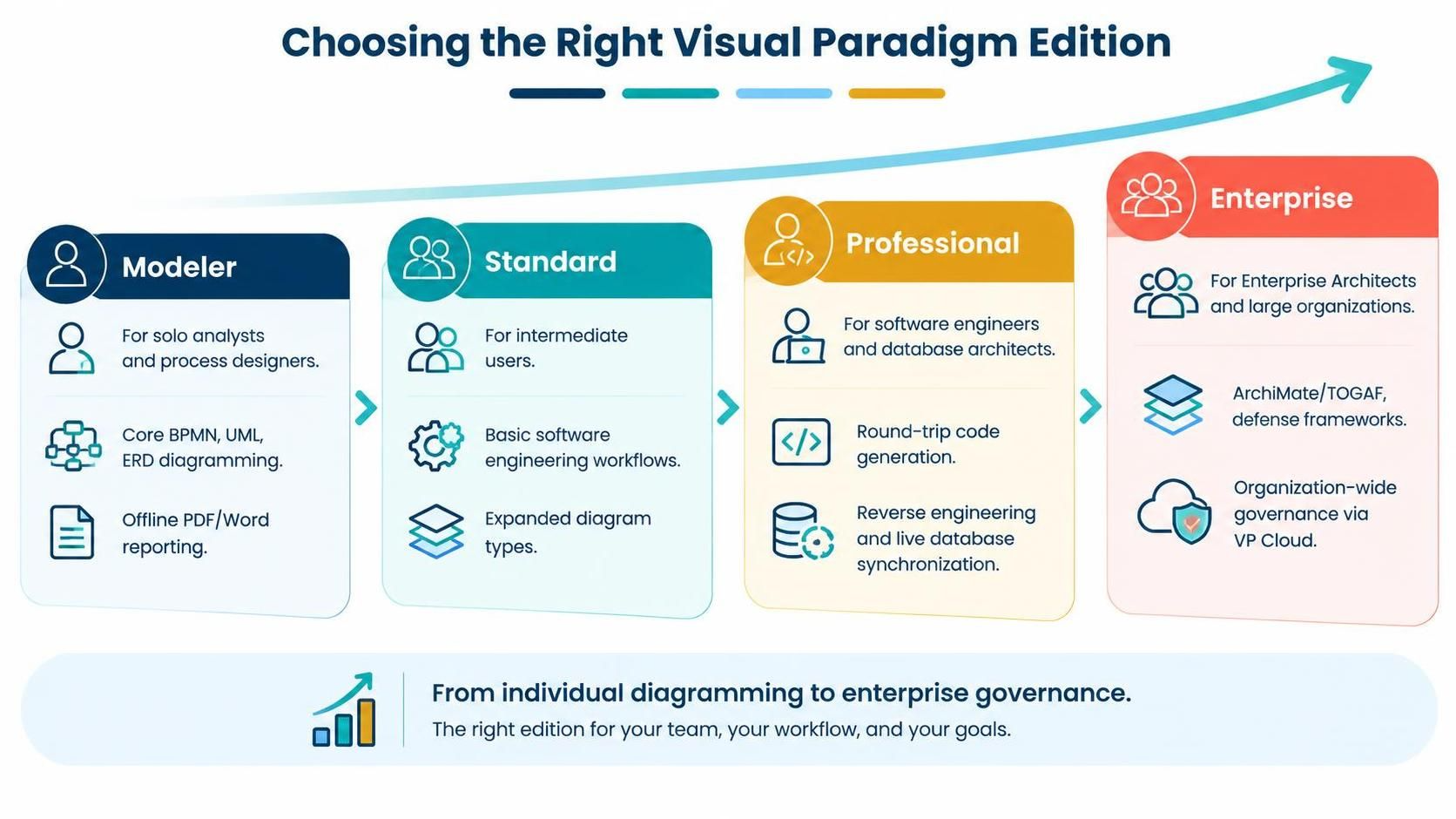
In the rapidly evolving landscape of software architecture and business process management, selecting the right toolset is as critical as the design itself. Visual Paradigm Desktop has positioned itself not merely as a diagramming utility, but as a comprehensive engineering environment. This tutorial explores the strategic progression through the Visual Paradigm Desktop editions—from the individual Modeler to the all-encompassing Enterprise tier—demonstrating how the platform scales to meet specific organizational needs while maintaining a unified workflow.
1. The Foundation: Visual Paradigm Modeler
The journey begins with the Modeler edition, designed specifically for solo analysts, process designers, and students who require robust functionality without enterprise overhead. This tier serves as the gateway to the platform’s core semantic modeling capabilities.
For the solo practitioner, the Modeler edition focuses on “core” diagramming. It supports the industry standards required for initial system design:
- BPMN (Business Process Model and Notation): Essential for mapping out business workflows and service orchestration.
- UML (Unified Modeling Language): The backbone for software design, including Class, Sequence, and Use Case diagrams.
- ERD (Entity Relationship Diagrams): Critical for database design and data modeling.
Furthermore, the Modeler edition emphasizes the importance of deliverables. It includes offline PDF and Word reporting capabilities, ensuring that your architectural blueprints can be effectively communicated to stakeholders without requiring them to have access to the software.
2. The Expansion: Visual Paradigm Standard
As systems grow in complexity, the limitations of basic diagramming become apparent. The Standard edition acts as the bridge for intermediate users, adding “basic software engineering workflows” to the core capabilities.
This tier introduces expanded diagram types that allow for a more holistic view of the system. While the Modeler edition focuses on the “What” and “How” of the design, the Standard edition begins to support the iterative nature of software development. It empowers users to manage the lifecycle of a project more effectively, moving beyond static diagrams into more dynamic representations of system behavior.
3. The Engineering Core: Visual Paradigm Professional
For software engineers and database architects, the Professional edition is the essential toolkit. This is where Visual Paradigm transitions from a documentation tool to an active engineering environment. The defining feature of this tier is the introduction of bidirectional capabilities.
The Professional edition unlocks:
- Round-trip Code Generation: You can generate source code directly from your UML class diagrams. Conversely, you can reverse-engineer existing legacy codebases into visual models, instantly visualizing the architecture of a system you did not build.
- Live Database Synchronization: This feature bridges the gap between design and reality. It allows the database schema in your ERD to stay synchronized with the actual database instance, ensuring that the documentation never becomes outdated.
4. The Summit: Visual Paradigm Enterprise
At the pinnacle of the ecosystem lies the Enterprise edition, tailored for Enterprise Architects and large organizations managing complex transformations. This tier is designed to enforce discipline and governance across the entire organization.
The Enterprise edition delivers features that are often required by strict regulatory or architectural frameworks:
- ArchiMate & TOGAF Support: Full support for these enterprise architecture frameworks allows organizations to align their IT strategy with business strategy using standardized modeling languages.
- Defense Frameworks: Support for specialized frameworks used in government and defense sectors.
- VP Cloud Governance: Organization-wide capabilities via the cloud, ensuring that all teams are working from a unified repository, maintaining consistency across the enterprise.
Conclusion: A Unified Engineering Environment
Whether you are reverse-engineering a legacy monolith using the Professional edition or governing an enterprise-wide transformation using the Enterprise edition, Visual Paradigm Desktop provides the rigor required for professional engineering. By combining deep semantic modeling with the speed of AI-assisted drafting and the collaboration power of the VP Cloud, teams can achieve a new level of efficiency.
Start with a prompt, refine with precision, and deploy with confidence. The right edition ensures you pay only for the capabilities you require, scaling from individual diagramming to enterprise governance.