
Understanding the architecture of distributed systems requires more than just code. It demands a clear vision of how components interact, communicate, and evolve. Profile diagrams offer a structured way to visualize these complex relationships without getting lost in implementation details. This guide explores how to apply profile diagrams effectively within a microservices environment. We will cover the core concepts, practical steps, and best practices to ensure your documentation remains accurate and useful. 🚀
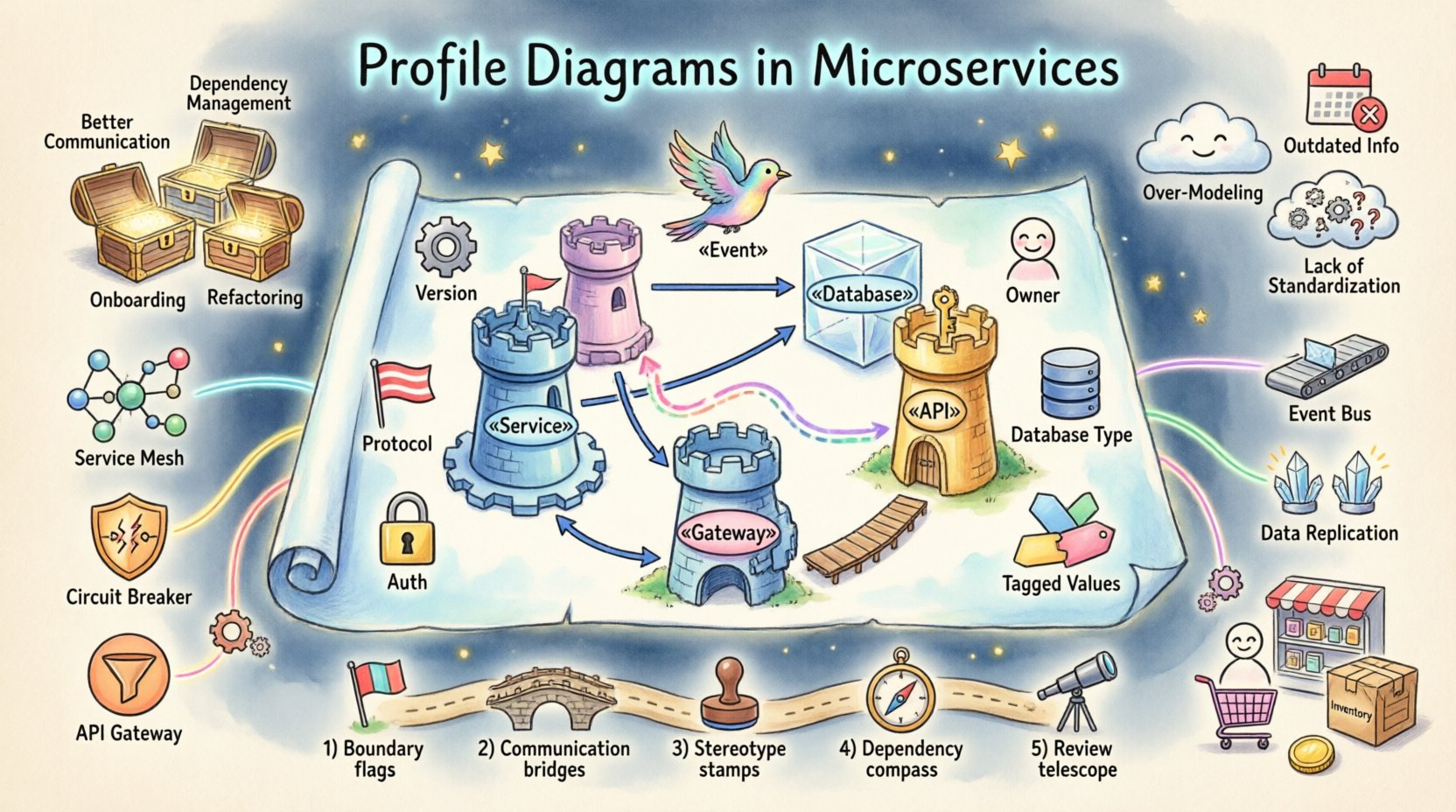
What is a Profile Diagram in This Context? 🧠
A profile diagram in the context of microservices serves as a specialized UML extension. It defines the specific stereotypes, tagged values, and constraints relevant to your distributed system. Unlike standard class diagrams, profile diagrams allow you to customize the modeling language to fit the nuances of service-oriented architecture. This customization helps teams communicate technical boundaries and dependencies clearly.
Key characteristics include:
- Abstraction: Focuses on logical relationships rather than physical deployment.
- Extensibility: Allows adding custom tags to standard elements.
- Standardization: Uses established modeling notations while adapting them.
- Clarity: Reduces noise by highlighting only critical interactions.
Why Microservices Need Visual Models 🏗️
As systems grow, textual documentation often becomes insufficient. Visual models provide a snapshot of the system state that is easier to digest. In a microservices setup, where services are decoupled and numerous, maintaining a shared understanding is critical. Profile diagrams bridge the gap between high-level business goals and low-level technical implementation.
Benefits of Using Profile Diagrams
- Better Communication: Developers, architects, and stakeholders can align on service boundaries.
- Dependency Management: Visualizing dependencies helps prevent circular references and tight coupling.
- Onboarding: New team members can grasp the system topology faster.
- Refactoring Support: Identifying impact areas before changing code.
Core Elements of a Microservice Profile 🧩
To build an effective profile diagram, you need to define specific elements that represent your microservices ecosystem. These elements go beyond standard classes and associations. They include specific stereotypes that denote service types, communication protocols, and data ownership.
Defining Stereotypes
Stereotypes are the building blocks of your custom profile. They allow you to label a class or component with specific meaning. Common stereotypes in this domain include:
- «Service»: Represents a deployable unit of functionality.
- «API»: Denotes the interface exposed by a service.
- «Database»: Indicates the data store associated with a service.
- «Gateway»: Marks the entry point for external traffic.
- «Event»: Signifies a message or event payload in the system.
Tagged Values
Tagged values provide additional metadata to your elements. They allow you to store version information, owner details, or protocol types directly on the diagram. This reduces the need for external spreadsheets or separate configuration files.
| Element | Tagged Value | Purpose |
|---|---|---|
| Service | Version | Tracks the current release number. |
| Service | Owner | Identifies the team responsible for maintenance. |
| API | Protocol | Specifies HTTP, gRPC, or WebSocket usage. |
| Database | Type | Describes SQL, NoSQL, or Cache storage. |
| Gateway | Auth | Indicates authentication method required. |
Step-by-Step Modeling Process 📝
Creating a profile diagram is a methodical process. It requires planning, definition, and validation. Following a structured approach ensures consistency across the team and prevents ad-hoc modeling that leads to confusion.
1. Identify Service Boundaries
Start by listing all known services in the system. Define the domain each service covers. This step prevents the “God Service” anti-pattern where one component tries to do everything. Group related functionalities into distinct units.
2. Define Communication Patterns
Map out how services talk to each other. Are they synchronous or asynchronous? Do they use direct calls or event streams? This information dictates the lines and arrows used in your diagram. Distinguish between request-response patterns and fire-and-forget messaging.
3. Assign Stereotypes and Tags
Apply the custom profile definitions you created earlier. Label each box and line with the appropriate stereotype. Add tagged values for metadata like version or protocol. This adds depth to the visual representation.
4. Validate Dependencies
Review the diagram for circular dependencies. Check if any service relies on another in a way that creates a tight coupling loop. Ensure that the data flow is logical and supports the business requirements.
5. Review and Iterate
Share the draft with the development team. Gather feedback on accuracy and clarity. Update the diagram as the system evolves. Documentation should never be a one-time task.
Common Patterns and Structures 🔄
Microservices often follow recognizable patterns. Recognizing these can speed up the modeling process and ensure consistency. Below are common structural patterns used in profile diagrams.
- Service Mesh: Shows a layer of infrastructure handling service-to-service communication.
- Circuit Breaker: Indicates fault tolerance mechanisms between dependent services.
- API Gateway: Depicts the single entry point for client requests.
- Event Bus: Illustrates the central message broker connecting event producers and consumers.
- Data Replication: Highlights how data is synced across different database instances.
Integration with Development Workflows ⚙️
Profile diagrams should not exist in a vacuum. They need to integrate with the daily workflows of the engineering team. This ensures the diagrams remain current and relevant.
Version Control
Store diagram files in the same repository as the source code. This makes it easy to track changes alongside code commits. Use version control to manage revisions and revert if necessary.
CI/CD Integration
Automate the generation of diagrams from code annotations where possible. If you use tools that support model-driven development, link the code to the model. This reduces the manual effort required to keep diagrams up to date.
Documentation Sites
Publish diagrams on internal documentation platforms. Ensure they are searchable and accessible to all team members. Embed diagrams in design documents to provide context.
Common Pitfalls and How to Avoid Them ⚠️
Even with good intentions, modeling can go wrong. Being aware of common mistakes helps you maintain the quality of your diagrams.
Over-Modeling
Adding too much detail can make the diagram unreadable. Focus on high-level interactions and critical dependencies. Avoid modeling every single method call.
Outdated Information
If the diagram does not reflect the current state of the system, it becomes misleading. Establish a routine for updating diagrams during code reviews or sprint planning.
Lack of Standardization
If different team members use different symbols or notations, confusion arises. Define a standard profile and enforce it across the organization.
Ignoring Non-Functional Requirements
Focus only on functionality and miss scalability or security concerns. Include tags for security protocols and load balancing strategies in your profile.
Maintenance and Versioning 🔄
Microservices evolve rapidly. Your profile diagram must evolve with them. This requires a disciplined approach to maintenance.
- Change Logs: Maintain a log of diagram changes alongside code changes.
- Ownership: Assign ownership of specific sections of the diagram to specific teams.
- Audit: Periodically audit the diagram against the actual system architecture.
- Deprecation: Mark obsolete services clearly to avoid confusion.
Collaboration and Documentation 🤝
Effective modeling is a collaborative effort. It requires input from architects, developers, and product owners. Sharing the modeling process ensures buy-in and accuracy.
Workshops
Hold workshops to define the profile together. This ensures everyone understands the symbols and conventions being used.
Review Cycles
Include diagram reviews in the code review process. Ask reviewers to check if the visual model matches the implementation.
Knowledge Sharing
Create a library of standard profiles and examples. This helps new members get up to speed quickly.
Metrics and Monitoring Integration 📊
Profile diagrams can also serve as a reference for monitoring and observability. By mapping services to metrics, you can visualize system health.
- Service Health: Link diagram elements to health check endpoints.
- Latency: Annotate lines with expected latency ranges.
- Throughput: Indicate expected message throughput for event streams.
- Error Rates: Mark critical paths that require higher error handling.
Case Study: Building a Profile for an E-Commerce System 🛒
Consider an online store with multiple services. The system includes user management, product catalog, inventory, order processing, and payment handling.
Step 1: Identify Services
Define the five core services mentioned above. Each service has its own database.
Step 2: Define Interactions
Orders call Inventory to check stock. Orders call Payment to process transactions. User Service provides authentication tokens.
Step 3: Apply Profile
Label Order as «Service». Label Database as «Database». Label API as «API». Add tags for version 1.2 and owner Team A.
Step 4: Review
Check if Inventory is called directly by the User Service. It should not be. Adjust the diagram to reflect the correct flow.
This example demonstrates how a profile diagram clarifies complex interactions without requiring code inspection.
Final Thoughts on Architecture Documentation 💡
Profile diagrams are a vital tool for managing complexity in microservices. They provide a shared language for teams to discuss architecture. By following a structured approach and maintaining discipline, you can create diagrams that add value over time. Focus on clarity, accuracy, and collaboration. Avoid the trap of creating diagrams that look good but do not reflect reality. Keep them living documents that evolve with your system. 🌱
Remember that the goal is not to create a perfect diagram, but to facilitate better understanding and decision-making. Regularly revisit your modeling strategy to ensure it still serves the team’s needs. Adapt the profile to fit the specific constraints and requirements of your project. With practice, these diagrams become an indispensable part of your development lifecycle.
Summary of Key Takeaways
- Use profiles to extend standard modeling notations for microservices.
- Define stereotypes and tagged values to add context.
- Integrate diagrams into version control and CI/CD pipelines.
- Keep diagrams updated to reflect system changes.
- Focus on communication and collaboration over perfection.
By adhering to these principles, you ensure your architecture documentation remains a reliable asset for your organization. 📈