
In the complex landscape of software development, the need to communicate structure and behavior clearly remains paramount. As systems grow in scale and heterogeneity, the standard Unified Modeling Language (UML) often requires adaptation to fit specific domains. Profile diagrams provide this necessary flexibility. They allow architects to extend the base metamodel without altering the core standard. This guide explores the trajectory of profile diagrams, their integration into modern engineering practices, and their role in maintaining clarity amidst rising complexity.
The evolution of software architecture is not merely about new languages or frameworks. It is about how we describe, plan, and validate the systems we build. Profile diagrams sit at the intersection of standardization and customization. They offer a structured way to define domain-specific concepts while preserving interoperability. Understanding their future potential is essential for architects aiming to maintain system integrity over long lifecycles.
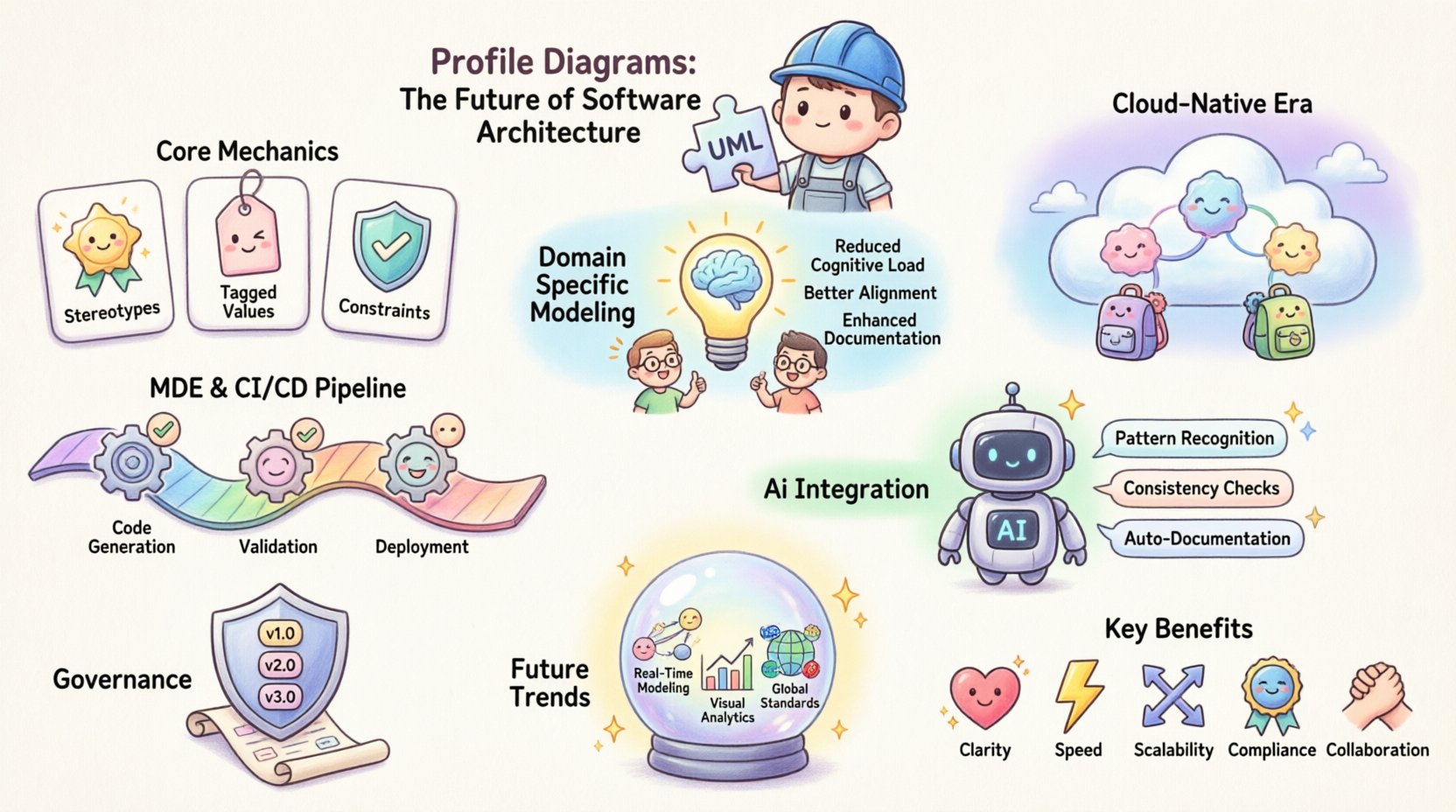
Understanding the Core Mechanics of Profile Diagrams 🧩
Before discussing the future, it is necessary to establish the foundation. A profile diagram is a specialized UML artifact designed to customize the metamodel. It does not change the standard itself but adds layers of meaning. This is achieved through stereotypes, tagged values, and constraints.
- Stereotypes: These act as classification markers. They extend existing elements like classes or use cases to denote specific behaviors or roles within a domain.
- Tagged Values: These attach metadata to elements. For instance, a database class might have a tag indicating its replication strategy.
- Constraints: These define rules that must be satisfied. They can be expressed in Object Constraint Language (OCL) or similar formalisms.
By combining these elements, architects create a vocabulary that is specific to their project. This reduces ambiguity. When a developer sees a stereotype, they understand the intent immediately, without needing to decipher complex code logic or external documentation.
The Relationship with Metamodels
Profiles are bound to metamodels. A metamodel defines the rules for constructing models. When a profile is applied, it instantiates specific extensions of these rules. This relationship ensures that while customization occurs, the underlying validation logic remains intact. This is crucial for automated tools that check model consistency.
Without this structure, customization leads to chaos. Different teams might define the same concept differently. Profiles enforce a standard extension mechanism. This allows for shared understanding across distributed teams. It ensures that a profile defined for a service layer is compatible with the profile defined for the data layer.
The Evolution Towards Domain Specific Modeling 🚀
General-purpose modeling languages struggle with niche requirements. A banking application has different compliance needs than a gaming platform. Profile diagrams address this by enabling Domain Specific Modeling (DSM). DSM shifts the focus from generic syntax to domain semantics.
- Reduced Cognitive Load: Engineers work with concepts native to their field rather than generic software constructs.
- Better Alignment: The model reflects business rules directly, bridging the gap between stakeholders and developers.
- Enhanced Documentation: Documentation becomes self-explanatory. The diagram describes the domain, not just the code structure.
This evolution is critical for legacy modernization. Many organizations possess complex legacy systems that do not fit modern patterns. Profiles allow these systems to be modeled using modern terminology while respecting their original constraints. This facilitates migration strategies without losing historical context.
Industry Specific Adaptations
Different sectors require different modeling standards. Healthcare systems must adhere to strict privacy regulations. Finance systems require rigorous audit trails. Profiles can encode these regulatory requirements directly into the diagram structure.
For example, a healthcare profile might include a stereotype for “Patient Data” with mandatory tags for encryption level and retention policy. A finance profile might include constraints on transaction atomicity. These are not afterthoughts; they are integral parts of the architectural definition.
Profiles in the Era of Cloud-Native and Microservices ☁️
The shift to cloud-native architectures introduces new challenges. Systems are now distributed, dynamic, and ephemeral. Traditional static diagrams often fail to capture this fluidity. Profile diagrams are adapting to meet these demands.
- Infrastructure as Code (IaC): Profiles can define metadata for infrastructure resources. This links the architectural model directly to deployment configurations.
- Service Mesh Integration: Profiles can describe sidecar patterns and traffic routing rules within the service topology.
- State Management: Profiles help define how state is handled across distributed nodes, a critical concern in microservices.
In a microservices environment, understanding the communication patterns is vital. Profiles allow architects to annotate services with specific interaction protocols. This visibility helps in identifying bottlenecks and security vulnerabilities before deployment.
Dynamic System Modeling
Cloud systems change rapidly. Profiles must support dynamic updates. This means the diagram definitions must be versioned and managed similarly to source code. Automated pipelines can validate profile changes against deployment targets. This ensures that the architectural intent is never lost during scaling events.
Furthermore, profiles facilitate the separation of concerns. While developers focus on business logic, operations teams focus on deployment profiles. This separation allows both groups to work efficiently without stepping on each other’s toes.
Integration with Model-Driven Engineering Pipelines ⚙️
Model-Driven Engineering (MDE) relies on models to generate code or configurations. Profile diagrams play a central role here. They provide the semantic details required for accurate generation. Without profiles, code generators often produce generic scaffolding that requires manual adjustment.
- Code Generation: Profiles define the mapping between model elements and code artifacts.
- Reverse Engineering: Existing systems can be analyzed to create profiles, allowing for documentation of black-box components.
- Validation: Automated checks ensure that generated code adheres to the architectural constraints defined in the profile.
This integration reduces the gap between design and implementation. It minimizes the risk of drift. When the model changes, the code updates automatically to reflect the new profile definitions. This consistency is vital for maintaining long-term system health.
CI/CD Pipeline Synergy
Modern Continuous Integration and Continuous Deployment (CI/CD) pipelines benefit from profile validation. Before a build proceeds, the system can check if the architectural profiles are consistent. If a profile requires a specific security header and it is missing, the pipeline can halt.
This proactive approach prevents technical debt accumulation. Issues are caught early in the development lifecycle. It shifts the quality assurance process from post-deployment testing to pre-deployment validation. This saves time and resources significantly.
The Role of Artificial Intelligence in Diagram Maintenance 🤖
Artificial Intelligence (AI) is transforming how models are created and maintained. AI tools can assist in generating profile definitions based on code analysis. This reduces the manual effort required to keep diagrams up to date.
- Pattern Recognition: AI can identify common architectural patterns and suggest appropriate stereotypes.
- Consistency Checks: Algorithms can detect conflicts between different profile definitions across modules.
- Documentation Updates: AI can automatically update diagram labels and descriptions based on code changes.
This automation does not replace the architect. Instead, it empowers them to focus on high-level design decisions. Routine maintenance tasks are handled by intelligent systems. This allows architects to spend more time on strategic planning and less on administrative updates.
Automated Refactoring
As systems evolve, profiles may need to change. AI can suggest refactoring paths. For instance, if a profile becomes obsolete due to a technology shift, the system can propose migration strategies. This keeps the modeling effort aligned with current best practices.
Additionally, AI can analyze historical data to predict future architectural needs. It can recommend profile extensions based on usage patterns. This predictive capability helps organizations stay ahead of scalability issues.
Governance, Versioning, and Standardization 📜
With the increasing importance of profiles, governance becomes critical. How do we manage changes? How do we ensure compatibility? These questions require robust versioning strategies.
- Version Control: Profile definitions must be stored in version control systems. Changes should be reviewed and approved.
- Interoperability: Profiles should follow open standards to ensure tools can exchange data.
- Documentation: Every profile extension must be documented. This includes the purpose, usage, and constraints.
Standardization is key to interoperability. Using established exchange formats like XML Metadata Interchange (XMI) allows models to move between different tools. This prevents vendor lock-in and ensures flexibility.
Managing Complexity
As profiles grow, they can become complex. Governance frameworks help manage this complexity. They define who can modify profiles and how changes are communicated. This structure prevents fragmentation.
Without governance, teams might create conflicting profiles. One team might define a “Service” differently than another. Governance ensures a single source of truth. It maintains the integrity of the architectural model across the entire organization.
Challenges and Considerations for Architects ⚖️
Despite the benefits, implementing profile diagrams presents challenges. Architects must be aware of potential pitfalls to ensure success.
- Over-Engineering: Creating too many stereotypes can confuse the model. Simplicity is preferred.
- Tool Fragmentation: Not all tools support all profile extensions equally. Selection of modeling tools is critical.
- Learning Curve: Teams need training to understand and use profiles effectively.
Architects must balance flexibility with usability. A profile that is too complex will be ignored. A profile that is too simple will not add value. Finding this balance requires experience and feedback loops.
Training and Adoption
Successful adoption requires training. Teams must understand why profiles are used and how to maintain them. Workshops and documentation are essential. This ensures that the investment in modeling yields returns.
Feedback from developers is also crucial. If the profiles hinder development, they need to be adjusted. The goal is to facilitate work, not obstruct it.
Comparative Analysis of Modeling Approaches
To understand the value of profiles, it helps to compare them with standard modeling techniques.
| Feature | Standard UML | Profile Diagrams |
|---|---|---|
| Customization | Limited | High |
| Domain Relevance | Generic | Specific |
| Extensibility | Low | High |
| Tool Support | Universal | Variable |
| Maintenance Effort | Low | Medium |
Key Benefits of Modern Profile Implementation
The strategic use of profile diagrams offers tangible advantages. These benefits justify the effort required to implement them.
- Clarity: Ambiguity is reduced through explicit definitions.
- Efficiency: Code generation and validation are faster with clear profiles.
- Scalability: Systems can grow without losing architectural coherence.
- Compliance: Regulatory requirements are embedded in the model.
- Collaboration: Teams share a common vocabulary.
Future Trends in Architectural Modeling 🔮
The future of profile diagrams looks promising. As software systems become more intricate, the need for precise modeling will increase. We expect to see more automation and better integration with development environments.
- Real-Time Modeling: Models will update in real-time as code changes.
- Visual Analytics: Diagrams will include performance data directly.
- Global Standards: Industry-wide profile standards will emerge for common domains.
Architects who adapt to these changes will be better positioned to build robust systems. The tools will evolve, but the fundamental need for structured communication will remain.
Strategic Implementation Steps
To begin integrating profile diagrams effectively, follow a structured approach.
- Assess Needs: Identify areas where standard modeling falls short.
- Define Standards: Create a core set of stereotypes for the project.
- Tooling Setup: Configure modeling tools to support the profiles.
- Train Teams: Ensure everyone understands the new vocabulary.
- Monitor and Refine: Gather feedback and adjust profiles as needed.
This step-by-step process ensures a smooth transition. It minimizes disruption while maximizing the benefits of the new modeling approach.
Final Thoughts on Architectural Evolution 🌟
Profile diagrams are more than just a technical detail. They represent a commitment to clarity and precision in software engineering. As the industry moves towards more complex, distributed, and regulated systems, the role of these diagrams will only grow.
Architects must view them as living artifacts. They require maintenance, updates, and care. But the payoff is a system that is easier to understand, modify, and scale. The future belongs to those who can model complexity effectively.
By adopting profile diagrams, teams can bridge the gap between abstract design and concrete implementation. This alignment is the foundation of successful modern software architecture. It ensures that the vision remains intact throughout the development lifecycle.
The journey is ongoing. New challenges will arise, and profiles will need to evolve. But the core principle remains: structure drives success. Embrace the tools that provide this structure, and build systems that stand the test of time.