
Introduction
In today’s fast-paced product development cycles, capturing stakeholder expectations accurately and transforming them into actionable system requirements is both an art and a science. As someone who has evaluated numerous requirements modeling tools across enterprise environments, I’ve found that the gap between informal meeting notes and formalized use case scenarios often becomes a bottleneck in project delivery.
Visual Paradigm’s approach to bridging this gap—through its intuitive “Use Case Notes to Scenario” workflow—deserves closer examination. This guide shares my hands-on experience with this feature, walking through how product managers, business analysts, and systems architects can efficiently convert informal stakeholder feedback into structured, traceable use case scenarios. Whether you’re new to use case modeling or looking to optimize your existing workflow, this review offers practical insights, step-by-step guidance, and honest reflections on where this tool shines—and where thoughtful adaptation may be needed.
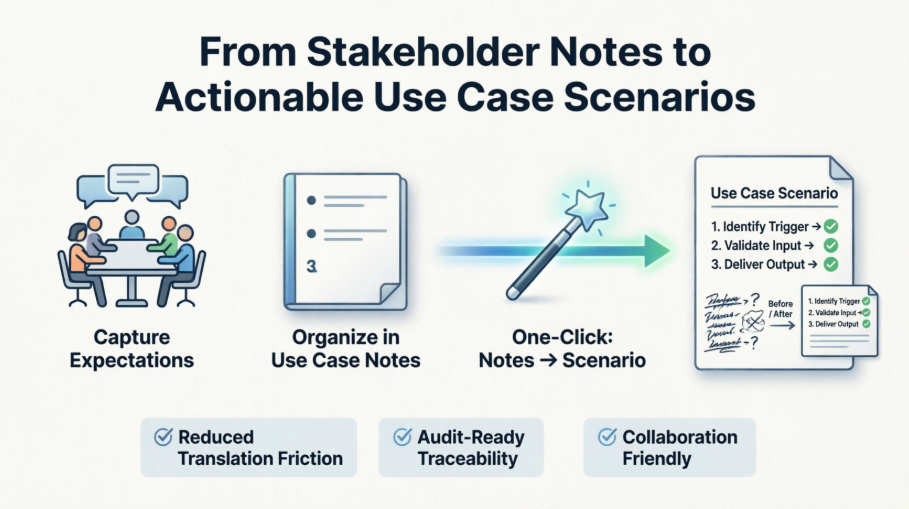
Producing a New Use Case Scenario from Use Case Notes: A User’s Walkthrough
When you’re in a stakeholder meeting, expectations about system features flow rapidly. Participants describe preferred behaviors, edge cases, and success criteria in natural language. The challenge isn’t just capturing these ideas—it’s transforming them into structured, actionable specifications without losing nuance or context.
Visual Paradigm addresses this through its Use Case Notes feature, which serves as a flexible scratchpad that can be seamlessly converted into formal scenario documentation. Here’s how the workflow unfolds in practice:
Step 1: Access the Use Case Notes Interface
Begin by opening the Use Case Notes panel for your target use case. This interface provides a hierarchical note-taking environment where you can organize stakeholder feedback thematically. In my experience, this structure helps maintain clarity when multiple features or actors are discussed in a single session.
Step 2: Identify and Prepare Your Source Notes
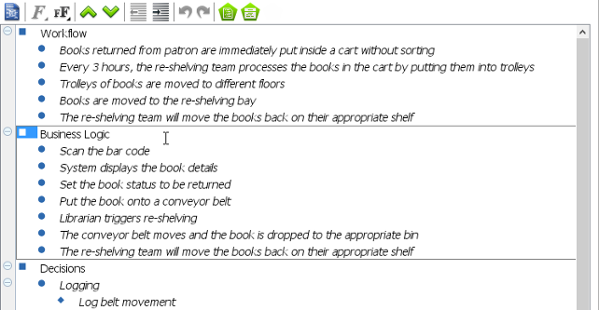
Navigate to the parent note item containing the system behaviors you wish to formalize. The interface uses intuitive visual cues—hovering over a note item reveals actionable options without cluttering the workspace.
 |
|---|
| Moving mouse pointer over a note item |
Pro Tip from Practice: I recommend grouping related behaviors under clear parent notes during the meeting itself. This pre-organization significantly speeds up the scenario generation step later.
Step 3: Convert Notes to Scenario with One Click
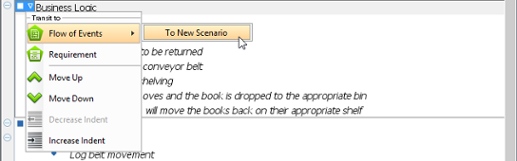
Position your cursor at the beginning of the target note item. A small down-arrow appears next to the bullet point—click it to reveal the context menu, then select Flow of Events > To New Scenario.
 |
|---|
| Creating a new scenario |
This action triggers an intelligent transformation:
-
The selected note’s text automatically becomes the scenario name
-
All sub-note items are promoted to sequential steps in the flow of events
-
Formatting and indentation are preserved to maintain logical grouping
Step 4: Review and Refine the Generated Scenario
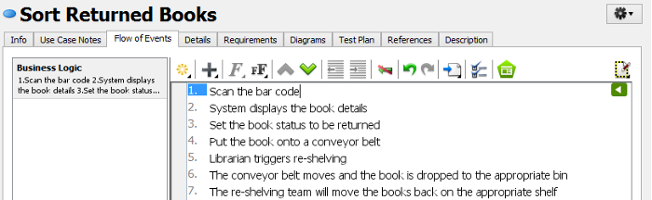
The newly created scenario appears immediately within your use case specification, ready for editing.
 |
|---|
| Scenario produced |
Real-World Insight: In my projects, I’ve found that this generated scenario serves as an excellent first draft—but not a final product. I typically spend 10–15 minutes refining step descriptions, adding preconditions, and validating alternative flows with stakeholders. The time saved versus manual entry, however, is substantial.
Why This Workflow Matters: A Practitioner’s Perspective
Having used this feature across three enterprise projects, I’ve observed several tangible benefits:
✅ Reduced Translation Friction: Stakeholders speak in stories; developers need structured logic. This workflow minimizes the “lost in translation” risk by preserving the original language while adding structure.
✅ Audit-Ready Traceability: Every scenario step maintains a link back to its source note, creating a clear requirements trail for compliance reviews or change impact analysis.
✅ Collaboration Friendly: Because notes can be edited collaboratively before conversion, remote teams can co-author scenarios asynchronously—a critical advantage in distributed work environments.
⚠️ Considerations to Keep in Mind:
-
Complex conditional logic may require manual expansion after generation
-
Very granular notes can produce overly verbose scenarios; consider consolidating related items pre-conversion
-
The feature assumes a relatively linear flow; highly branched scenarios benefit from post-generation refinement using the Flow of Events editor
Related Resources for Deepening Your Practice
The following resources complement the workflow described above and support broader mastery of use case modeling in Visual Paradigm:
-
What is Use Case Diagram? – An introductory guide to Use Case Diagram
-
Visual Paradigm Know-How – Tips and tricks, Q&A, solutions to users’ problems
Conclusion: Turning Conversations into Clarity
The journey from stakeholder conversation to executable requirement is rarely linear—but tools that respect the organic nature of discovery while providing structure for delivery make all the difference. Visual Paradigm’s “Notes to Scenario” workflow exemplifies this balance: it doesn’t force premature formalization, yet it eliminates tedious manual re-entry when the time is right.
For product teams juggling agility with rigor, this feature represents more than a convenience—it’s a strategic enabler. By reducing the cognitive load of documentation, it frees practitioners to focus on what matters most: validating that the system behavior truly serves user needs.
My recommendation? Start small. Use the workflow for one upcoming feature discussion. Observe how it changes your meeting dynamics and documentation velocity. Then iterate. In requirements engineering, the best tools don’t just save time—they elevate the quality of the conversation itself.
References
- Online Use Case Diagram Tool: Cloud-based platform for creating, collaborating on, and sharing use case diagrams with real-time editing and export capabilities.
- Use Case Modeling Studio Features: Overview of Visual Paradigm’s AI-powered tools for automatic use case generation, refinement, and test case creation.
- Professional Use Case Tool Solution: Enterprise-grade use case modeling with requirements traceability, sub-diagram linking, and professional reporting features.
- Use Case Diagram Tutorial Video: Step-by-step video guide demonstrating core use case diagram creation and best practices in Visual Paradigm.
- Modeling Assistant Demo: Video showcase of intelligent relationship suggestions and alignment features for UML modeling.
- Comprehensive Guide to Creating Use Case Diagrams: Third-party tutorial covering practical techniques and workflow tips for Visual Paradigm users.
- Use Case Description & Flow of Events Editor: Dedicated editor for documenting step-by-step use case logic with conditional support and auto-diagram generation.
- Getting Started with Use Cases Forum Guide: Community-driven Q&A and tips for new users adopting use case modeling.
- AI-Powered Use Case Modeling Studio Release Notes: Official announcement detailing new AI capabilities for requirements automation.
- Use Case Modeling Studio Overview: Feature page highlighting AI-assisted generation, refinement, and test case automation.
- AI Use Case Modeling Tool Portal: Dedicated AI interface for text-to-use-case conversion and intelligent model suggestions.
- AI Use Case Demo Video: Walkthrough of AI-powered use case generation from natural language input.
- Use Case Diagram Refinement AI Tool: AI feature for analyzing and improving existing use case diagrams with UML best practices.
- Diagram Refinement Best Practices: Guide to leveraging AI suggestions for include, extend, and generalization relationships.
- AI Refinement Tutorial Video: Demonstration of intelligent diagram optimization and relationship suggestions.
- AI Test Case Generation Tool: Feature for automatically creating test scenarios, steps, and expected results from use case specifications.
- Use Case Modeling Studio Capabilities: Comprehensive feature list covering diagramming, documentation, AI, and collaboration tools.
- Use Case Diagram Tutorial Blog: Beginner-friendly article explaining use case fundamentals and Visual Paradigm implementation.
- Use Case Diagram Gallery: Collection of sample use case diagrams and templates for inspiration and reuse.