
Strategic planning relies on accurate environmental scanning. PEST analysis remains a staple framework for organizations navigating complex markets. However, the political dimension often introduces noise that obscures clear decision-making. When signals conflict, the integrity of the entire analysis suffers. This guide details how to troubleshoot these discrepancies effectively.
Volatility in the political sphere is not new, but the speed of information flow has accelerated the problem. Stakeholders may receive contradictory reports regarding regulatory changes, trade agreements, or election outcomes. Resolving these conflicts requires a structured approach to data validation and weighting. The goal is not to predict the future perfectly, but to build a robust scenario model that accounts for uncertainty.
1. Understanding the Source of Conflict 🧩
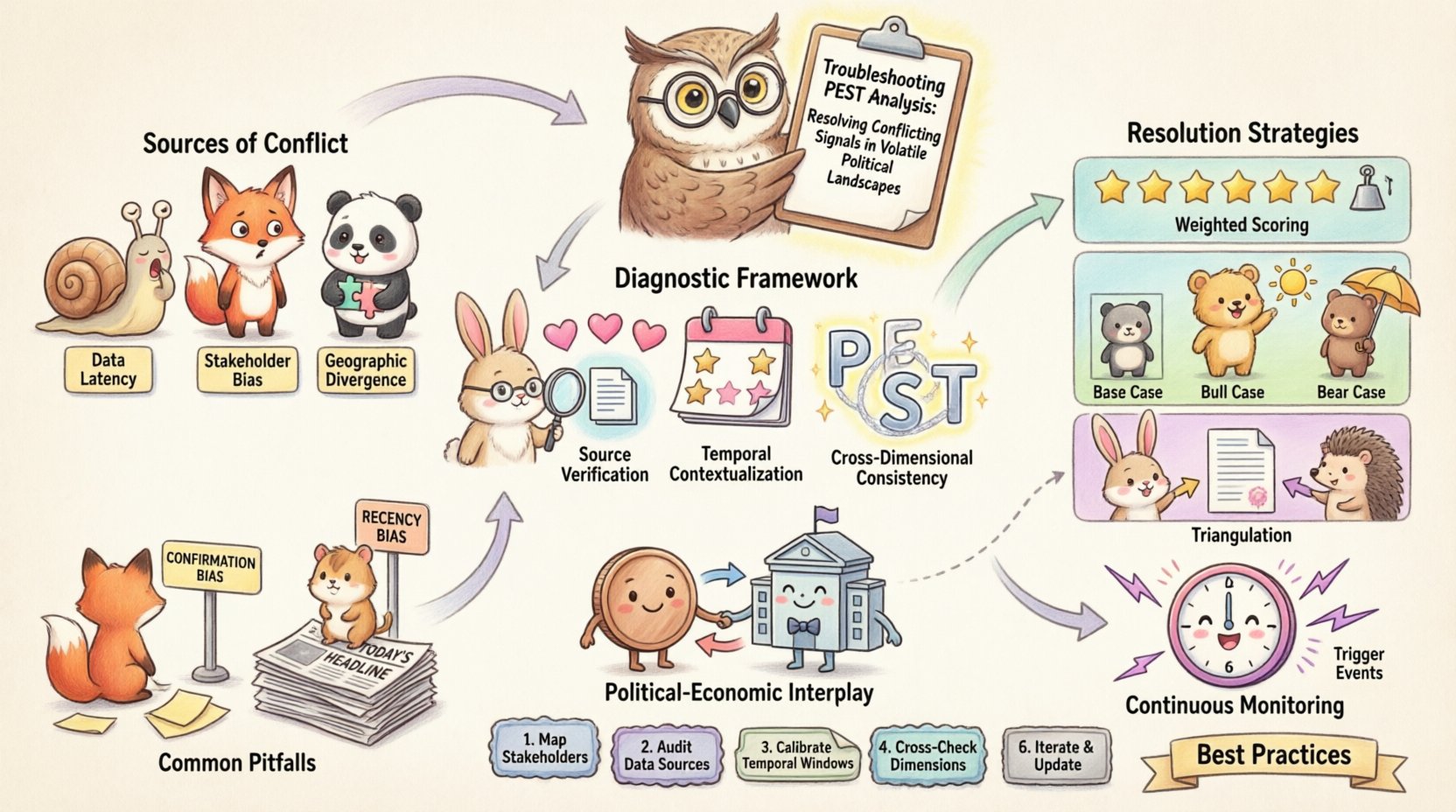
Before resolving issues, you must diagnose the root cause. Conflicting signals in a PEST analysis usually stem from three main areas: data latency, conflicting stakeholder interests, and divergent geographic interpretations.
- Data Latency: Official policy changes often lag behind informal signals. Early reports may suggest a regulatory shift, while final legislation contradicts it.
- Stakeholder Bias: Different departments within an organization may interpret political risk through their own lenses. Marketing focuses on consumer sentiment, while finance focuses on tax implications.
- Geographic Divergence: A global policy might be implemented differently in local regions, creating a fragmented picture of the overall landscape.
Recognizing these sources helps prevent the analysis team from treating every signal as equally valid. It allows for the application of filters that prioritize authoritative data sources over speculative commentary.
2. Diagnostic Framework for Political Signals 🔍
A systematic diagnostic process reduces ambiguity. When you encounter a political signal that contradicts another, apply the following validation steps before incorporating it into the final model.
Step 1: Source Verification
Not all political information holds the same weight. Prioritize primary sources over secondary analysis. The hierarchy of trust generally follows this order:
- Primary Legislative Text: Draft bills, signed acts, and official gazettes.
- Government Agency Statements: Press releases from ministries or regulatory bodies.
- Established News Outlets: Reputable journalism with fact-checking standards.
- Industry Analyst Reports: Third-party interpretations which may contain bias.
- Market Rumors: Unverified social media or forum discussions.
Step 2: Temporal Contextualization
Time plays a critical role in political volatility. A signal from six months ago may be irrelevant today. Evaluate the timeline of the information against the current political cycle.
- Is the policy active, proposed, or repealed?
- Does the signal align with the current election cycle?
- Has there been a recent regime change affecting enforcement?
Step 3: Cross-Dimensional Consistency
Political signals rarely exist in isolation. They impact Economic, Social, and Technological factors. Check for consistency across the other PEST dimensions. If a political signal suggests high stability but economic indicators show recession, the political data may be flawed or incomplete.
3. Resolution Strategies for Conflicting Data 🛠️
Once you have identified conflicting signals, you need methods to resolve them. Below are proven strategies to harmonize data points without discarding valuable intelligence.
Strategy A: Weighted Scoring System
Assign weights to different signals based on their reliability and impact. This quantifies the uncertainty and prevents one outlier from skewing the entire analysis.
| Signal Type | Reliability Weight | Impact Weight | Combined Score |
|---|---|---|---|
| Official Legislation | High (1.0) | Variable | Calculated |
| Executive Order | Medium-High (0.8) | Variable | Calculated |
| Policy Proposal | Medium (0.5) | Variable | Calculated |
| Analyst Forecast | Low-Medium (0.3) | Variable | Calculated |
By calculating a combined score, you create a transparent method for prioritizing which signals drive the strategic narrative. This removes subjective bias from the selection process.
Strategy B: Scenario Planning
Instead of choosing one signal over another, build multiple scenarios. This acknowledges the volatility and prepares the organization for various outcomes.
- Base Case: Assumes the most probable outcome based on current official data.
- Bull Case: Assumes favorable political shifts based on optimistic interpretations of conflicting signals.
- Bear Case: Assumes adverse political shifts based on the most restrictive interpretations.
This approach ensures that the PEST analysis remains useful even if the political landscape shifts unexpectedly. It transforms conflict into a risk management tool.
Strategy C: Triangulation
Triangulation involves verifying a political signal through two independent channels. If a regulatory change is reported by a news outlet, verify it against a legal database or industry association. If both agree, confidence increases. If they disagree, investigate further.
- Check official government registries.
- Consult local legal counsel.
- Review industry association briefings.
This method reduces the risk of acting on misinformation or outdated data.
4. The Interplay of Political and Economic Factors 💰
Political volatility often manifests through economic indicators. Currency fluctuations, interest rate changes, and inflation rates are often direct consequences of political decisions. Troubleshooting the political section of PEST requires understanding these economic linkages.
Common Conflict Points
- Trade Tariffs: Political announcements may promise protectionism, but economic data shows reliance on imports. Resolve this by analyzing supply chain dependencies.
- Tax Policy: Proposed tax cuts may conflict with budget deficit realities. Resolve this by reviewing the national debt trajectory.
- Subsidies: Government support for green energy may conflict with fossil fuel industry lobbying. Resolve this by assessing long-term legislative trends versus short-term political rhetoric.
Integration Checklist
When integrating political and economic data, ensure the following:
- Alignment of Incentives: Do political goals align with economic realities?
- Enforcement Capability: Does the government have the resources to enforce the policy?
- Market Reaction: How have markets historically reacted to similar signals?
Ignoring these connections leads to a fragmented analysis that fails to capture the true business environment.
5. Managing Social and Technological Nuance 🌐
Political signals do not exist in a vacuum. They influence social behavior and technological adoption. Troubleshooting must account for how political instability affects the other three PEST factors.
Social Factors
Political unrest often triggers social shifts. Migration patterns, labor strikes, and consumer confidence are sensitive to political noise. If political data suggests stability but social sentiment indicates unrest, prioritize the social data for risk assessment.
- Monitor public opinion polls regarding government performance.
- Track labor union activity and strike frequency.
- Analyze social media sentiment for signs of civil dissatisfaction.
Technological Factors
Technology is often a tool of political control or economic growth. Data sovereignty laws, internet censorship, and innovation grants are politically driven. Conflicts arise when technological trends contradict political intent.
- Data Privacy: Does the political push for data localization align with global tech infrastructure?
- Innovation Grants: Are funding priorities shifting based on political agendas?
- Infrastructure Investment: Is the government investing in digital infrastructure as promised?
Resolving these conflicts ensures the technological section of your PEST analysis remains grounded in reality.
6. Continuous Monitoring and Updates 🔄
A PEST analysis is not a static document. In volatile political landscapes, the status of information changes daily. Establish a routine for review and update.
Review Frequency
- High Volatility: Monthly reviews during election cycles or geopolitical crises.
- Medium Volatility: Quarterly reviews for standard policy shifts.
- Low Volatility: Biannual reviews for stable regulatory environments.
Trigger Events
Do not wait for the scheduled review to update the analysis. Immediate updates are necessary when specific events occur:
- New legislation is passed or rejected.
- Key political leaders resign or are elected.
- Major geopolitical events occur (e.g., sanctions, trade wars).
- Unexpected economic shocks impact political stability.
7. Building Organizational Resilience 🛡️
The ultimate goal of troubleshooting PEST analysis is organizational resilience. By resolving conflicting signals, you create a strategy that can withstand external shocks.
Key Capabilities to Develop
- Information Literacy: Train teams to distinguish between opinion and fact.
- Agility: Build processes that allow for quick strategic pivots.
- Diversification: Avoid over-reliance on a single market or political environment.
- Scenario Testing: Regularly stress-test strategies against the scenarios developed during the analysis.
8. Common Pitfalls to Avoid ⚠️
Even with a structured framework, errors can occur. Be vigilant against these common mistakes.
- Confirmation Bias: Seeking only data that supports pre-existing strategies.
- Recency Bias: Giving too much weight to the most recent news while ignoring long-term trends.
- Over-Optimization: Trying to predict the exact outcome rather than preparing for a range of outcomes.
- Siloed Analysis: Allowing the political team to work independently without input from economic or social teams.
Avoiding these pitfalls ensures the integrity of the analysis remains intact throughout the planning process.
9. Practical Application: A Step-by-Step Workflow 📋
To implement this troubleshooting methodology, follow this workflow for your next PEST analysis cycle.
- Gather Data: Collect all available political, economic, social, and technological signals.
- Identify Conflicts: Highlight data points that contradict each other or seem inconsistent.
- Validate Sources: Apply the source verification hierarchy to each conflicting point.
- Apply Weighting: Assign reliability scores to the remaining data.
- Develop Scenarios: Create base, bull, and bear cases based on the weighted data.
- Review with Stakeholders: Discuss the scenarios with leadership to ensure alignment.
- Document Assumptions: Clearly state the assumptions made during the resolution process.
- Set Monitoring Triggers: Define what events will require an update to the analysis.
10. Final Considerations on Data Integrity ✅
Data integrity is the foundation of strategic planning. In a volatile political environment, the difference between success and failure often lies in how well you manage conflicting information. By applying these troubleshooting techniques, you move from reactive planning to proactive strategy.
Remember that PEST analysis is a tool for insight, not a crystal ball. Its value comes from the clarity it brings to uncertainty. When political signals conflict, do not ignore the conflict. Use it as a signal to dig deeper. The resolution process itself adds value by revealing the depth of the risk.
Consistent application of these methods builds a culture of critical thinking within the organization. Teams become better at questioning data, verifying sources, and understanding the nuances of the environment. This capability is more valuable than any single report produced.
Summary of Best Practices 📝
- Always verify political data against primary sources.
- Use weighted scoring to prioritize conflicting signals.
- Create multiple scenarios to account for volatility.
- Integrate political data with economic and social indicators.
- Update the analysis regularly based on trigger events.
- Train teams on information literacy and bias detection.
By adhering to these practices, you ensure that your PEST analysis remains a robust tool for navigating the complexities of the modern business environment. The political landscape will always be volatile, but your strategic response can be stable and informed.
Related posts:
 Definitive Overview of PEST Analysis: The Essential Framework for Strategic Market Entry
 Q&A on PEST Analysis: Expert Answers to Your Most Pressing Market Entry Questions
 Tutorial PEST Analysis: From Raw Data to Actionable Strategy for Non-Analysts
 Deep Dive PEST Analysis: Uncovering Hidden Macro-Forces That Kill Competitors Before You Launch