
Entering a new market requires more than just a great idea; it demands a clear understanding of the environment in which that idea will exist. For early-stage ventures, strategic planning is not a luxury—it is a survival mechanism. Among the various tools available, the PEST analysis stands out as a foundational framework for scanning external macro-environmental factors. This method examines Political, Economic, Social, and Technological influences that can impact an organization.
However, conducting a PEST analysis is often treated as a checkbox exercise. Many teams rush through the process, collecting outdated data or failing to connect the dots between different factors. This guide explores the best practices for PEST analysis, focusing on avoiding common pitfalls in early-stage market research. By adhering to these standards, you can build a robust strategic foundation.
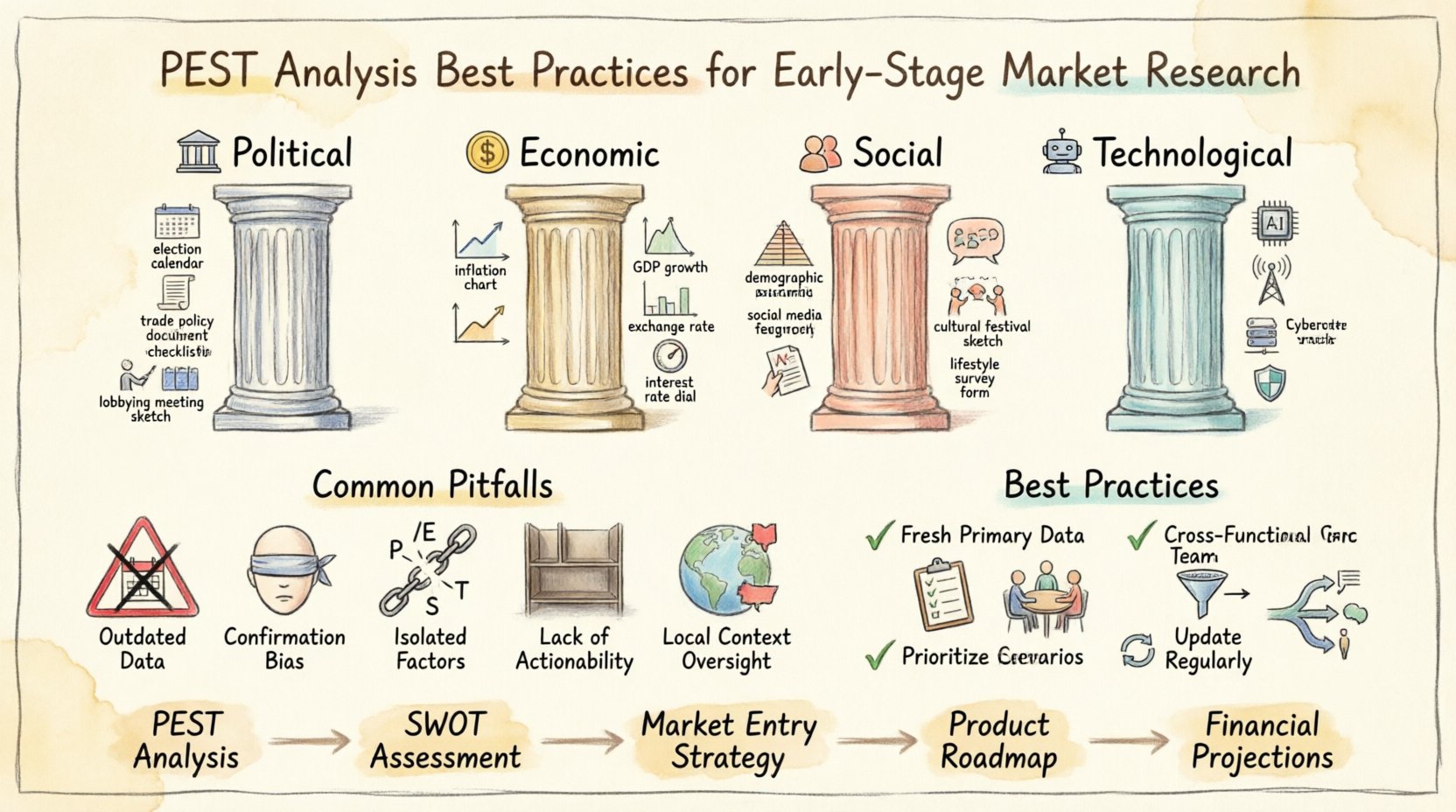
Understanding the PEST Framework 🧩
The PEST analysis is a strategic tool used to understand the external factors affecting a business. It moves beyond internal capabilities to look at the broader landscape. For startups and small enterprises, these external forces often dictate success or failure more than internal efficiency.
- Political: Government policies, stability, trade restrictions, and tax laws.
- Economic: Growth rates, interest rates, exchange rates, and inflation.
- Social: Cultural aspects, health consciousness, population growth, and demographics.
- Technological: Innovation, automation, R&D activity, and technology incentives.
Each category requires specific attention. A change in political regulation can halt a product launch. An economic downturn can shrink your target market. Social shifts can render a product obsolete. Technological advancements can disrupt your entire business model. Recognizing these interdependencies is key.
Detailed Breakdown of Each Pillar 🔍
To conduct a meaningful analysis, you must dive deeper than surface-level observations. Below is a detailed look at what each component entails for an early-stage company.
1. Political Factors 🏛️
Political factors refer to the extent to which a government intervenes in the economy. In early-stage research, this is often the most volatile area. You need to assess:
- Regulatory Environment: Are there strict compliance requirements for your industry?
- Tax Policy: How does taxation affect your margins and pricing strategy?
- Political Stability: Is the region stable enough to support long-term investment?
- Trade Controls: Are there tariffs or restrictions on importing necessary materials?
- Labor Laws: What are the regulations regarding hiring, firing, and wages?
For example, a fintech startup must understand banking regulations before launching. If the government decides to tighten data privacy laws, your architecture might need a complete overhaul. Ignoring this can lead to costly legal battles later.
2. Economic Factors 💰
Economic factors determine the purchasing power of potential customers and the cost of capital. Early-stage companies often operate on thin margins, making economic sensitivity crucial.
- Disposable Income: How much money does the average consumer have to spend?
- Economic Growth: Is the market expanding or contracting?
- Inflation Rates: Will costs rise faster than your revenue?
- Interest Rates: How expensive is it to borrow money for growth?
- Exchange Rates: If you source globally, currency fluctuations matter.
During high inflation periods, consumers prioritize essentials over luxuries. If your product is a non-essential service, you must adjust your messaging or risk losing sales. Economic analysis helps you forecast revenue under different scenarios.
3. Social Factors 👥
Social factors encompass the human elements of your market. This includes culture, lifestyle, and attitudes. Understanding the people you serve is vital for product-market fit.
- Demographics: Age, gender, income level, and education.
- Cultural Trends: What is currently popular or taboo?
- Health Consciousness: Is there a shift towards wellness or convenience?
- Work-Life Balance: How does this affect demand for your service?
- Urbanization: Are your customers moving to cities or rural areas?
For instance, a shift towards remote work created massive demand for collaboration tools. If you are launching a product today, ignoring the social shift towards sustainability could alienate a significant portion of your audience.
4. Technological Factors 🤖
Technological factors are often the most dynamic. They can disrupt existing markets overnight. For startups, this is both a risk and an opportunity.
- Innovation Rate: How fast is technology evolving in your sector?
- Automation: Can machines do the work your team is currently doing?
- R&D Activity: What are competitors investing in?
- Infrastructure: Is the necessary internet or hardware available to your users?
- Intellectual Property: Are patents blocking your path?
If you build a product based on current tech, you risk obsolescence in two years. Conversely, leveraging new tech can give you a first-mover advantage. Continuous monitoring of the technological landscape is non-negotiable.
Common Pitfalls to Watch Out For ⚠️
Even experienced strategists make mistakes. In early-stage research, time pressure often leads to shortcuts. Below is a table highlighting frequent errors and their consequences.
| Pitfall | Description | Consequence |
|---|---|---|
| Outdated Data | Using information from more than 12 months ago. | Strategic decisions based on a landscape that no longer exists. |
| Confirmation Bias | Looking only for data that supports your initial idea. | Failing to see critical threats or market gaps. |
| Isolation of Factors | Treating P, E, S, and T as separate silos. | Missing how economic shifts impact social behaviors. |
| Lack of Actionability | Creating a report that sits on a shelf. | Zero ROI on the research effort. |
| Overlooking Local Context | Applying global trends to a specific local market. | Product-market mismatch in the target region. |
Addressing these pitfalls requires discipline. You must verify sources, challenge your own assumptions, and ensure the output drives decision-making.
Strategic Best Practices ✅
To elevate the quality of your market research, consider implementing these specific workflows.
1. Gather Fresh, Primary Data
Secondary data (reports, news articles) is useful, but primary data is superior. Conduct surveys, interviews, and focus groups. Talk directly to potential customers. This provides insights that generic reports cannot offer. It grounds your analysis in reality.
2. Use Cross-Functional Teams
Do not let one person conduct the PEST analysis. Involve sales, marketing, product, and finance. Each department sees different signals. Sales hears customer complaints. Finance sees cost fluctuations. Marketing sees social trends. Combining these perspectives creates a holistic view.
3. Prioritize Relevance
Not all factors matter equally. You cannot analyze every government policy or every tech trend. Focus on the factors that directly impact your business model. If you are a local bakery, international trade tariffs are irrelevant. If you are a software exporter, they are critical. Filter the noise.
4. Create Scenarios
Instead of one static analysis, create multiple scenarios. What if the economy crashes? What if a new competitor enters? What if regulations tighten? Scenario planning helps you prepare for volatility. It turns the analysis into a strategic tool rather than a history lesson.
5. Update Regularly
A PEST analysis is not a one-time task. The environment changes. Set a schedule to review your findings quarterly or semi-annually. Mark your calendar. A static document becomes a liability as soon as it is published.
Integrating with Strategic Planning 🚀
The value of PEST analysis is realized only when it informs other frameworks. It is rarely used in isolation. Here is how it connects to other tools.
- SWOT Analysis: The PEST factors often feed into the Opportunities and Threats sections of a SWOT analysis. External factors become internal strategic considerations.
- Market Entry Strategy: Use the findings to decide which markets to enter first. Avoid regions with high political risk if you lack the capital to absorb shocks.
- Product Roadmap: Technological factors should dictate your development timeline. If a competitor is releasing an AI feature, you need to know if you should adopt it.
- Financial Projections: Economic factors like inflation and interest rates should be built into your financial models to ensure realistic forecasting.
By linking PEST to these frameworks, you ensure that the research translates into actionable business strategy. It moves the work from the boardroom to the execution floor.
Real-World Application Scenarios 💡
To illustrate how this works in practice, consider a hypothetical scenario: launching a health-tech wearable device.
Political
The device collects medical data. You must navigate FDA regulations or equivalent bodies in your target country. Data privacy laws like GDPR in Europe or HIPAA in the US apply. If you expand globally, you must be prepared for varying compliance costs.
Economic
Health tech is often considered a discretionary purchase. In a recession, people cut back. You need to price your device competitively or offer financing. You also need to consider insurance reimbursement rates.
Social
There is a growing obsession with health metrics and longevity. However, there is also skepticism about data privacy. Your marketing must balance the benefit of tracking with the assurance of security.
Technological
Battery life is a constant challenge. Sensor accuracy is improving. AI integration allows for predictive health insights. You must stay ahead of the curve to remain relevant.
In this scenario, the PEST analysis reveals that while the social trend is positive, the regulatory and technological hurdles are significant. This informs the go-to-market strategy to focus on compliance and R&D first.
Frequently Asked Questions ❓
Here are answers to common questions regarding this framework.
- How often should I run a PEST analysis?
At least once a year for strategic planning. However, for fast-moving industries, a quarterly review of specific factors is recommended. - Can I use this for internal strategy?
Yes, but it is primarily an external tool. It helps you understand the context in which your internal strategy operates. - What if I don’t have a lot of data?
Start with what you have. Qualitative data from expert interviews can fill gaps when quantitative data is missing. - Is PEST the same as PESTLE?
PESTLE adds Legal and Environmental factors. PEST is the core. If you need those specific factors, expand the framework. - How do I present this to investors?
Summarize the key risks and opportunities. Show that you understand the market landscape and have a plan to navigate it.
Final Thoughts on Market Research 🌐
Market research is the compass for your business journey. Without it, you are navigating blind. The PEST analysis provides a structured way to scan the horizon. It forces you to look outside your company walls and acknowledge the forces that shape your industry.
By avoiding common pitfalls like outdated data and confirmation bias, you ensure your strategy is built on reality. By integrating these findings into your broader planning, you turn insights into action. Remember, the goal is not to predict the future perfectly, but to prepare for whatever comes next.
Commit to the process. Keep your data fresh. Involve your team. And always be ready to adapt. This discipline will set your early-stage venture apart from competitors who rely on intuition alone.
Related posts:
 Definitive Overview of PEST Analysis: The Essential Framework for Strategic Market Entry
 Q&A on PEST Analysis: Expert Answers to Your Most Pressing Market Entry Questions
 Tutorial PEST Analysis: From Raw Data to Actionable Strategy for Non-Analysts
 Deep Dive PEST Analysis: Uncovering Hidden Macro-Forces That Kill Competitors Before You Launch