


Business environments shift constantly. Markets evolve, regulations change, and consumer behaviors transform overnight. Without a clear lens to view these external forces, organizations risk making decisions based on outdated assumptions. This is where a PEST analysis becomes essential. It is a strategic framework designed to scan the macro-environmental factors that influence an organization. While often used by professional strategists, the methodology is accessible to anyone seeking clarity in planning.
This guide breaks down the process from gathering raw information to formulating concrete actions. You do not need a degree in economics or a background in data science to execute this effectively. The focus here is on practical application, ensuring that the insights you gather translate directly into business decisions. We will explore the four core dimensions, data sourcing strategies, and methods for filtering signal from noise.
🧐 What is PEST Analysis?
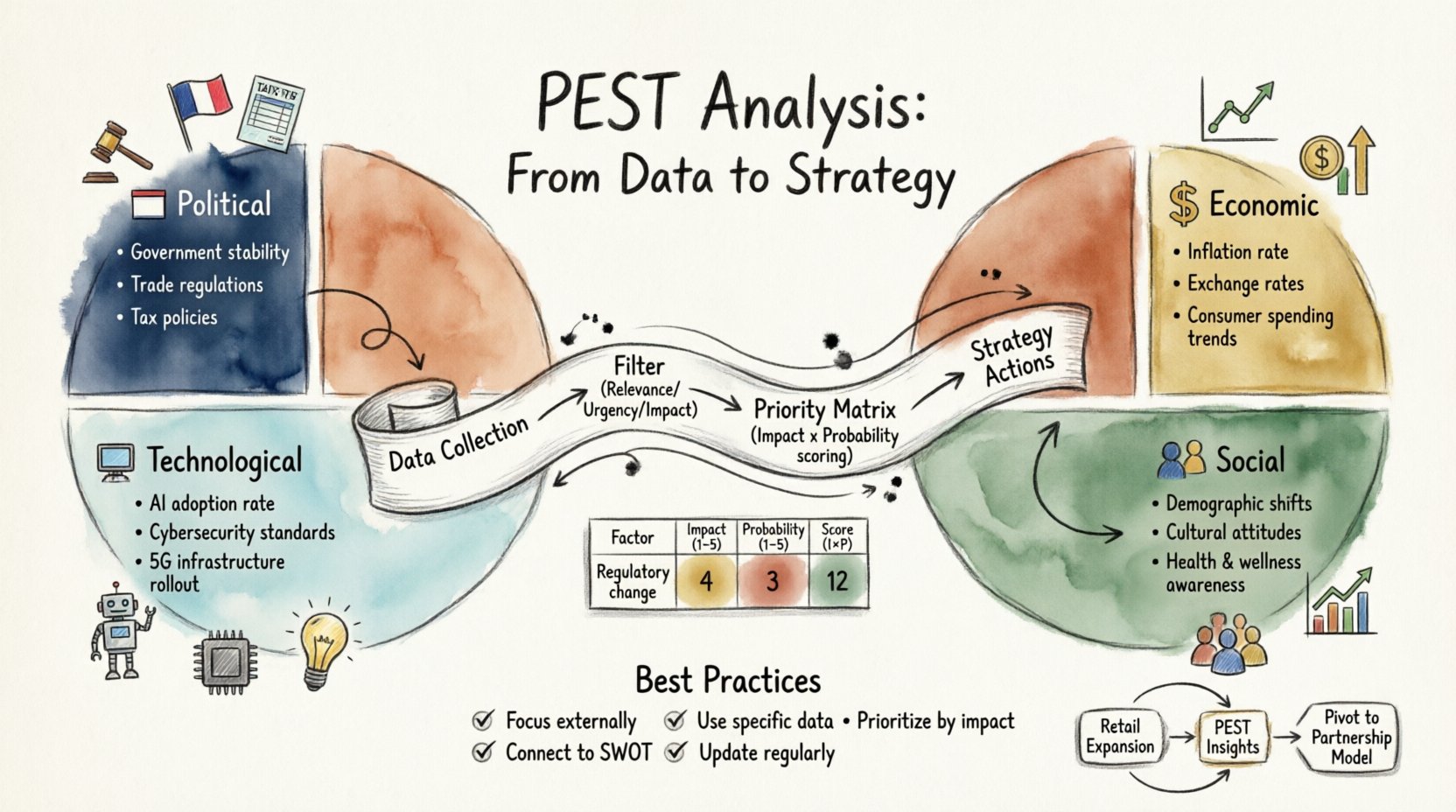
PEST stands for Political, Economic, Social, and Technological. It is a framework used to identify external factors that can impact an organization. Unlike internal audits which focus on strengths and weaknesses within the company, this approach looks outward. It helps answer the question: “What is happening outside that we cannot control, but must respond to?”
- Political: Government actions, trade restrictions, tax policies, and labor laws.
- Economic: Economic growth, interest rates, exchange rates, and inflation levels.
- Social: Cultural trends, population growth, age distribution, and health consciousness.
- Technological: Innovation rate, automation, R&D activity, and technology incentives.
By categorizing these factors, teams can avoid tunnel vision. It forces a structured look at the landscape, ensuring that no major external threat or opportunity is overlooked during the planning phase.
🏗️ The Four Pillars Explained
Understanding the components is the first step. Each pillar represents a distinct category of external influence. Below is a detailed breakdown of what to look for within each section.
1. Political Factors 🏛️
Government stability and policy play a massive role in business operations. These factors are often the most volatile and require close monitoring.
- Tax Policy: Changes in corporate tax rates can directly affect profit margins.
- Labor Laws: Minimum wage adjustments and union regulations impact operational costs.
- Trade Restrictions: Tariffs, embargoes, or quotas affect supply chains and import costs.
- Environmental Regulations: Compliance costs for emissions or waste disposal.
- Political Stability: Risk of civil unrest or policy shifts in new administrations.
2. Economic Factors 💰
Economic conditions determine the purchasing power of customers and the cost of capital for the business.
- Economic Growth: GDP trends indicate whether the market is expanding or contracting.
- Interest Rates: High rates increase borrowing costs, potentially slowing expansion.
- Inflation: Rising prices affect input costs and consumer spending habits.
- Exchange Rates: Crucial for businesses importing materials or selling internationally.
- Disposable Income: The amount of money households have available for non-essential spending.
3. Social Factors 👥
Demographics and cultural attitudes shape demand. Understanding the “who” and “why” behind consumer behavior is critical.
- Population Growth: Determines the size of the potential market.
- Age Distribution: An aging population requires different products than a youth-heavy demographic.
- Lifestyle Trends: Shifts toward remote work, wellness, or sustainability.
- Attitude toward Work: Views on the 9-to-5 schedule or gig economy participation.
- Health and Safety: Post-pandemic shifts in hygiene standards or safety protocols.
4. Technological Factors 💻
Technology drives efficiency and creates new markets. It can also disrupt existing business models overnight.
- Innovation Rate: How fast is the industry changing?
- Automation: Potential for replacing labor with machines or software.
- Research & Development: Public and private spending on new tech.
- Technology Incentives: Government grants for adopting green tech or digital tools.
- Infrastructure: Availability of internet access, logistics networks, or energy grids.
📥 Step-by-Step Data Collection
Gathering data is the foundation of a reliable analysis. Without accurate information, the resulting strategy will be flawed. The goal is to find credible sources that provide up-to-date information without getting lost in irrelevant noise.
Sources of Information
Do not rely on a single source. Cross-reference data to ensure accuracy. Here are primary channels for gathering intelligence:
- Government Publications: Census data, economic reports, and legislative databases.
- Industry Reports: Market research firms often publish detailed sector analyses.
- News Outlets: Financial and business news provide real-time updates on regulatory changes.
- Academic Journals: For deep dives into social trends or economic theory.
- Competitor Analysis: Reviewing competitor press releases and annual reports reveals their strategic focus.
Filtering the Data
Not all information is relevant. You must filter the vast amount of available data to find what applies to your specific situation. Use the following criteria to evaluate data points:
- Relevance: Does this factor directly impact our industry or region?
- Urgency: Is this a long-term trend or a short-term fluctuation?
- Impact: How severe would the effect be if this factor changes?
- Confidence: How reliable is the source of this information?
🎛️ Processing Data: Signal vs. Noise
Once you have collected the data, the next challenge is processing it. A common mistake is listing every fact found. Instead, focus on the factors that require a strategic response. We recommend using a scoring matrix to prioritize findings.
Consider the following table to help structure your prioritization:
| Factor | Impact (1-5) | Probability (1-5) | Priority Score | Action Required? |
|---|---|---|---|---|
| New Tax Regulation | 5 | 4 | 20 | Yes |
| Shift in Fashion Trends | 2 | 3 | 6 | No |
| Global Supply Chain Shift | 5 | 5 | 25 | Yes |
By assigning scores, you move from qualitative guesses to quantitative priorities. High scores indicate factors that demand immediate attention and resource allocation. Low scores can be monitored but do not require immediate strategic shifts.
🚀 Converting Insights into Strategy
Data alone does not change outcomes. The value lies in translating insights into actionable business strategies. This section outlines how to bridge the gap between analysis and execution.
Scenario Planning
Create different future scenarios based on the high-priority factors. Ask “What if” questions to prepare for various outcomes.
- Best Case: Economic growth accelerates, and regulations become favorable.
- Worst Case: Recession hits, and trade barriers increase significantly.
- Most Likely: Moderate growth with stable regulatory environments.
For each scenario, define the specific actions your organization would take. This preparation reduces reaction time when real events occur.
SWOT Integration
Combine the external findings with internal capabilities. A SWOT analysis (Strengths, Weaknesses, Opportunities, Threats) is the natural companion to PEST.
- Opportunities: External trends you can capitalize on using your strengths.
- Threats: External trends that could harm you if you do not mitigate them.
For example, if a Social trend shows a rise in health consciousness (PEST), and your company has strong R&D capabilities (SWOT Strength), the strategy is to launch a new product line targeting this demographic.
Resource Allocation
Decide where to invest time and money based on the priority scores. If a Technological factor poses a high threat, allocate budget toward modernization. If a Political factor presents an opportunity, invest in lobbying or compliance teams.
🚫 Common Mistakes to Avoid
Even experienced teams make errors when conducting this analysis. Awareness of common pitfalls helps ensure the quality of your output.
- Generic Analysis: Avoid broad statements like “Technology is changing.” Be specific, e.g., “AI automation is reducing entry-level coding roles.”
- Ignoring Interconnections: Factors often overlap. Economic downturns can lead to political instability. Acknowledge these relationships.
- Stale Data: Using data from three years ago to predict next year’s market. Ensure all sources are current.
- Internal Bias: Focusing only on data that confirms existing beliefs. Welcome data that challenges your assumptions.
- One-Time Exercise: Treating the analysis as a single event. The environment changes, so the analysis must be revisited regularly.
🌍 Real-World Application Example
To illustrate the process, consider a hypothetical company planning to expand into a new region. This example demonstrates how to move from raw data to a strategic decision.
The Scenario
A retail company wants to open stores in a foreign country. They need to assess if the market is viable.
The Analysis
- Political: The country has stable governance but is introducing stricter labor laws.
- Economic: Inflation is high, reducing consumer purchasing power.
- Social: Younger demographics prefer online shopping over physical retail.
- Technological: Internet penetration is low, limiting e-commerce potential.
The Strategy
Based on this data, the company decides against a full physical expansion. Instead, they pivot to a partnership model with a local logistics provider to handle distribution, mitigating the risk of high fixed costs due to inflation. They also invest in a mobile-first e-commerce platform to address the technological limitations.
🔄 Keeping Your Analysis Fresh
External environments are dynamic. A strategy based on last year’s data is likely obsolete today. Establish a routine for updating your analysis.
- Quarterly Reviews: Dedicate time every quarter to scan for new developments.
- Trigger Events: Set up alerts for specific keywords related to your industry regulations or competitors.
- Stakeholder Feedback: Ask sales and customer support teams about changes in customer behavior they are noticing.
- Version Control: Keep records of previous analyses to track how the environment has shifted over time.
📝 Summary of Best Practices
Executing a successful PEST analysis requires discipline and objectivity. It is not about predicting the future perfectly, but about being prepared for multiple futures. By adhering to these guidelines, you can build a robust foundation for strategic planning.
- Focus on external factors, not internal operations.
- Use specific data points rather than vague generalizations.
- Prioritize findings based on impact and probability.
- Connect external insights to internal strengths and weaknesses.
- Update the analysis regularly to maintain relevance.
The goal is to create a living document that informs decision-making. When used correctly, this framework reduces uncertainty and empowers teams to move forward with confidence. It transforms raw data into a clear roadmap for the future.