


In the landscape of complex system architecture, clarity is the currency of efficiency. Profile diagrams serve as the blueprint for extending modeling languages to fit specific domains. However, without strict adherence to standards, these diagrams risk becoming sources of confusion rather than clarity. When teams operate without a unified set of rules, the cost of misinterpretation rises significantly. This guide outlines the essential practices for establishing and maintaining profile diagram standards to foster collaboration and precision.
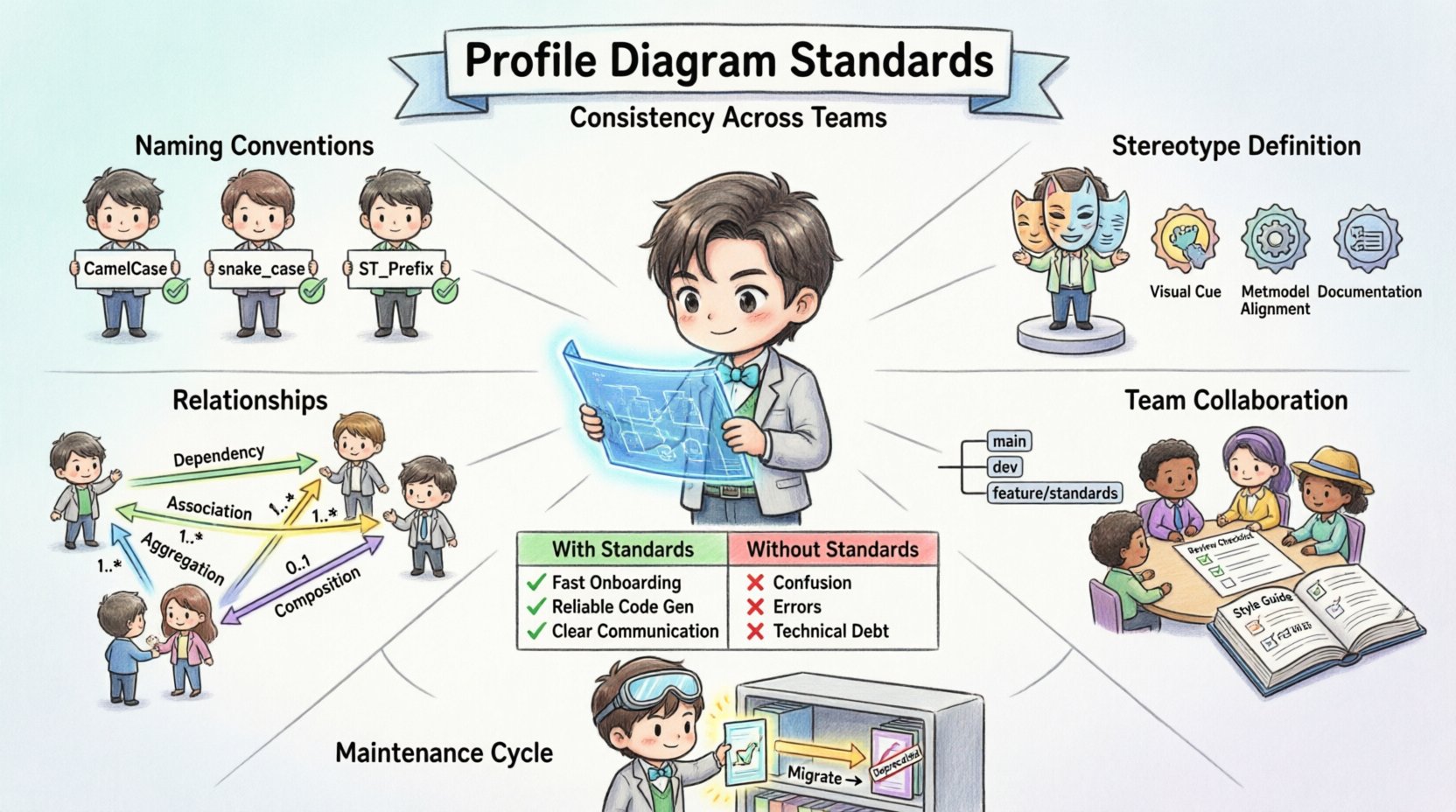
Understanding the Role of Profile Diagrams 🧩
A profile diagram allows architects to define new stereotypes, constraints, and tagged values that extend the base modeling language. It is not merely a drawing exercise; it is a semantic definition layer. When a team creates a profile, they are essentially creating a vocabulary for the system. If that vocabulary varies from one engineer to another, the resulting models become fragmented.
Consistency in these diagrams ensures that:
- Communication is Unambiguous: Everyone interprets a stereotype in the same way.
- Automation Works: Code generation tools rely on predictable structures to produce accurate output.
- Maintenance is Streamlined: Updates to the model can be applied globally without breaking dependencies.
- Knowledge Transfer is Smooth: New team members can onboard faster when patterns are established.
Without these standards, the architecture drifts. One developer might use a stereotype for “Database” while another uses “Repository” for the same concept. Over time, this divergence creates technical debt in the documentation itself, making the model harder to trust.
Foundations of Standardization 🏗️
Building a robust standard begins before the first element is placed on the canvas. It requires governance and a clear understanding of the domain. The following areas must be addressed to ensure structural integrity.
1. Naming Conventions 🏷️
Names are the primary interface between humans and models. Inconsistent naming creates friction during code reviews and integration tasks. A standard naming convention should be applied to packages, stereotypes, classes, and relationships.
- Case Sensitivity: Decide on a convention (e.g., CamelCase, PascalCase, or snake_case) and apply it universally.
- Prefixes and Suffixes: Use prefixes to denote categories. For example, use
ST_for stereotypes orPK_for packages. - Verbosity: Avoid overly short names that lack context, but do not use full sentences. Aim for descriptive yet concise identifiers.
- Language Agnostic: If the system supports multiple programming languages, ensure names do not conflict with reserved keywords in any of those languages.
2. Stereotype Definition 🎭
Stereotypes are the core of a profile. They define how a standard model element behaves within your specific context. Standardizing their definition is critical.
- Visual Representation: Define a standard visual cue. This includes specific icons or shapes that denote a stereotype, ensuring visual recognition even without reading the text.
- Metamodel Alignment: Ensure the stereotype extends the correct base class. Extending a
Classwhen the logic implies aComponentcreates logical errors in the model. - Documentation: Every stereotype must have a clear description explaining its purpose, usage constraints, and lifecycle.
3. Tagged Values and Constraints 🔒
Models often require specific data to be attached to elements. Tagged values provide this metadata. To maintain consistency, the schema for these values must be defined.
- Data Types: Specify whether a tagged value is a string, integer, boolean, or enumeration.
- Required Fields: Indicate which values are mandatory for a stereotype to be valid.
- Constraints: Define mathematical or logical constraints. For instance, a
timeoutvalue must always be greater than zero.
Structural Integrity and Relationships 🏛️
How elements connect is just as important as what they are called. Inconsistent relationship modeling leads to broken dependency chains and failed builds.
Relationship Semantics
There is often confusion between association, dependency, and aggregation. A standard must clarify the distinction within your specific domain.
- Dependency: Use this when one element uses another but does not own it.
- Association: Use this to represent a structural link where both ends have a known cardinality.
- Aggregation: Use this when a whole-part relationship exists, but the part can exist independently.
- Composition: Use this when the part cannot exist without the whole.
Cardinality and Multiplicity
Numbers matter. Ambiguity in cardinality leads to runtime errors. The standard should dictate how to display multiplicities (e.g., 0..1, 1..*, 1).
- Directionality: Ensure arrows point in the direction of dependency or ownership clearly.
- Labeling: If a relationship has a name, it should be placed on the line without obscuring other elements.
- Completeness: Every element should have defined relationships where applicable. Isolated elements suggest incomplete modeling.
Team Collaboration and Governance 🤝
Standards are not static documents; they are living agreements enforced by a team. Governance ensures that the standards are not just written, but followed.
Review Cycles
Establish a regular cadence for reviewing models. This is not a one-time check but an ongoing process.
- Peer Review: Before a model is merged or promoted to a higher version, it must be reviewed by a second architect.
- Checklist Adherence: Create a checklist based on the standards (e.g., “Are all stereotypes defined?”, “Is the naming convention met?”).
- Automated Validation: Where possible, use tooling to validate the model against the schema automatically.
Documentation and Onboarding
New team members need a single source of truth for these standards. This documentation should be accessible and searchable.
- Style Guide: Maintain a dedicated document outlining the rules of the profile.
- Examples: Provide positive and negative examples. Show what a correct profile looks like and what to avoid.
- Change Logs: Track changes to the standards. If a rule changes, document the reason and the date of the update.
Version Control
Models evolve. Versioning ensures that history is preserved and changes are traceable.
- Model Versions: Assign version numbers to the profile definition itself.
- Element Versioning: Track changes to specific stereotypes or packages.
- Branching Strategy: Define how branches are created for experimental profiles before they are merged into the main standard.
Common Pitfalls and How to Avoid Them 🚧
Even with the best intentions, teams often fall into traps that degrade the quality of the modeling effort. Recognizing these patterns early is key to prevention.
1. Ad-Hoc Modeling
This occurs when an engineer creates a new stereotype on the fly to solve an immediate problem without updating the official profile. This leads to fragmentation.
- Solution: Enforce a process where new stereotypes must be proposed, reviewed, and added to the official library before use in production models.
2. Mixed Methodologies
Different teams might use different modeling styles. One team might focus on data flow, while another focuses on state changes. This creates a disjointed view of the system.
- Solution: Align on a unified methodology. Define which aspects of the system are modeled and which are left out.
3. Drift Over Time
Standards degrade if they are not maintained. A standard from three years ago might not fit the current technology stack.
- Solution: Schedule annual reviews of the standards. Remove obsolete stereotypes and add new ones as the domain evolves.
Comparison of Practices 📊
To visualize the impact of standardization, consider the following comparison between a team with established standards and one without.
| Aspect | With Standards 🟢 | Without Standards 🔴 |
|---|---|---|
| Onboarding Time | New members understand the model quickly. | Time spent deciphering inconsistent notation. |
| Code Generation | Reliable and predictable output. | Errors due to missing or conflicting metadata. |
| Communication | Clear shared vocabulary. | Confusion over terms and relationships. |
| Maintenance | Easy to update globally. | Manual updates prone to human error. |
| Tooling | Validation tools work effectively. | Tools struggle with ambiguous structures. |
Maintenance and Evolution 🔄
Standards must grow with the organization. A rigid system that does not adapt becomes an obstacle. However, adaptation must be controlled to prevent chaos.
Change Management Process
When a change is proposed, it should follow a formal path.
- Proposal: Submit a request detailing the change and the justification.
- Impact Analysis: Determine how the change affects existing models and downstream systems.
- Approval: A governance board reviews the impact and approves or rejects the change.
- Implementation: Update the documentation and the central profile library.
- Notification: Inform all teams of the change and the effective date.
Backward Compatibility
When updating a profile, consider the impact on existing models. If a stereotype is deprecated, provide a migration path. Do not simply delete it without warning, as this breaks existing work.
- Deprecation Notices: Mark old stereotypes as deprecated but keep them functional for a transition period.
- Mapping: Provide rules for mapping old elements to new ones.
- Versioning: Ensure that older models can still be read even if the profile has evolved.
Final Considerations for Implementation 🚀
Implementing these standards is a journey, not a destination. It requires commitment from leadership and participation from the entire engineering team. The goal is not to restrict creativity but to channel it into a structure that supports the system’s longevity.
Start small. Define the core stereotypes and relationships first. Expand the standard as the complexity of the system grows. Regularly audit the models to ensure adherence. Over time, the consistency will pay off in reduced errors, faster development cycles, and a more robust system architecture.
Remember that the model is a communication tool. Its primary audience is people, not just machines. A consistent profile diagram reduces the cognitive load on everyone involved, from the initial architect to the final maintainer. By investing time in these standards, you build a foundation that supports the entire lifecycle of the software product.
Adopt the standards. Enforce them gently but firmly. Keep them updated. This approach ensures that your profile diagrams remain a reliable asset for your organization.