


Strategic planning relies heavily on understanding the landscape in which an organization operates. Among the various frameworks available, the PEST Analysis remains a cornerstone for examining external factors. However, despite its longevity, a significant number of leadership teams approach this tool with outdated assumptions. These misconceptions can lead to superficial reports that fail to inform critical decision-making.
For Strategy Directors, understanding the nuances of the PEST model is not just about ticking boxes. It is about uncovering hidden risks and identifying opportunities that competitors might overlook. When used correctly, this framework provides a clear view of the macro-environmental forces. Yet, when treated as a bureaucratic exercise, it becomes noise. This guide addresses the five most persistent myths surrounding PEST Analysis. By dismantling these barriers, you can align your strategic planning with reality rather than assumption.
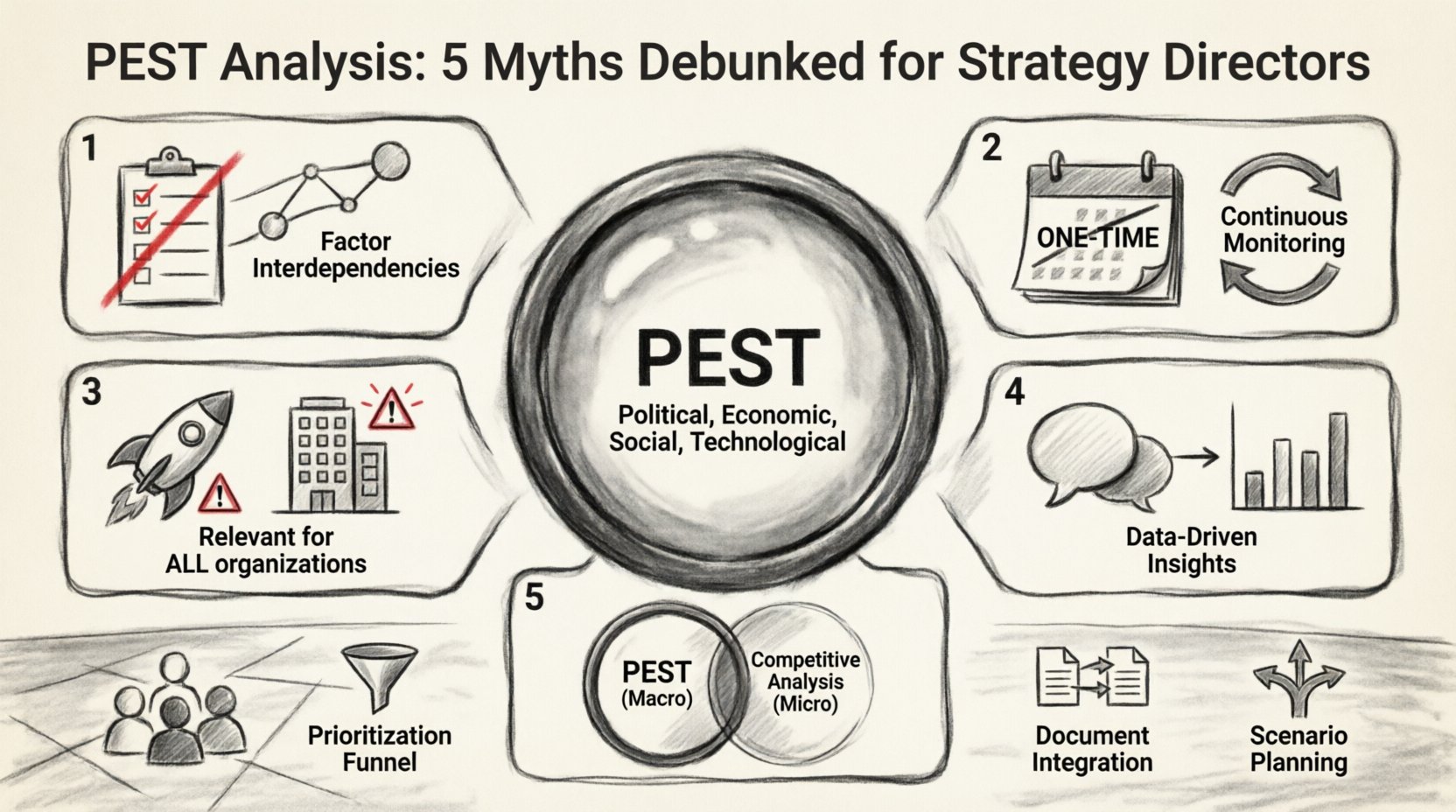
1. Myth: It Is Merely a Checklist Exercise 📋
The most common error occurs when teams treat the PEST Analysis as a static list to be completed annually. Many directors believe that simply listing factors under Political, Economic, Social, and Technological headers constitutes a completed analysis. This approach reduces a dynamic strategic tool into a clerical task.
A checklist mentality ignores the interconnectivity of variables. For instance, a technological shift often triggers a regulatory response. If you list them separately without analyzing the relationship, you miss the causal link. A robust analysis requires deep inquiry into how these factors influence one another.
- The Checklist Trap: Writing down “New Tax Laws” under Political and “Inflation Rate” under Economic without explaining how the tax law impacts inflation or consumer spending.
- The Impact of Depth: A true analysis explains why a factor matters to the specific business unit, not just the organization as a whole.
- The Result: Strategies built on checklist data are often reactive rather than proactive.
To avoid this, shift the focus from identification to interpretation. Every item listed must answer the question: “So what?” If a political change does not alter your cost structure, market access, or competitive advantage, it may not need to be a primary driver of your strategy. Depth trumps breadth in this context.
2. Myth: It Is a One-Time Event 📅
Another pervasive misconception is that a PEST Analysis is a single event. Many organizations conduct a comprehensive review at the start of a fiscal year and then file the document away. This static approach assumes that the external environment is stable enough to warrant a single snapshot.
The modern business environment is volatile. Regulatory landscapes change with election cycles. Economic indicators shift with global trade agreements. Technology evolves at a pace that renders annual reviews obsolete before they are even published. Relying on a yearly document creates a lag between market reality and strategic action.
- Frequency Matters: Strategic intelligence should be treated as a continuous stream, not a bucket filled once a year.
- Trigger-Based Updates: Instead of a calendar date, update your analysis when specific triggers occur. A new tariff, a breakthrough in AI, or a shift in consumer sentiment should prompt an immediate review.
- Agility: Teams that update their environmental scan quarterly can pivot faster than those waiting for the annual planning cycle.
Consider the economic volatility seen in recent years. Inflation rates that were stable in Q1 might double by Q3. If your strategy is based on Q1 data, you are already behind. Continuous monitoring allows for agile adjustments to resource allocation and risk management.
3. Myth: It Is Only Relevant for New Ventures 🆕
There is a belief that frameworks like PEST Analysis are primarily for startups or companies entering new markets. The logic follows that established organizations have stable market positions and therefore do not need to scan the horizon. This is a dangerous fallacy.
Incumbents are often more vulnerable to disruption than new entrants. Legacy structures can blind organizations to external shifts until it is too late. The decline of brick-and-mortar retail is a prime example of established players failing to account for technological and social changes until their market share evaporated.
- Disruption Risk: Large organizations are targets for disruption. A new technology can render a core competency useless overnight.
- Regulatory Pressure: As companies grow, they attract more regulatory scrutiny. Political factors often target market leaders more aggressively than small players.
- Talent Wars: Social trends regarding remote work or corporate culture affect retention rates in mature companies just as much as in startups.
For established Strategy Directors, the PEST Analysis acts as an early warning system. It highlights the erosion of the moat. Ignoring these external factors in favor of internal efficiency metrics is a recipe for stagnation. You must look outward to see if your inward focus is misplaced.
4. Myth: Qualitative Data Is Sufficient 📊
Many strategic teams rely heavily on expert opinion and anecdotal evidence when conducting a PEST Analysis. They believe that because these factors are broad and macro-level, precise data is unnecessary. They lean on qualitative assessments like “consumer sentiment is rising” or “tech is advancing.” While qualitative insight is valuable, it is insufficient on its own.
Qualitative data often lacks the specificity needed for resource allocation. You cannot budget for a campaign based on a feeling. You need metrics to validate the hypothesis. A strategy built on hunches is difficult to defend to a board or investors.
- The Need for Metrics: Instead of saying “interest in electric vehicles is high,” specify the year-over-year growth percentage in sales or registration numbers.
- Objective vs. Subjective: Qualitative data is subjective. Quantitative data provides the evidence base for strategic bets.
- Validation: Use data to validate your qualitative assumptions. If your team thinks social trends favor a product, verify this with search volume data or survey statistics.
Combining qualitative narrative with quantitative evidence creates a compelling case. It allows the strategy team to move from “we think” to “we know.” This distinction is critical when securing approval for significant investments or pivoting business models.
5. Myth: It Replaces Competitive Analysis 🔍
Sometimes, directors treat the PEST Analysis as a substitute for competitive intelligence or Porter’s Five Forces. They assume that understanding the macro-environment is enough to understand the micro-environment. This creates a blind spot regarding direct competition.
PEST Analysis focuses on the macro-environment. It looks at the whole industry or nation. It does not look at specific rivals. A political change might affect the whole sector, but your competitors might be positioned better to handle it than you are. Ignoring competitor capabilities while analyzing the environment is a strategic gap.
| Framework | Primary Focus | Strategic Use |
|---|---|---|
| PEST Analysis | Macro-Environmental Factors | Long-term horizon, external risks/opportunities |
| Porter’s 5 Forces | Industry Structure | Profitability potential, competitive intensity |
| SWOT Analysis | Internal & External | Gap analysis between capabilities and environment |
These tools are complementary. The PEST Analysis sets the stage. It tells you what is happening in the world. The competitive analysis tells you who is moving on that stage and how they are playing. Using PEST alone gives you the weather report, but not the traffic conditions.
Best Practices for Implementation 🛠️
To move beyond these misconceptions, Strategy Directors must implement specific best practices. These steps ensure the analysis drives action rather than gathering dust.
1. Cross-Functional Collaboration
Do not let the strategy team work in a silo. Bring in representatives from legal, sales, product, and finance. A legal expert will spot regulatory changes that a strategist might miss. A sales representative knows the immediate impact of economic shifts on customer purchasing power. Diversity of perspective prevents blind spots.
2. Prioritization of Factors
You cannot act on every factor identified. Create a scoring mechanism to prioritize findings. Rate factors based on:
- Impact: How severely does this affect the bottom line?
- Probability: How likely is this to happen?
- Timeframe: Is this immediate or a long-term trend?
Focus your energy on high-impact, high-probability events. This ensures that resources are allocated to the threats and opportunities that truly matter.
3. Integration into Strategic Documents
The output of the PEST Analysis must be integrated into other planning documents. Do not create a standalone report. Link specific PEST findings to:
- Risk registers
- Capital expenditure plans
- Market entry strategies
- Product roadmaps
When the analysis informs the budget, it becomes a living document. When it sits in a separate folder, it is ignored.
4. Scenario Planning
Use the PEST factors to build scenarios. What happens if inflation doubles? What happens if a new technology disrupts the supply chain? Scenario planning allows you to test the resilience of your strategy against different macro-environmental outcomes. This prepares leadership to react quickly when one of these scenarios materializes.
Real-World Implications of Ignorance 💥
History is filled with organizations that ignored the signs of external change. Consider the rise of streaming services. Traditional media giants initially dismissed the technological shift and social change in consumption habits. They viewed the new media landscape through the lens of their existing revenue models. The result was a rapid loss of market relevance.
Conversely, companies that embraced environmental scanning adapted. Retailers that recognized the social shift toward online shopping early secured their survival. They did not just react; they anticipated. This anticipation is the value of a rigorous PEST Analysis.
When a Strategy Director fails to understand the economic drivers, they may over-invest in inventory during a downturn. When they miss social trends, they may launch products that do not resonate with the current workforce or consumer base. The cost of these errors is measured in lost revenue and market share.
Conclusion and Forward Momentum 🚀
The PEST Analysis is a powerful tool, but only if wielded with precision. It is not a checklist, a one-time task, or a substitute for competitive intelligence. It requires continuous attention, quantitative backing, and cross-functional input. By debunking these five myths, Strategy Directors can transform their planning process from a ritual into a competitive advantage.
The environment will not wait for your next annual review. Factors are shifting daily. The goal is to build an organization that is aware of these shifts and capable of responding. Start by auditing your current process. Are you relying on old data? Are you missing the interconnectivity of factors? Are you ignoring the macro trends that could reshape your industry?
True strategic leadership comes from seeing the horizon clearly. When you align your internal capabilities with external realities, you create a roadmap that is both ambitious and achievable. This is the essence of modern strategic planning. Use the PEST framework not as a burden, but as a lens to focus your vision on the future.