


Entering a new market is one of the most significant decisions a business can make. It requires capital, time, and strategic foresight. Before committing resources, it is essential to understand the external environment that surrounds your potential venture. The PEST Analysis provides a structured framework for this assessment, examining Political, Economic, Social, and Technological factors.
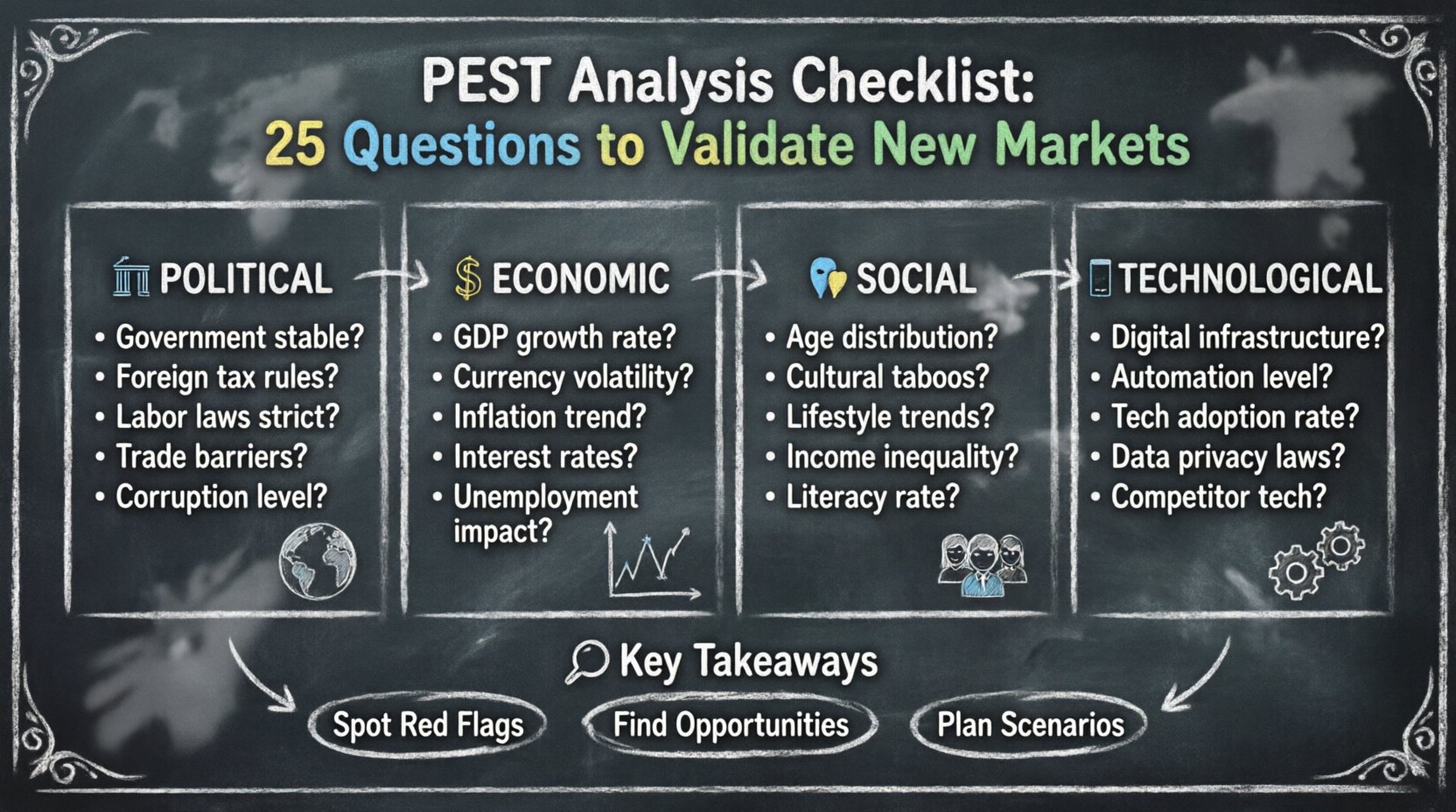
This guide offers a comprehensive checklist of 25 critical questions designed to validate any new market opportunity. By systematically addressing these areas, organizations can identify risks and opportunities that are often overlooked in initial planning phases.
🌍 Understanding the PEST Framework
The PEST analysis is a strategic tool used to evaluate the macro-environmental factors affecting an organization. Unlike internal analyses which focus on strengths and weaknesses, PEST looks outward. It helps teams understand the “why” behind market shifts.
- Political: Government actions, stability, tax policies, and trade restrictions.
- Economic: Growth rates, exchange rates, inflation, and interest rates.
- Social: Demographics, cultural trends, lifestyle changes, and consumer attitudes.
- Technological: Innovation rates, automation, R&D activity, and technological infrastructure.
Using this framework ensures that decisions are not made in a vacuum. It forces leadership to consider the broader ecosystem in which the business intends to operate.
🏛️ Political Factors: 5 Critical Questions
Political stability and government intervention can make or break a market entry. Regulations change frequently, and compliance costs can be substantial.
1. Is the current government stable and predictable?
Political instability can lead to sudden policy shifts. A government that changes frequently may alter regulations without warning. Assess the history of regime changes and the likelihood of future unrest.
2. What are the current tax structures for foreign entities?
Taxation directly impacts the bottom line. Different jurisdictions offer various incentives for foreign direct investment, while others impose high tariffs. Calculate the effective tax rate on profits and repatriated earnings.
3. How strict are labor laws and employment regulations?
Hiring and firing costs vary wildly. Some regions mandate union representation, while others have at-will employment. Understanding these costs is vital for operational budgeting.
4. Are there trade barriers or import/export restrictions?
If your supply chain relies on cross-border movement, tariffs can erode margins. Check for quotas, embargoes, or specific licensing requirements for your industry.
5. What is the level of corruption and transparency?
Bureaucracy can slow down projects. High corruption indices suggest that informal payments or complex networking might be necessary to navigate permits. This adds risk to the operational model.
💰 Economic Factors: 5 Critical Questions
Economic conditions determine the purchasing power of your target audience and the cost of doing business. A booming economy does not guarantee success if costs are too high.
6. What is the current GDP growth rate?
Gross Domestic Product indicates the overall health of the economy. Positive growth suggests demand, while stagnation might indicate a saturated market or recession.
7. How volatile is the local currency?
Currency fluctuation impacts revenue if you are converting back to your home currency. High volatility requires hedging strategies or local pricing adjustments.
8. What is the inflation rate and its trend?
High inflation erodes consumer purchasing power. It also increases the cost of raw materials and labor. Monitor central bank policies to predict future trends.
9. What are the prevailing interest rates?
High interest rates make borrowing expensive for expansion. They also encourage saving over spending. This affects both your financing costs and your customer demand.
10. How does the unemployment rate affect labor availability?
Low unemployment means a tight labor market and higher wage demands. High unemployment might mean a larger talent pool but potentially lower consumer spending.
👥 Social Factors: 5 Critical Questions
Social trends drive consumer behavior. A product that works in one culture may fail in another due to values, habits, or demographics.
11. What is the age distribution of the population?
An aging population requires different products than a youth-heavy demographic. Consider the median age and the dependency ratio.
12. Are there specific cultural taboos or sensitivities?
Marketing and branding must respect local norms. Symbols, colors, and language can have unintended meanings. Conduct thorough cultural due diligence.
13. What are the prevailing lifestyle trends?
Are people becoming more health-conscious? Are they working remotely? Align your value proposition with how people actually live, not how they used to live.
14. How does income inequality look in this region?
A wide gap between rich and poor affects market segmentation. Luxury goods may sell well in wealthy enclaves, while mass-market goods need affordability.
15. What is the literacy rate and education level?
Education impacts the adoption of complex products and digital literacy. It also determines the skill level of the available workforce.
📱 Technological Factors: 5 Critical Questions
Technology drives efficiency and innovation. It also disrupts traditional business models. Understanding the tech landscape is crucial for competitive advantage.
16. What is the level of digital infrastructure?
Internet penetration and mobile network quality determine if you can offer digital services. Poor infrastructure limits your channel options.
17. How advanced is the automation and manufacturing capability?
Local manufacturing tech affects your supply chain. High automation reduces labor costs but requires high capital investment.
18. What is the rate of technology adoption?
Early adopters drive innovation, but the mass market follows later. Determine if your target audience is ready for your tech level.
19. Are there data privacy and security regulations?
Compliance with data laws (like GDPR equivalents) is mandatory. Fines for non-compliance can be severe. Ensure your data handling practices align with local laws.
20. What is the competitive technological landscape?
Are competitors using AI or advanced logistics? If they are, you may need to match or exceed their capabilities to remain relevant.
📊 Summary of the 25 Critical Questions
To make this checklist actionable, we have summarized the questions into a structured table. This allows for a quick audit before deep-dive research.
| Category | Focus Area | Key Question |
|---|---|---|
| Political | Stability | Is the government stable? |
| Political | Taxation | What are the foreign tax structures? |
| Political | Labor | How strict are labor laws? |
| Political | Trade | Are there trade barriers? |
| Political | Transparency | What is the corruption level? |
| Economic | Growth | What is the GDP growth rate? |
| Economic | Currency | How volatile is the currency? |
| Economic | Inflation | What is the inflation trend? |
| Economic | Rates | What are the interest rates? |
| Economic | Unemployment | How does unemployment affect labor? |
| Social | Demographics | What is the age distribution? |
| Social | Culture | Are there cultural taboos? |
| Social | Lifestyle | What are the lifestyle trends? |
| Social | Income | How does income inequality look? |
| Social | Education | What is the literacy rate? |
| Technological | Infrastructure | What is the digital infrastructure level? |
| Technological | Automation | How advanced is local automation? |
| Technological | Adoption | What is the tech adoption rate? |
| Technological | Privacy | Are there data privacy laws? |
| Technological | Competition | What is the competitive tech landscape? |
🔍 Interpreting the Results
Answering these questions is only the first step. The value lies in synthesis. You must weigh the answers against your business model.
Identifying Red Flags
Look for patterns that indicate systemic risk. If multiple Political questions highlight instability, or if Economic factors show hyperinflation, the risk profile is high. These are not deal-breakers, but they require mitigation strategies.
Finding Opportunities
Conversely, look for gaps. If Social factors show a rising middle class with low access to your product type, that is an opportunity. Technological factors showing low infrastructure might suggest a need for offline-first solutions.
Scenario Planning
Do not rely on a single forecast. Create best-case, worst-case, and most-likely scenarios based on your answers. For instance, if currency volatility is high, model the business plan assuming a 20% devaluation.
⚠️ Common Pitfalls in PEST Analysis
Even with a checklist, teams can make mistakes that skew the analysis.
- Static Thinking: Markets change. A PEST analysis done today might be obsolete in six months. Treat it as a living document.
- Generalization: Avoid assuming national averages apply to your specific niche. A country might have high GDP but low access in rural areas.
- Ignoring Interconnectivity: Economic factors often drive Social factors. Inflation might change purchasing habits. Consider how these factors interact.
- Data Reliability: Relying on outdated or biased sources can lead to wrong conclusions. Verify data with multiple local sources.
🚀 Integrating into Strategic Planning
Once the analysis is complete, translate the findings into action.
Risk Mitigation Strategies
For every high-risk factor identified, define a mitigation plan. If political risk is high, consider joint ventures with local partners who understand the landscape.
Marketing Adaptation
Use the Social factors to tailor your messaging. If the target audience values sustainability, highlight your eco-friendly practices. If they value speed, emphasize efficiency.
Operational Adjustments
Adjust your supply chain based on Economic and Technological factors. If labor is expensive, invest in automation. If taxes are high, optimize your legal structure.
📈 Final Thoughts on Market Validation
Validating a market opportunity is not about finding a perfect environment. Perfect environments do not exist. The goal is to find an environment where you can manage the risks and capitalize on the opportunities.
Using this 25-question checklist ensures you have covered the macro-environmental bases. It moves the conversation from intuition to evidence-based decision-making. By rigorously applying this framework, you reduce the likelihood of costly entry failures.
Remember that market analysis is iterative. As conditions change, revisit these questions. Stay agile, stay informed, and let the data guide your strategic path.