


The business landscape is shifting beneath our feet. What worked a decade ago no longer guarantees success today. For strategic planners, the PEST Analysis has long served as a bedrock for understanding the external environment. However, the rapid ascent of Artificial Intelligence and the urgent transition toward a Green Economy demand a reimagining of this classic tool. This guide explores how to adapt PEST for modern complexities, ensuring organizations remain resilient and forward-thinking.
Traditional models often treat factors as static. In reality, political borders blur with digital data flows, and economic indicators now include carbon credits. By integrating these emerging forces, leaders can navigate uncertainty with greater clarity.
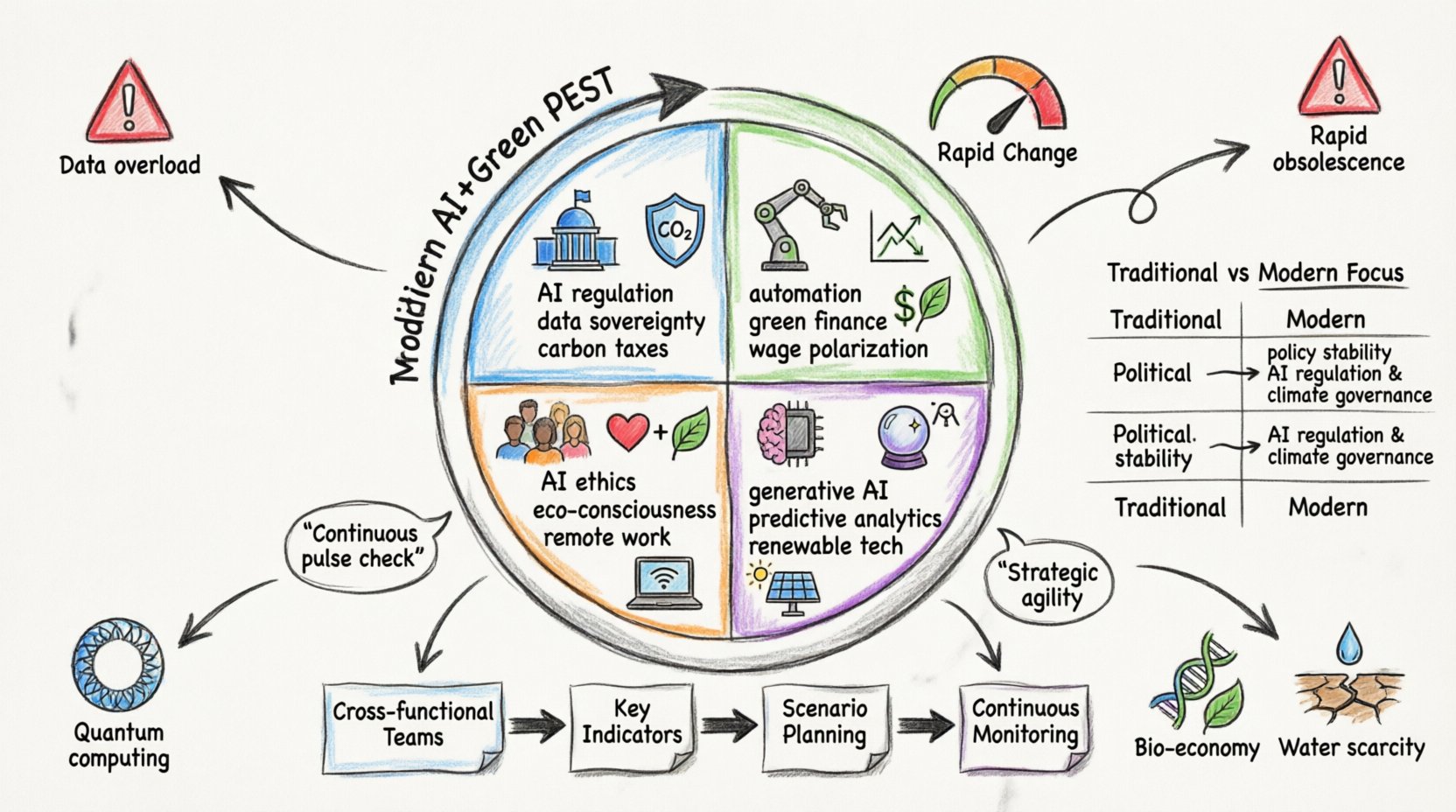
Understanding the Evolution of the PEST Framework 🔄
Originally developed in the 1960s, the PEST framework analyzes Political, Economic, Social, and Technological factors. Over time, it evolved into PESTLE (adding Legal and Environmental) and STEEPLE (adding Ethical). Yet, the core remains the same: scanning the horizon for risks and opportunities.
Adapting this framework requires more than adding acronyms. It requires a fundamental shift in how we perceive influence. Here is why the classic version needs an upgrade:
- Speed of Change: Traditional analysis often happened annually. AI shifts markets in months.
- Interconnectivity: A political decision in one region impacts supply chains globally due to digital integration.
- Intangibles: Carbon footprints and data privacy are now as critical as tax rates.
Organizations must treat PEST not as a checkbox exercise, but as a continuous pulse check on the macro-environment.
Political Factors: The Age of Digital Sovereignty and Climate Policy 🏛️
Political factors traditionally covered government stability, tax policy, and trade restrictions. Today, the definition of “state power” includes digital sovereignty and environmental mandates.
1. Artificial Intelligence Regulation
Governments are moving quickly to regulate AI. The European Union’s AI Act is a prime example of how political will shapes technological deployment. Businesses must monitor:
- Compliance Costs: High-risk AI systems require audits and transparency reports.
- Data Sovereignty: Laws dictating where data can be stored (e.g., GDPR, China’s data laws).
- Export Controls: Restrictions on high-tech semiconductor sales to certain nations.
2. Green Economy Legislation
Climate change is no longer just a scientific concern; it is a legislative one. Carbon pricing mechanisms are expanding globally.
- Carbon Taxes: Direct costs on emissions affect operational budgets.
- Subsidies: Governments offer incentives for renewable energy adoption and sustainable practices.
- Mandatory Reporting: ESG (Environmental, Social, and Governance) reporting is becoming legally required in many jurisdictions.
Strategic planners must now view political risk not just as policy shifts, but as regulatory compliance hurdles that can make or break a product launch.
Economic Factors: Automation, Inequality, and Green Finance 💰
Economic analysis has moved beyond GDP growth and inflation rates. The new economic reality is defined by how technology alters labor and how sustainability alters capital.
1. Labor Market Disruption
AI automation is reshaping the workforce. This impacts economic factors in several ways:
- Wage Polarization: High-skill AI roles command premium wages, while routine tasks face automation pressure.
- Productivity Gains: Companies adopting AI see efficiency spikes, altering competitive advantages.
- Reskilling Costs: Investment in human capital becomes a major economic line item.
2. The Rise of Green Finance
Capital allocation is shifting toward sustainability. Investors increasingly demand evidence of environmental stewardship.
- Access to Capital: “Green bonds” offer lower interest rates for sustainable projects.
- Insurance Costs: Climate risk affects insurance premiums for physical assets.
- Supply Chain Economics: Localizing supply chains to reduce carbon footprints changes logistics costs.
Economic planning must now account for the cost of inaction on climate and the efficiency gains from AI integration.
Social Factors: Ethics, Remote Work, and Conscious Consumption 🌍
Social trends have always been part of PEST, but the nature of societal pressure has changed. Consumers and employees now demand ethical alignment from the organizations they support.
1. The AI Ethics Debate
Public trust in technology is fragile. Social acceptance of AI depends on transparency and fairness.
- Algorithmic Bias: Public backlash can occur if AI tools discriminate in hiring or lending.
- Job Security: Fear of displacement affects consumer confidence and morale.
- Human Touch: A counter-trend values human interaction over automated efficiency.
2. Sustainability as a Social License
Consumers vote with their wallets. The Green Economy is driven by social demand.
- Eco-Consciousness: Preference for products with minimal packaging or carbon-neutral shipping.
- Workforce Expectations: Talent seeks employers with strong environmental and social goals.
- Community Impact: Local communities demand that businesses contribute to local green initiatives.
Neglecting these social currents can lead to brand damage that financial performance cannot easily repair.
Technological Factors: The Dual Engine of AI and Sustainability 🚀
Technology is no longer just the “T” in PEST; it is the driver of change for the other three factors. The convergence of AI and Green Tech creates a unique landscape.
1. Artificial Intelligence Capabilities
The technological factor now focuses on the maturity and accessibility of AI tools.
- Generative AI: Content creation and coding assistance are becoming commodity features.
- Predictive Analytics: Better forecasting for demand and risk management.
- Infrastructure: Cloud computing and edge devices enable real-time data processing.
2. Green Technology Integration
Technology is also the solution to environmental challenges.
- Renewable Energy Storage: Advances in battery tech enable 24/7 green power.
- Smart Grids: AI-driven energy distribution reduces waste.
- Circular Economy Tools: Platforms that track product lifecycles for recycling and reuse.
Organizations must evaluate not just their own tech stack, but the technological maturity of their suppliers and partners.
Comparing Traditional vs. Modern PEST Analysis 📊
To visualize the shift, consider how the focus of each category changes when adapting for the AI and Green Economy.
| Category | Traditional Focus | Modern Adapted Focus |
|---|---|---|
| Political | Tax rates, trade tariffs, stability | Data privacy laws, AI regulation, carbon taxes |
| Economic | GDP, inflation, interest rates | Green investment, automation costs, gig economy |
| Social | Demographics, culture, lifestyle | Digital ethics, sustainability awareness, remote work |
| Technological | Hardware, R&D, infrastructure | AI adoption, cybersecurity, renewable tech |
This table highlights that the variables remain similar, but the specific data points have shifted significantly.
Challenges in Modern PEST Analysis ⚠️
Adapting the framework is not without difficulties. Several hurdles stand between a strategist and a clear picture of the future.
- Data Overload: With so much information on AI and climate trends, filtering signal from noise is hard.
- Rapid Obsolescence: Insights gathered today may be outdated in six months due to tech speed.
- Interdisciplinary Knowledge: Teams need experts in both tech and sustainability, not just general management.
- Measurement Difficulty: How do you quantify the “social risk” of an AI bias scandal?
Overcoming these requires a culture of agility. Static reports do not work. Dynamic dashboards and continuous monitoring are necessary.
Implementing an Adapted PEST Strategy 🔧
How do teams move from theory to practice? Here is a structured approach to integrating these new factors into strategic planning.
Step 1: Assemble Cross-Functional Teams
Do not let only the strategy department handle this. Include representatives from:
- IT and Data Security
- Sustainability or ESG
- Human Resources
- Legal and Compliance
Step 2: Define Key Indicators
Select specific metrics for each PEST category. For example:
- Political: Number of pending AI regulations in target markets.
- Economic: Cost of carbon credits per ton.
- Social: Employee satisfaction scores regarding remote work.
- Technological: Percentage of supply chain using renewable energy.
Step 3: Scenario Planning
Use the PEST data to build scenarios. What happens if AI regulation tightens? What if carbon taxes double? This prepares the organization for multiple futures rather than betting on one.
Step 4: Continuous Monitoring
Set up alerts for key indicators. Review the PEST analysis quarterly, not annually. The environment changes too fast for yearly reviews.
Future-Proofing Your Organization 🛡️
The goal of this adaptation is resilience. By understanding these external forces, companies can pivot before crises hit. Here are key areas to watch in the coming years.
- Quantum Computing: Will disrupt current encryption and data security models.
- Bio-Economy: Fusion of biology and technology for sustainable materials.
- Metaverse and Digital Twins: New economic spaces that require new legal and social frameworks.
- Water Scarcity: A critical economic and social risk affecting supply chains.
Leaders who ignore these signals risk irrelevance. Those who integrate them into their core strategy gain a competitive edge.
Final Thoughts on Strategic Agility 💡
The PEST Analysis remains a vital tool, but its application must evolve. The combination of Artificial Intelligence and the Green Economy creates a dual pressure system that organizations must navigate carefully. Political decisions now impact code, and economic decisions impact the planet.
Success lies in flexibility. It lies in recognizing that a technology breakthrough can alter social norms overnight, and that environmental policy can reshape economic viability. By adopting a modernized view of PEST, leaders ensure they are not just reacting to change, but anticipating it.
The future belongs to those who can read the signs of the times and adapt their frameworks accordingly. The classic PEST model provides the skeleton, but the AI and Green Economy provide the flesh and blood of modern strategy.