


Entering a new market is rarely a matter of having the best product alone. It requires a profound understanding of the environment in which that product will live. This is where the PEST Analysis comes into play. It is a strategic framework used to scan the external macro-environmental factors that affect an organization. By conducting a thorough examination, you gain insight into the forces that can make or break a business venture.
Too often, organizations focus solely on internal capabilities or direct competitor moves. They miss the shifting tides of politics, economics, society, and technology. This oversight can lead to catastrophic failures. A competitor might look strong today, but if a regulatory change or a technological shift occurs tomorrow, their foundation could crumble. This guide provides a detailed roadmap for leveraging PEST analysis to identify these hidden vulnerabilities.
Understanding the Macro-Environmental Landscape 🌍
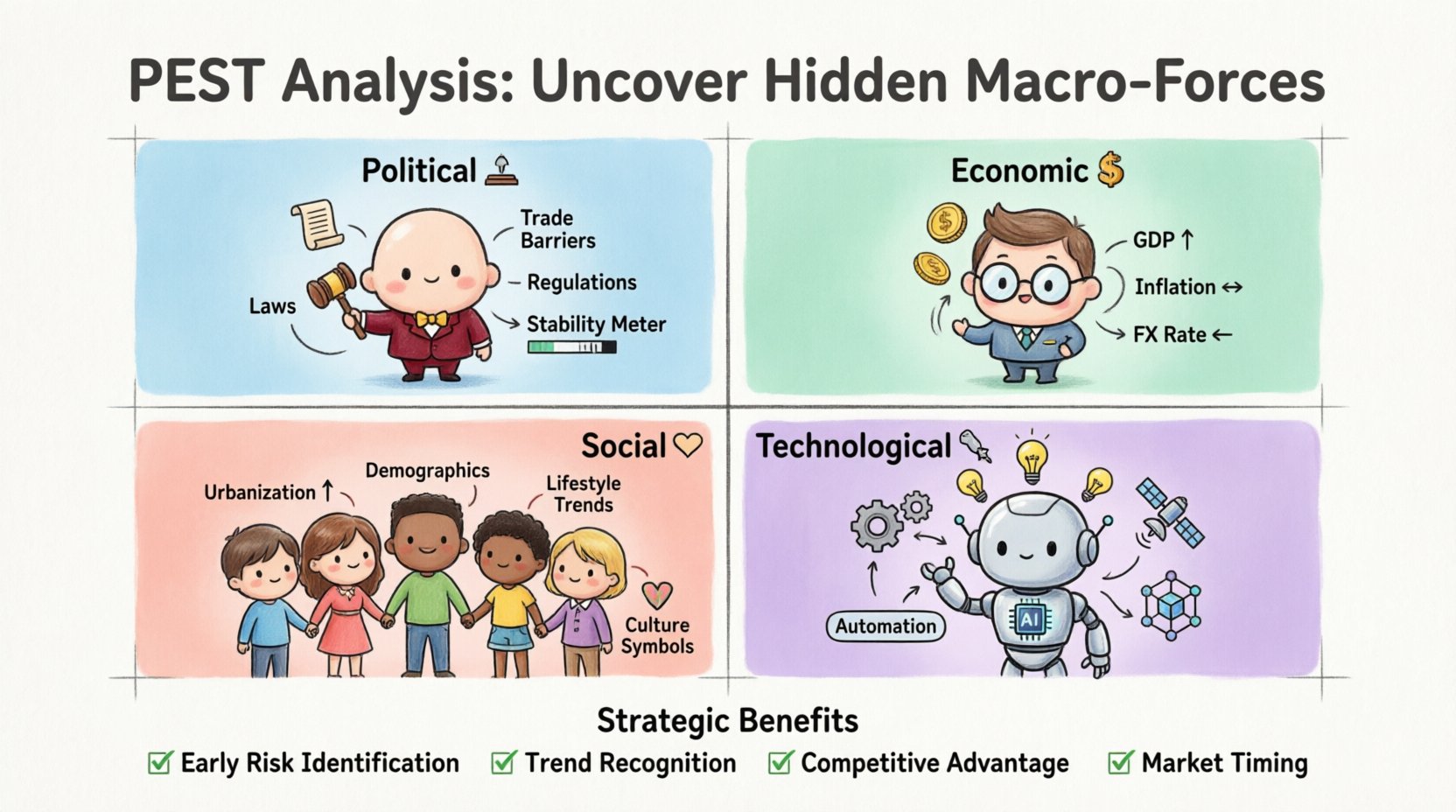
The business ecosystem is dynamic. It is constantly shifting due to events that are largely outside the control of any single company. These are the macro-environmental forces. While you cannot control the weather, you can prepare for the storm. PEST stands for Political, Economic, Social, and Technological. These four categories encompass the broad external influences that shape industry dynamics.
When you apply this framework, you move beyond surface-level observations. You look for the structural changes that alter the rules of the game. This is critical for new market entries. If you launch a product that relies on a technology that is becoming obsolete, or a service that violates upcoming regulations, your launch will fail regardless of your marketing budget.
Key benefits of this approach include:
- Early identification of regulatory risks 🚫
- Recognition of emerging consumer trends 📈
- Understanding of currency and inflation impacts 💰
- Assessment of technological disruption potential 🤖
- Strategic alignment with societal shifts 🤝
The Four Pillars of PEST Analysis 🔨
Each letter in PEST represents a distinct domain of external influence. To conduct a meaningful analysis, you must dig deep into each pillar. Generic observations are not enough. You need specific data points that relate directly to your industry.
| Factor | Key Question | Impact Scope |
|---|---|---|
| Political | How do government policies affect operations? | High (Compliance, Trade) |
| Economic | What is the financial health of the market? | Medium (Pricing, Demand) |
| Social | How do demographics shape consumer behavior? | High (Adoption, Culture) |
| Technological | What innovations are changing the landscape? | Medium (Efficiency, Threat) |
Political Factors: Regulation and Stability 🏛️
Political factors relate to the degree of government intervention in the economy. This includes tax policy, labor laws, trade restrictions, tariffs, and political stability. In some industries, political factors are the single biggest determinant of success.
Consider the energy sector. A shift in government policy towards renewable energy can instantly devalue assets in the fossil fuel sector. Conversely, subsidies for green technology can create massive opportunities for new entrants. When analyzing this factor, you must look at both current laws and proposed legislation.
Specific areas to investigate include:
- Trade Barriers: Are there tariffs that increase import costs for your supply chain?
- Environmental Regulations: Will compliance costs eat into your margins?
- Political Stability: Is the region prone to civil unrest or sudden regime changes?
- Labor Laws: How do minimum wage laws and union regulations affect your staffing costs?
- Antitrust Laws: Will your market share growth trigger regulatory scrutiny?
Competitors often ignore these until it is too late. They assume stability will continue. If you anticipate a regulatory crackdown on data privacy, for example, you can adjust your architecture now while your competitors scramble later. This head start is a competitive advantage.
Economic Factors: Growth and Currency 💰
Economic factors determine the purchasing power of potential customers and the cost of capital. These indicators include inflation rates, exchange rates, and economic growth rates. A recession can wipe out demand for non-essential goods, while a booming economy can fuel expansion.
Exchange rates are particularly critical for businesses operating across borders. If your revenue is in a local currency but your costs are in a strong foreign currency, your profitability is at risk. Understanding these fluctuations allows for better pricing strategies and hedging mechanisms.
Key economic indicators to monitor:
- GDP Growth: Is the economy expanding or contracting?
- Interest Rates: How does this affect borrowing costs for your customers and your company?
- Inflation: Are input costs rising faster than you can pass them on to customers?
- Unemployment Rates: High unemployment might mean lower disposable income but cheaper labor.
- Disposable Income: How much money do consumers actually have to spend after taxes?
During an economic downturn, competitors might cut corners on quality or service to save costs. This creates an opening for you to emphasize value and reliability. If you know the economic cycle, you can time your market entry to coincide with recovery phases.
Social Factors: Demographics and Culture 🤝
Social factors involve the cultural aspects of the target market. This includes population growth rates, age distribution, career attitudes, and health consciousness. These factors drive consumer demand. A product that fits the current social zeitgeist will sell; one that clashes with it will struggle.
Demographics are shifting rapidly in many regions. An aging population requires different products than a youth-heavy population. Cultural norms dictate what is acceptable. For instance, a marketing campaign that works in one country might be offensive in another due to religious or social taboos.
Essential social metrics to analyze:
- Population Density: Does this affect logistics and distribution channels?
- Lifestyle Trends: Are consumers shifting towards remote work or wellness?
- Education Levels: Does the market understand complex technical products?
- Urbanization: Is the market moving towards cities, affecting retail footfall?
- Attitude Towards Risk: Is the culture conservative or innovative?
Competitors often fail to adapt to social shifts. They continue selling to the demographic they knew five years ago. If you identify a shift towards sustainability early, you can position your brand as the ethical choice. This resonates deeply with modern consumers and can alienate competitors who are seen as outdated.
Technological Factors: Innovation and Disruption 🤖
Technological factors relate to the impact of new technologies on the industry. This includes automation, research and development (R&D) activity, and the rate of technological change. In the digital age, this is often the most volatile factor.
Technological disruption can render a business model obsolete overnight. Think of how streaming services disrupted video rental stores. The technology wasn’t just better; it changed the consumer expectation entirely. You must assess not just what technology exists, but what is on the horizon.
Areas of technological scrutiny:
- Automation: Can competitors automate processes to lower costs?
- Internet Infrastructure: Is the market ready for high-speed digital services?
- Patent Landscape: Are there IP barriers blocking your entry?
- AI and Data: How is artificial intelligence changing your value proposition?
- Emerging Tech: Are there technologies like blockchain or IoT that could redefine your sector?
Competitors may be entrenched in legacy systems. They are slow to adopt new tech due to sunk costs. This inertia is your opportunity. If you build on a modern, flexible stack, you can pivot faster when the market shifts again.
Integrating PEST with Competitor Intelligence 🕵️
Knowing the factors is only half the battle. You must understand how they affect your specific competitors. A PEST analysis is not just a checklist; it is a lens through which you view your opposition. You are looking for their vulnerabilities.
Consider a competitor who relies heavily on imported raw materials. If the Economic factor shows a weakening local currency, their costs will spike. If you source locally, your cost structure remains stable. This is a direct competitive advantage derived from macro-analysis.
Steps to map PEST to Competitors:
- Identify Competitor Dependencies: What external factors do they rely on?
- Assess Sensitivity: How much does their performance fluctuate with these factors?
- Map Vulnerabilities: Where are they exposed to risk?
- Formulate Counter-Strategy: How can you position your brand to exploit these weaknesses?
For example, if a competitor has a social media presence that is highly dependent on a specific algorithm, and a Political factor suggests upcoming data privacy changes, that competitor’s reach may shrink. You can adjust your strategy to build a more direct, owned media channel.
Executing the Analysis Without Specialized Tools 📝
You do not need expensive enterprise software to conduct a robust PEST analysis. The value lies in the thinking, not the tool. You can use standard documentation methods to gather and synthesize data.
Effective data collection methods include:
- Government Publications: Census data, economic reports, and legislative records are often free.
- Industry Reports: White papers from trade associations offer deep sector insights.
- News Aggregation: Set up alerts for key terms related to your market.
- Customer Feedback: Direct conversations reveal social and economic pressures customers face.
- Expert Interviews: Talk to consultants who specialize in the region or sector.
Organize your findings in a structured document. Create a central repository where all team members can access the latest data. Regular reviews are essential. Macro-environments change monthly, sometimes weekly. A static analysis becomes obsolete quickly.
Common Pitfalls to Avoid During Assessment 🚧
Even with the best intentions, analysis can go wrong. There are common mistakes that dilute the effectiveness of the PEST framework.
Be wary of these errors:
- Generalization: Avoid broad statements like “the economy is good.” Use specific data points.
- Recency Bias: Do not focus only on recent news. Historical trends often predict future stability.
- Ignoring Interconnectivity: Political changes often drive Economic changes. Treat the factors as a system, not silos.
- Internal Focus: Do not let internal biases cloud the external data. Be objective.
- Static View: Do not treat the analysis as a one-time event. It must be a continuous process.
Turning Data into Strategic Advantage 🎯
The final step is action. Data without strategy is noise. Once you have identified the macro-forces, you must translate them into business decisions.
Strategic applications include:
- Risk Mitigation: If a factor poses a threat, create a contingency plan.
- Market Timing: Delay launch if a negative factor is imminent, or accelerate if a positive window is opening.
- Product Adaptation: Modify features to align with social or technological shifts.
- Resource Allocation: Invest in areas where the environment supports growth.
- Partnership Formation: Find partners who can help navigate specific political or economic hurdles.
When you launch, you are not just launching a product. You are launching a strategy that is attuned to the environment. This reduces friction and increases the probability of success. Your competitors who launch without this understanding are flying blind. You are navigating with a map.
By systematically uncovering these hidden macro-forces, you protect your launch and weaken your opposition. The goal is not just to survive the market, but to thrive where others stumble. This is the power of a deep dive PEST analysis.
Conclusion 🏁
Strategic foresight is the differentiator between those who lead and those who follow. The PEST framework provides the structure needed to scan the horizon. It reveals the tectonic shifts that precede market upheavals. By mastering the integration of these external factors into your planning, you gain a significant edge.
Remember that the landscape is never static. Continuous monitoring is the only way to maintain this advantage. Keep your data fresh, your analysis rigorous, and your strategies agile. This approach ensures that when competitors are reacting to the storm, you are already positioned in the eye of the calm.