


Software architecture often relies on recursive patterns to manage complexity. The Composite Design Pattern is a structural solution that allows clients to treat individual objects and compositions of objects uniformly. While elegant, this approach introduces specific risks. When a composite structure fails, the impact can cascade through the entire application. This guide provides a systematic approach to identifying, isolating, and resolving design flaws within composite hierarchies.
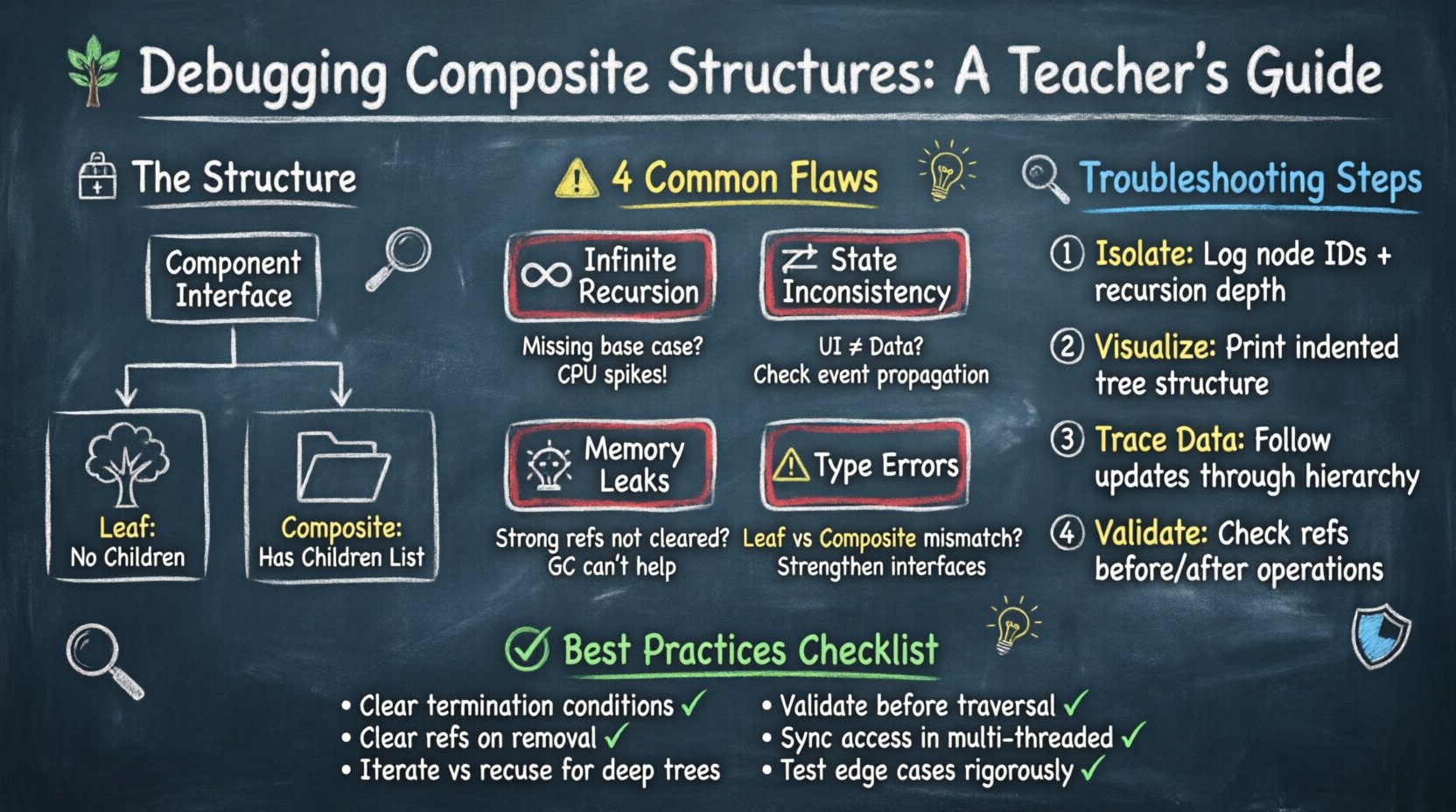
Understanding the Composite Structure 🌳
A composite structure organizes elements into a tree-like hierarchy. This model consists of three primary roles:
- Component: The interface for all objects in the hierarchy. It declares methods for accessing and managing child components.
- Leaf: The end of the tree. A leaf has no children and implements the component interface with basic behavior.
- Composite: The container. It maintains a list of child components and delegates operations to them.
This structure is fundamental in user interfaces, file systems, and organizational charts. However, the recursive nature creates potential pitfalls. Debugging requires understanding how data flows through these layers.
Common Design Flaws and Symptoms 🚩
Errors in composite structures often manifest in subtle ways. They may appear as performance degradation, memory leaks, or logic errors that only trigger under specific conditions. Below are the most frequent issues encountered during development and maintenance.
1. Infinite Recursion Loops
When a method traverses the tree, it must have a clear termination condition. If a child component references its parent without a check, or if the traversal logic lacks a base case, the system enters an infinite loop. This typically crashes the application or hangs the main thread.
- Symptom: Application freezes or CPU usage spikes to 100%.
- Root Cause: Missing null checks or circular references in the child list.
2. State Inconsistency
Composite structures often rely on shared state. If a parent updates its state based on children, but a child updates its state independently without notifying the parent, the hierarchy becomes desynchronized. This is common in UI rendering where visual state must match data state.
- Symptom: UI elements show outdated information or data models contradict the visual representation.
- Root Cause: Lack of event propagation or race conditions during state updates.
3. Memory Leaks via Strong References
Components often hold strong references to their children. If a parent is removed but children still hold references to the parent, garbage collection cannot reclaim the memory. Conversely, if children hold references to parents, detaching a leaf can leave the parent holding dead weight.
- Symptom: Application memory usage grows steadily over time without release.
- Root Cause: Failure to clear references during component removal or cleanup.
4. Type Safety Violations
In dynamically typed environments, or even in statically typed systems with inheritance, passing a leaf where a composite is expected (or vice versa) can cause runtime errors. If the interface is not strict, clients may call methods that only exist on specific node types.
- Symptom: Runtime exceptions when invoking methods on specific nodes.
- Root Cause: Weak interface contracts or improper casting.
Troubleshooting Methodology 🔍
Resolving these issues requires a disciplined approach. You cannot fix what you do not understand. The following steps outline a logical process for diagnosing composite structure problems.
Step 1: Isolate the Failure Point
Before modifying code, identify exactly where the logic breaks. Use logging to trace the execution path. Do not rely on stack traces alone, as they may not show the state of the object graph.
- Print the current node ID at the start of recursive methods.
- Log the depth of the recursion to detect loops early.
- Verify the state of the parent-child list before and after the operation.
Step 2: Visualize the Hierarchy
Text logs are insufficient for complex trees. Visualizing the structure helps reveal structural anomalies. Many tools allow you to render the object graph as a diagram. If a tool is unavailable, write a helper method that prints the tree structure with indentation representing depth.
Example logic for visualization:
- Iterate through the root node.
- For each child, print an indentation proportional to the depth.
- Display the node type (Leaf or Composite).
- Check for duplicate node IDs or missing children.
Step 3: Analyze Data Flow
Trace how data moves through the structure. Does every update propagate correctly? Does every read retrieve the correct value? Inconsistencies often arise from asynchronous updates where the consumer reads before the writer finishes.
- Check for lock mechanisms during write operations.
- Ensure read operations do not block write operations unnecessarily.
- Verify that the order of operations matches the dependency graph.
Common Issues Reference Table 📊
Use this table to quickly map symptoms to potential causes and solutions.
| Symptom | Potential Cause | Diagnostic Action |
|---|---|---|
| Application Hangs | Infinite Recursion | Set a maximum depth limit in debug mode. |
| Memory Usage Increases | Uncleared References | Check object references on node removal. |
| Incorrect UI Rendering | State Desynchronization | Implement event listeners for state changes. |
| Null Pointer Exceptions | Missing Children Check | Add guards before accessing child lists. |
| Logic Errors in Aggregation | Improper Accumulation Logic | Verify base case values for leaf nodes. |
Deep Dive: Specific Flaw Scenarios 🔬
Understanding the mechanics of these flaws helps in prevention. Let us examine specific scenarios in detail.
Scenario A: The Detached Parent Problem
When a composite removes a child, the child often retains a reference to the parent. If the child is later reattached to a different parent, it may still send notifications to the old parent. This creates orphaned listeners and logic errors.
- Fix: Ensure the
removemethod explicitly sets the parent reference to null on the child. - Fix: Use a weak reference if the parent relationship is not strictly required for the child’s lifecycle.
Scenario B: The Aggregation Loop
Operations like calculateTotal often sum up values from all children. If a child is added dynamically during this calculation, the loop may process the new child, which in turn adds another, creating a dynamic expansion.
- Fix: Create a snapshot of the child list before iterating.
- Fix: Use an iterator that does not support structural modification during traversal.
Scenario C: The Thread Safety Gap
Composite structures are frequently used in UI threads or multi-threaded environments. If two threads modify the child list simultaneously, the internal array or list structure may become corrupted. This leads to skipped elements or duplicate processing.
- Fix: Synchronize access to the child collection.
- Fix: Use thread-safe data structures for the child list.
- Fix: Decouple the structure modification from the traversal logic.
Refactoring for Stability 🏗️
Once flaws are identified, refactoring is necessary to prevent recurrence. The goal is to make the structure robust without sacrificing the simplicity of the composite pattern.
1. Enforce Interface Contracts
Ensure that the component interface strictly defines what operations are available. Avoid exposing internal implementation details of the composite to the client. This limits the surface area for errors.
- Make the child list private and provide only controlled access methods.
- Use immutable views of the child list where possible.
2. Implement Validation Hooks
Before a child is added or removed, validate the state. Does the child already exist? Is the parent valid? Does the structure meet invariants?
- Add a
validateAdd(child)method before insertion. - Check for circular references during the validation phase.
3. Decouple Traversal Logic
Separate the logic that traverses the tree from the logic that modifies it. This reduces the risk of modifying the structure while iterating. Use visitor patterns to handle traversal complexity externally.
- Keep traversal methods read-only.
- Move modification logic to dedicated manager classes.
Performance Considerations 🚀
Composite structures can become expensive as they grow. Debugging is not just about correctness; it is also about efficiency. Large trees can cause stack overflow errors during deep recursion.
1. Stack Depth Limits
Recursive methods consume stack space. If the tree depth exceeds the system stack limit, the application crashes. This is a critical flaw to address in deep hierarchies.
- Convert recursive algorithms to iterative ones using an explicit stack data structure.
- Set a hard limit on tree depth and reject nodes that exceed it.
2. Lazy Evaluation
Loading all children immediately can consume excessive memory. Consider lazy loading for large branches. Only instantiate child nodes when they are accessed.
- Store a factory function instead of the actual child instance.
- Initialize children only upon the first call to a specific method.
3. Batch Operations
Adding or removing nodes one by one triggers validation and event firing for every single operation. For bulk changes, batch the operations.
- Provide a
bulkAddmethod that disables notifications during the process. - Fire a single event after the batch is complete.
Testing the Composite Structure 🧪
Unit tests for composite structures must cover both individual components and the hierarchy as a whole. Relying on integration tests alone is insufficient for deep recursive bugs.
1. Test the Base Case
Verify that the leaf component behaves correctly. This is the termination condition for recursion. If the base case is broken, the entire structure fails.
- Assert that leaf operations do not attempt to access children.
- Verify that leaf state changes are isolated.
2. Test the Recursive Case
Verify that the composite correctly delegates to its children. This ensures the pattern is functioning as intended.
- Assert that the operation count matches the sum of child operations.
- Check that the hierarchy depth is maintained correctly.
3. Test Edge Cases
Empty trees, single nodes, and deeply nested structures are where bugs hide.
- Test operations on an empty composite.
- Test removing the last child from a composite.
- Test swapping parents without losing children.
4. Stress Testing
Simulate high load to find memory leaks and performance bottlenecks.
- Generate large random trees and run standard operations.
- Monitor memory usage over time.
- Measure execution time for deep traversals.
Preventing Future Flaws 🛡️
Prevention is better than cure. Establishing coding standards and architectural guidelines reduces the likelihood of introducing composite structure defects.
- Code Reviews: Focus specifically on recursive logic and reference management during peer reviews.
- Documentation: Clearly document the expected depth and size of the tree.
- Static Analysis: Use tools to detect potential recursion depth issues or circular references.
- Design Patterns: Adhere to the Composite pattern strictly. Do not mix it with other structural patterns in ways that obscure the hierarchy.
Summary of Best Practices ✅
Building robust composite structures requires attention to detail. The following checklist summarizes the essential actions for maintenance and development.
- Always define a clear termination condition for recursive methods.
- Ensure references are cleared when nodes are removed.
- Validate the tree structure before traversal.
- Use iteration instead of recursion for very deep trees.
- Synchronize access to child lists in multi-threaded environments.
- Test empty states and single-node states rigorously.
- Monitor memory usage during development and production.
By adhering to these guidelines, developers can maintain the integrity of their composite architectures. Debugging becomes less about fixing crashes and more about optimizing the flow of control through the hierarchy. The goal is a structure that is flexible enough to model complex relationships but rigid enough to prevent logical errors.
Remember that the composite pattern is a tool for abstraction. It should hide complexity, not introduce it. When the abstraction leaks, the debugging process begins. Stay vigilant, keep your hierarchies clean, and ensure that every node knows its place in the tree.