


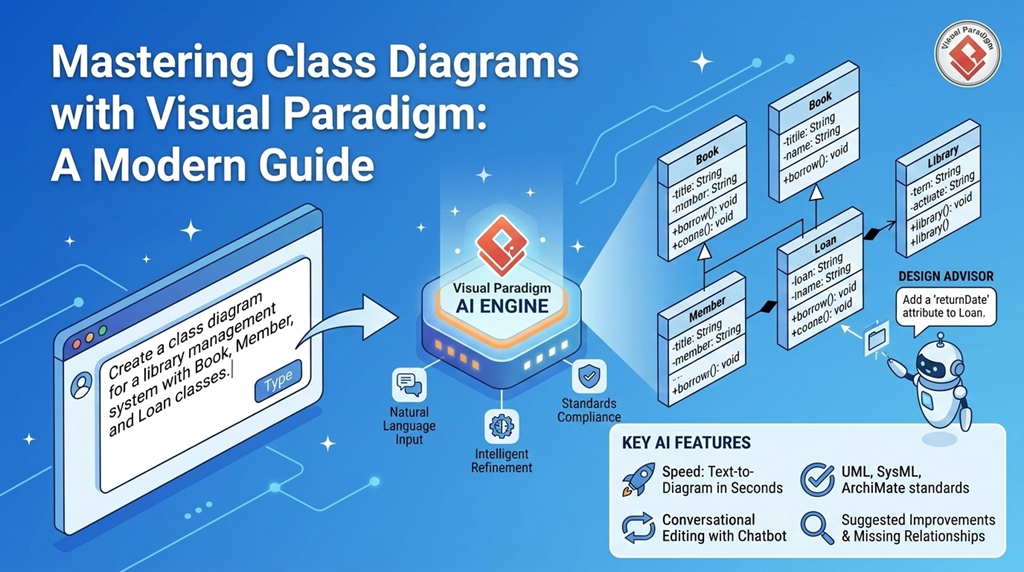
Class diagrams are a cornerstone of object-oriented software design, offering a clear, visual representation of a system’s structure. As part of the Unified Modeling Language (UML), they define classes, their attributes, operations, and the relationships between them—acting as a blueprint for developers and architects alike. These diagrams help translate abstract concepts into concrete software models, ensuring consistency and clarity across teams.
In today’s fast-paced development environment, creating accurate and maintainable class diagrams manually can be time-consuming and error-prone. That’s where Visual Paradigm steps in—a powerful visual modeling platform that streamlines the entire process. With support for over 100 diagram types, including UML, BPMN, and ERD, Visual Paradigm serves as a central hub for software design, business modeling, and enterprise architecture.
Why Class Diagrams Matter in Modern Development
A well-structured class diagram provides a shared understanding of a system’s architecture. It outlines how data is organized, how components interact, and how responsibilities are distributed. This clarity supports better communication among stakeholders, reduces ambiguity, and helps prevent design flaws early in the development lifecycle.
In object-oriented programming, class diagrams map real-world entities to software constructs. For example, in an e-commerce system, you might define classes like Customer, Product, Order, and Payment, each with specific attributes and behaviors. Relationships such as inheritance, association, and aggregation are visualized to show how these classes work together.
Because class diagrams are foundational, they must be accurate, scalable, and maintainable. They often serve as the basis for code generation, reverse engineering, and documentation—making their quality critical.
Visual Paradigm: The Professional Environment for Class Diagrams
Visual Paradigm is more than just a diagramming tool—it’s a comprehensive modeling environment designed for professionals. It supports the full lifecycle of software development, from initial design to implementation and maintenance.
Within Visual Paradigm, class diagrams are not static images. They are model elements that can be reused across diagrams, linked to other models, and synchronized with actual source code. This integration enables a bidirectional flow: changes in the code can update the diagram, and changes in the diagram can generate or update code—ensuring consistency throughout development.
The platform also supports integration with IDEs like IntelliJ IDEA and Eclipse, allowing developers to work seamlessly between code and models. This makes it easier to maintain alignment between design and implementation, especially in large-scale projects.
AI-Powered Modeling: A New Era in Class Diagram Design
Visual Paradigm has embraced artificial intelligence to transform how class diagrams are created and refined. Its AI ecosystem reduces the friction between idea and execution, making modeling faster and more intuitive.
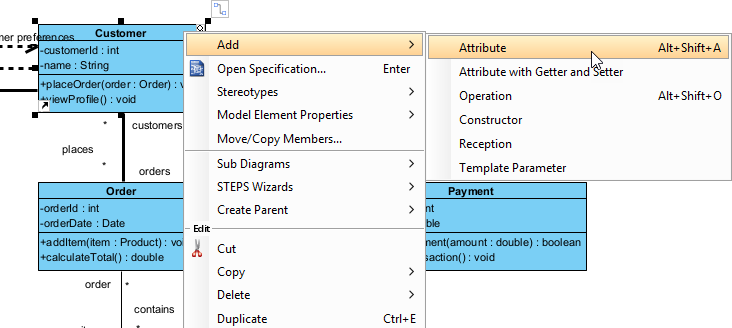
Visual Paradigm Desktop: AI Enabled Modeler
VP Desktop is Visual Paradigm’s flagship tool for serious modeling. It blends AI speed with professional-grade editing that other tools can’t match.
Start by using the built-in AI diagram generator to produce a class diagram from a simple text prompt. Describe your system—”a library management app with Book, Member, Loan, and Fine classes”—and AI lays out classes, attributes, operations, and key relationships automatically. The layout follows UML best practices, so you avoid messy arrangements.
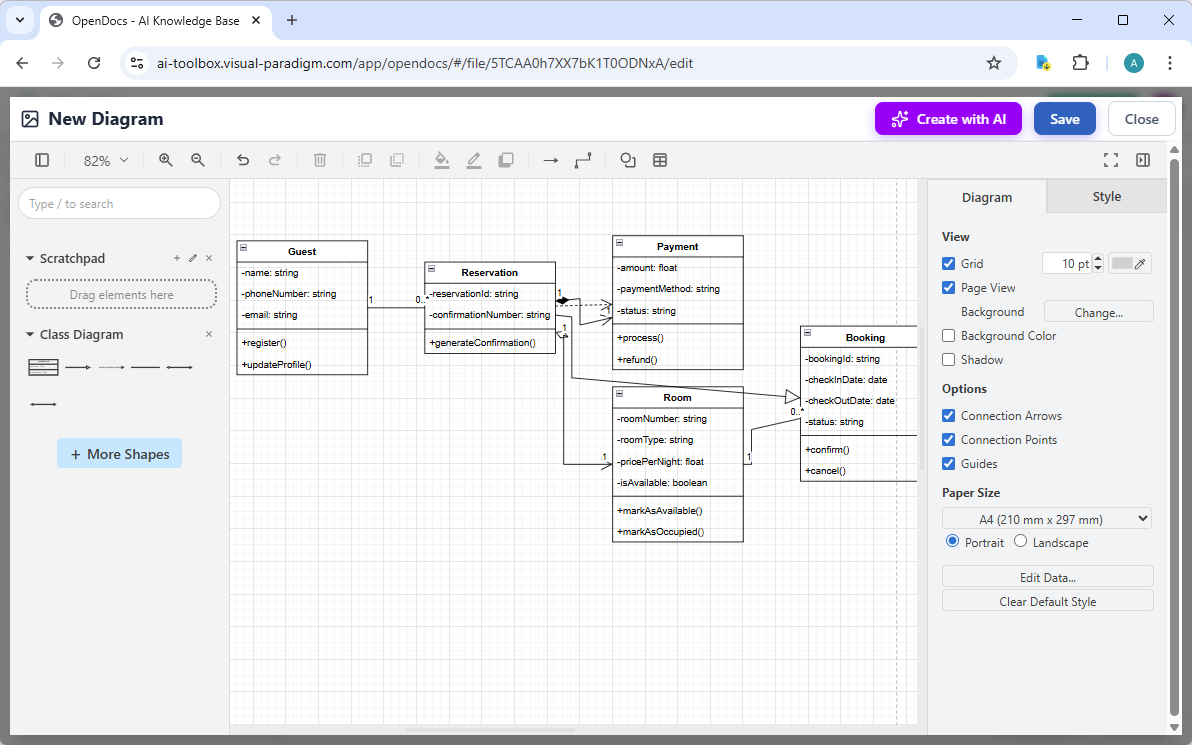
Visual Paradigm OpenDocs: Smart, AI Powered Knowledge Management Platform
Need to share class diagrams in docs, wikis, or reports? OpenDocs turns static images into living, interactive content.
Embed any AI-generated or custom class diagram right into dynamic pages. Team members click elements to zoom, edit (if permitted), or view linked details like attributes or related code snippets. It’s perfect for knowledge bases, architecture overviews, or onboarding guides.
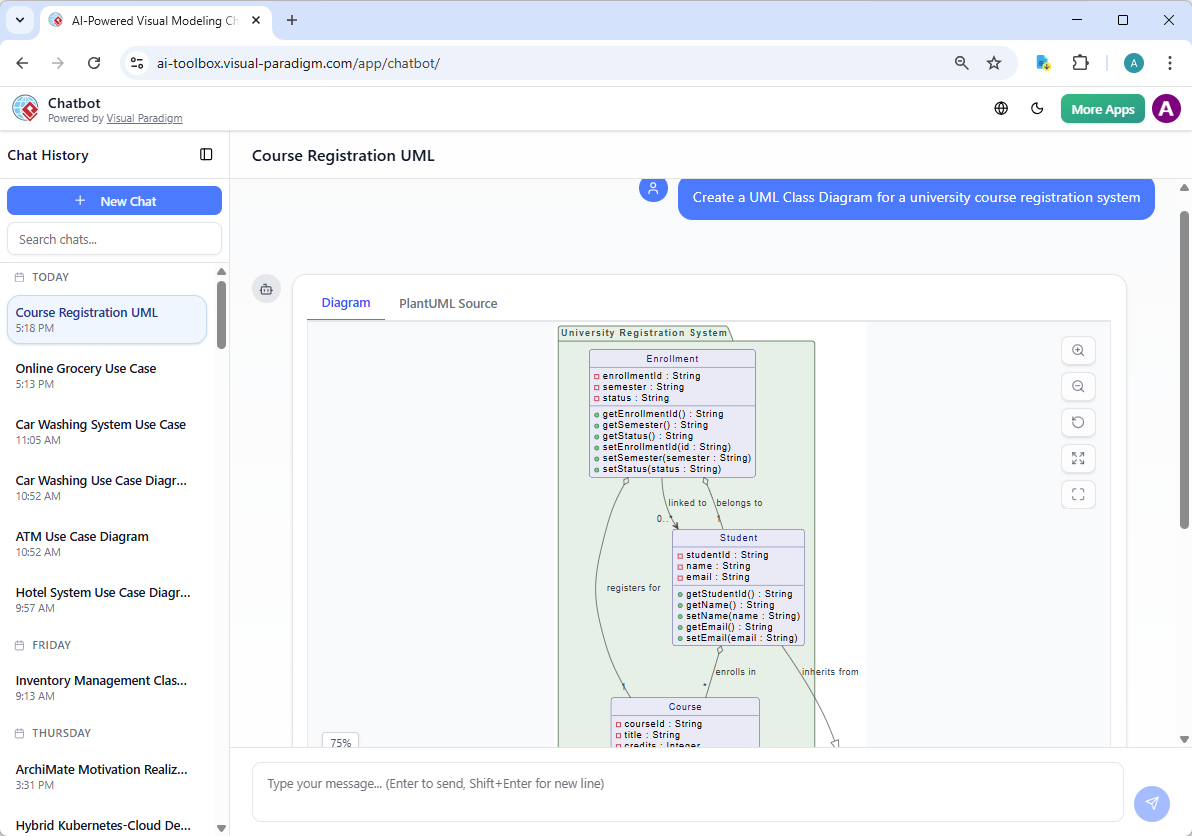
Visual Paradigm AI Chatbot for Visual Modelers
Want the fastest way to prototype? Visual Paradigm’s AI Visual Modeling Chatbot turns natural language into diagrams through simple chat.
Say: “Generate a class diagram for an e-commerce platform including User, Product, Cart, Order, and Payment.” The chatbot builds it instantly—complete with associations, inheritance if needed, and clean layout. Then iterate: “Add a Discount class with polymorphism” or “Explain the composition between Order and OrderItem.” It updates live and answers questions like “Why this association?” or “Suggest improvements for scalability.”
These features lower the barrier to entry, enabling both beginners and experts to create professional-grade models efficiently.
Benefits of AI-Enhanced Modeling
The integration of AI into class diagram creation offers several practical advantages:
- Increased Productivity: Automating layout, notation, and refinement frees up time for focus on domain logic and system behavior.
- Lower Learning Curve: Users don’t need deep UML expertise to create accurate diagrams. The AI handles syntax and structure, allowing novices to produce high-quality models.
- Standards Compliance: AI-generated outputs follow UML, SysML, and ArchiMate standards, making them suitable for formal reviews and stakeholder communication.
- Rapid Prototyping: High-level ideas can be turned into structured models in minutes, accelerating design iterations and decision-making.
This approach supports agile and iterative development, where quick feedback and frequent updates are essential.
A Practical Example: Generating a Class Diagram with AI
To illustrate the power of AI in modeling, consider the following prompt:
“Create a class diagram for a library management system. Include classes for
Book,Member,Loan, andLibrary. Add attributes liketitle,author,memberId, anddueDate. Define relationships such asMemberborrowsLoan, andLoanis associated withBook.”
The AI interprets this request and generates a complete class diagram with the correct classes, attributes, and associations—ready for refinement or use in code generation.
This capability is especially valuable during early design phases, when ideas are still evolving and rapid iteration is key.
Conclusion
Class diagrams remain essential for modeling object-oriented systems, and Visual Paradigm provides a modern, efficient way to create and manage them. By combining robust UML modeling with AI-driven automation, the platform enables faster, more accurate design—bridging the gap between conceptual ideas and working software.
Whether you’re a developer, architect, or business analyst, Visual Paradigm empowers you to design with confidence, consistency, and clarity.
- AI-Assisted UML Class Diagram Generator – Visual Paradigm: Browser-based AI wizard that generates editable UML class diagrams from natural language descriptions or step-by-step prompts; automatically identifies classes, attributes, operations, relationships, multiplicities, and validations, with PlantUML code previews, SVG exports, AI critique reports, and seamless project saving for rapid, accurate object-oriented design.
- Use Case Modeling Studio – Visual Paradigm: AI-powered web tool that converts high-level system goals or textual descriptions into detailed use case specifications, generates multiple UML diagrams (use case, activity, sequence, class, ERD), produces test cases, and enables interactive refinement to streamline requirements analysis, design, and testing workflows.
- AI Chatbot for Diagram Refinement – Visual Paradigm: Conversational AI assistant trained on UML/SysML standards; generates and iteratively refines diagrams from natural language commands, supports adding/removing elements, adjusting relationships, querying explanations, suggesting improvements, and seamless import to desktop/cloud workspaces for efficient modeling.
- Comprehensive Guide to Visual Paradigm AI-Powered Modeling for Software and Business – Diagrams AI: In-depth resource on AI integration across Visual Paradigm: text-to-diagram generation, real-time refinements, standards compliance (UML, BPMN, SysML), model critique/validation, and application in software design, business process modeling, and enterprise architecture.
- What is a Class Diagram? – Visual Paradigm UML Guide: Detailed explanation of UML class diagrams as static structure models; covers components (classes, attributes, operations), visibility, multiplicity, relationships (inheritance, association, aggregation, composition, dependency), perspectives (conceptual/specification/implementation), notation, best practices, and examples for software architecture and database design.
- Integrating Visual Paradigm with IntelliJ IDEA – Circle Visual Paradigm: Step-by-step instructions for seamless integration: installing the Visual Paradigm plugin in IntelliJ, round-trip engineering (code to model and model to code synchronization), real-time model updates, and leveraging UML diagrams directly within the IDE for agile development.
- What is a Class Diagram? Definition, Symbols, and Importance – Visual Paradigm AI Blog: Explains class diagrams as core UML structural models for defining system entities, attributes, operations, and relationships; details key symbols, importance in OO design/database mapping, and how AI accelerates creation/refinement in Visual Paradigm for faster prototyping and validation.
- Visual Paradigm 18.0 Release: AI-Powered Features – Updates: Release notes on major AI enhancements in version 18.0: expanded text-to-diagram support (UML, BPMN, SysML), improved chatbot accuracy, automatic refinements, standards compliance, and productivity tools for software development, business modeling, and enterprise architecture.
- Visual Paradigm: The All-in-One Visual Modeling Platform – Cybermedian: Broad overview of Visual Paradigm as a unified suite for UML, SysML, BPMN, ArchiMate, DFD, ERD, and more; emphasizes AI-driven diagram generation, code synchronization, traceability, collaboration, and applicability across software development, business processes, and enterprise architecture.
- AI Use Case Diagram Refinement Tool – Visual Paradigm: AI feature that analyzes use case narratives or initial diagrams to automatically detect and insert precise <> and <> relationships, uncover hidden dependencies, enhance accuracy/completeness, and ensure UML compliance with minimal manual effort.
- Visual Paradigm AI Diagram Generation Guide – Guides: Practical step-by-step walkthrough: selecting diagram type, inputting natural language descriptions, AI auto-generation with layout and element detection, iterative refinements via chat, preview/export options, and tips for optimal prompts to achieve high-quality UML/SysML/BPMN diagrams quickly.
- Revolutionizing UML Modeling on Mac with Visual Paradigm – Guides: Tips for macOS users: installing Visual Paradigm, leveraging native performance, using AI features for diagram creation/refinement, integrating with Xcode/IntelliJ, and utilizing cloud collaboration for efficient UML/SysML modeling on Apple hardware.
- UML Modeling in Software Development Process and Tools – Visual Paradigm (Chinese Edition): Guide to integrating UML into the software lifecycle (requirements, analysis, design, implementation, testing); covers best practices, tool selection (including Visual Paradigm’s AI features), and alignment with agile/waterfall processes for improved clarity and maintainability.
- Benefits of Model-Driven Development in Visual Paradigm: Highlights advantages of model-driven approaches with Visual Paradigm: UML/ERD-based modeling, automatic persistence layer/code generation, reverse engineering, synchronized model-code updates, improved quality, and AI enhancements for faster development and reduced errors.
- Visual Paradigm Online – Cloud-Based Modeling Suite: Fully online platform for diagramming (UML, BPMN, SysML, ArchiMate, DFD, ERD), AI features, document editing, spreadsheets, presentations, PDF tools, and real-time collaboration—all accessible via browser for business process management, enterprise architecture, and team-based modeling.
- What Makes Visual Paradigm’s AI Chatbot Different from Other AI Diagram Tools? – Visual Paradigm Blog (India Edition): Breakdown of unique strengths: formal training on UML/SysML standards, contextual/iterative editing in a unified workspace, high-quality compliant outputs, model-aware suggestions, and superior results over generic text-to-diagram tools for professional modeling.