


Entering an emerging economy offers immense growth potential, but it also introduces a unique set of uncertainties. For multinational corporations, understanding the macro-environment is not optional; it is a survival requirement. One of the most robust frameworks for this assessment is the PEST Analysis. While the acronym stands for Political, Economic, Social, and Technological factors, the Political dimension often dictates the viability of operations in volatile regions.
This article examines how major global brands have utilized PEST Analysis to navigate political shocks. We will look at real-world scenarios, dissect the decision-making processes, and outline a methodology for strategic planning without relying on proprietary software. The goal is to provide a clear, authoritative guide on maintaining stability amidst instability.
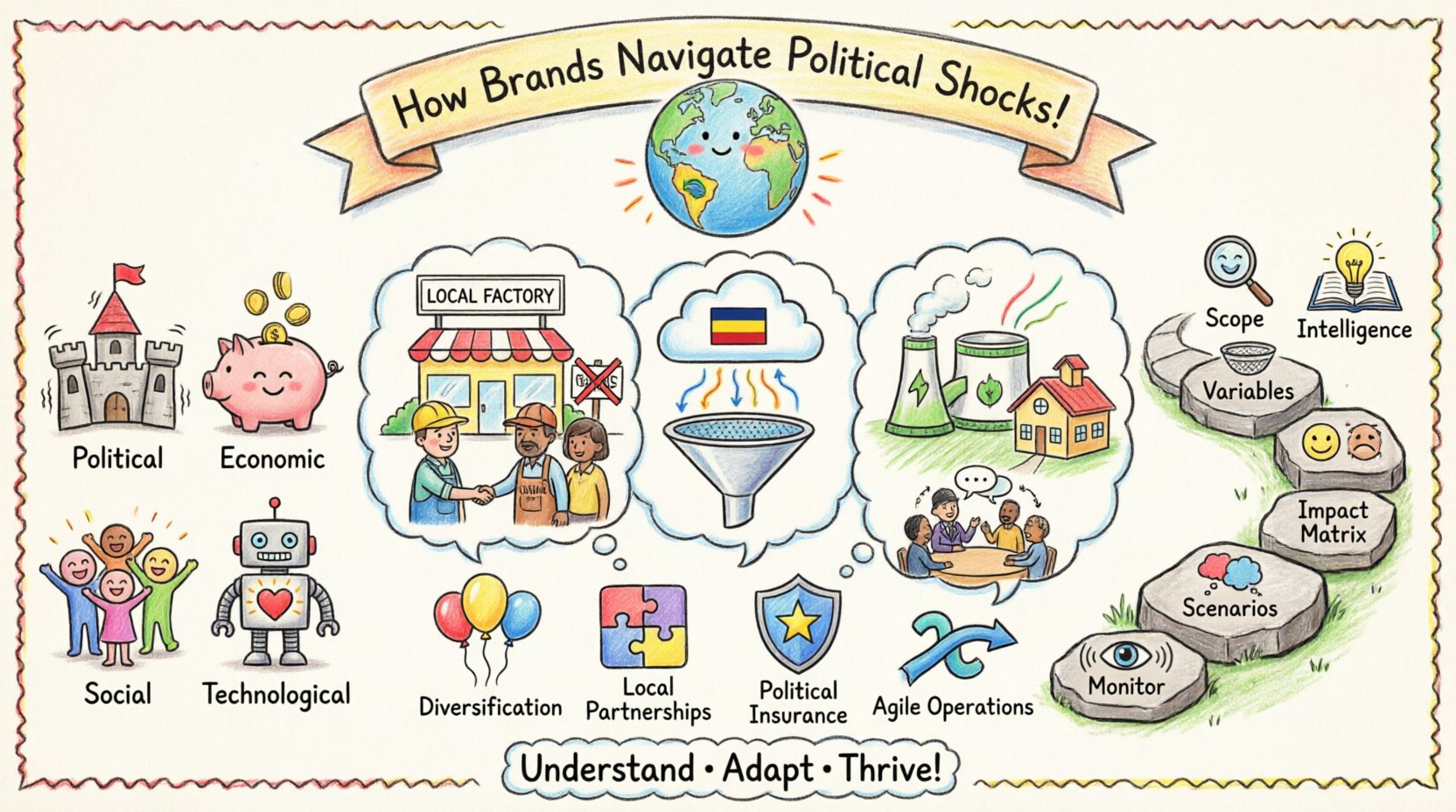
Understanding the Political Factor in PEST Analysis 🏛️
Political stability is the bedrock of business continuity. In the context of PEST Analysis, political factors encompass government policies, trade restrictions, labor laws, and the broader geopolitical climate. When a global brand enters a new market, they are not just entering a sales territory; they are entering a jurisdiction with specific rules and potential risks.
In emerging economies, these factors can shift rapidly. A change in administration, a sudden tariff implementation, or civil unrest can disrupt supply chains overnight. A comprehensive PEST Analysis allows organizations to anticipate these shifts before they impact the bottom line.
- Government Stability: Is the regime stable, or is there a risk of upheaval?
- Trade Regulations: Are there barriers to import or export?
- Tax Policy: How does the tax structure impact profitability?
- Legal Framework: Are contracts enforceable and is intellectual property protected?
Without a structured approach to gathering this intelligence, organizations operate in the dark. The following case studies illustrate how detailed analysis leads to resilience.
Case Study 1: A Major Retailer in Latin America 🛒
A prominent global retailer expanded its footprint into Brazil during a period of significant economic fluctuation. The company faced a complex political landscape characterized by trade protectionism and labor strikes. To manage these risks, they conducted a rigorous PEST Analysis focused heavily on political variables.
The Challenge
The initial expansion plan assumed a stable regulatory environment. However, the government introduced new tariffs on imported goods to protect local manufacturing. Additionally, local labor unions were becoming more aggressive regarding wage demands and working conditions.
The PEST Approach
The strategy team mapped out the political factors specifically:
- Political: Monitored election cycles and potential policy shifts regarding foreign investment.
- Economic: Analyzed currency volatility and inflation rates linked to political decisions.
- Social: Assessed consumer sentiment regarding foreign brands.
- Technological: Evaluated infrastructure readiness for logistics.
The Outcome
By identifying the high risk of tariff increases, the retailer shifted its strategy. Instead of importing finished goods, they established a local manufacturing hub. This decision was politically savvy, as it aligned with the government’s protectionist goals. Furthermore, they engaged early with labor representatives, integrating their concerns into the operational model. This proactive stance prevented costly strikes and ensured business continuity.
Key Takeaways
| Factor | Initial Risk | Mitigation Strategy |
|---|---|---|
| Import Tariffs | High | Local Manufacturing |
| Labor Laws | Medium | Early Union Engagement |
| Regulatory Changes | High | Local Legal Counsel |
Case Study 2: A Tech Platform in Southeast Asia 📱
A leading technology company faced a different set of challenges in Southeast Asia. Here, the political shock came in the form of data sovereignty laws and censorship regulations. The digital landscape was evolving, and governments were asserting control over how data was stored and processed.
The Challenge
The platform operated on a centralized cloud model. New legislation in the region required data to be stored locally on servers within the country. Additionally, certain types of content were restricted, which impacted the platform’s content moderation policies.
The PEST Approach
The organization recognized that Technological infrastructure was inextricably linked to Political mandates. They conducted a deep dive into the regulatory environment:
- Political: Analyzed the intent behind data laws. Was it security-driven or protectionist?
- Economic: Assessed the cost of building local data centers versus using existing third-party providers.
- Social: Understood public trust in local versus foreign data handling.
- Technological: Evaluated the feasibility of decentralized architecture.
The Outcome
The company decided to partner with local data centers rather than building their own. This reduced capital expenditure and ensured compliance with data sovereignty laws. They also adapted their content algorithms to meet local restrictions without compromising core functionality. By treating political constraints as technical requirements, they maintained market access.
Case Study 3: Energy Infrastructure in Africa ⚡
An energy corporation sought to develop infrastructure in a resource-rich African nation. The primary concern was not just the geology, but the political stability and community relations. Corruption, infrastructure decay, and community unrest were significant threats.
The Challenge
Long-term projects require stability over decades. Political instability could halt construction, and community opposition could lead to safety risks. The political landscape was fragmented, with regional leaders holding significant sway over resource allocation.
The PEST Approach
The focus here was on the Social and Political interplay. The team looked beyond the capital city to regional dynamics.
- Political: Mapped relationships between central government and local chiefs.
- Economic: Analyzed revenue sharing models and tax incentives.
- Social: Conducted community impact assessments to understand local needs.
- Technological: Evaluated the reliability of the power grid for operations.
The Outcome
The corporation implemented a community development fund. A percentage of profits was reinvested into local schools and healthcare. This built social capital, which acted as a buffer against political instability. They also established a local advisory board comprising community leaders and government officials. This ensured that grievances were addressed before they became political liabilities.
Building a Resilient PEST Framework 🛠️
How can other organizations replicate this success? The process requires discipline and a willingness to adapt. Here is a step-by-step guide to conducting a PEST Analysis for political risk assessment.
1. Define the Scope
Begin by defining the specific market and the timeline. Are you looking at a 5-year plan or a 10-year horizon? The political climate changes differently over different timeframes. A short-term focus might miss long-term structural shifts.
2. Gather Intelligence
Reliable data is the foundation of analysis. Sources should include:
- Government white papers and policy statements.
- Reports from international think tanks and NGOs.
- Local news outlets and industry publications.
- Insights from local consultants and legal experts.
3. Identify Key Variables
Not every political event is relevant. Filter the data to identify variables that directly impact operations. For example, a change in foreign ministry personnel might be irrelevant, but a change in trade policy is critical.
4. Assess Impact and Probability
Use a matrix to score each factor.
– Probability: How likely is this event to occur?
– Impact: How severe would the consequence be?
High probability and high impact factors require immediate attention and contingency planning.
5. Develop Scenarios
Scenario planning is essential for political shocks. Create a best-case, worst-case, and most-likely scenario. Ask yourself:
- What if the government changes?
- What if trade tariffs double?
- What if civil unrest disrupts logistics?
6. Monitor Continuously
A PEST Analysis is not a one-time document. It is a living process. Set up a monitoring system to track key indicators. If a specific political indicator moves, trigger a review of the strategy.
Strategic Mitigation Strategies 🛡️
Once the risks are identified, how do you protect the business? There are several established strategies for mitigating political risk.
Diversification
Do not rely on a single market for critical revenue streams. If one region faces a political shutdown, other markets can sustain the operation. This requires a balanced portfolio of investments.
Local Partnerships
Partnering with local entities can provide a buffer. Local partners understand the unwritten rules and have established networks. They can navigate bureaucracy more effectively than a foreign entity.
Political Insurance
Many international bodies offer insurance against political expropriation or instability. This financial instrument can protect assets if the worst happens. It is a cost of doing business in volatile regions.
Agile Operations
Build flexibility into the operational model. Can supply chains be rerouted quickly? Can production shift to a different location? Agile organizations can pivot faster when political winds change.
The Intersection of Political and Economic Factors 📈
It is crucial to remember that Political factors rarely exist in isolation. They are deeply intertwined with Economic factors. A political decision to devalue currency affects inflation, which affects consumer spending.
When conducting the analysis, look for the cross-connections. For example:
- Political Stability ➔ Economic Confidence: Stable governments attract investment.
- Trade Policy ➔ Supply Chain Costs: Tariffs increase the cost of goods sold.
- Regulation ➔ Compliance Costs: New laws require investment in legal and administrative teams.
Neglecting these intersections can lead to flawed strategies. A brand might assume political stability based on a new leader’s rhetoric, only to find that economic sanctions are being imposed by international partners.
Common Pitfalls to Avoid 🚫
Even with a framework, mistakes happen. Here are common errors organizations make when analyzing political risks.
- Over-reliance on Home Country Bias: Assuming political norms are the same as in the headquarters’ country.
- Ignoring Informal Networks: Focusing only on laws and ignoring the influence of powerful individuals or groups.
- Static Analysis: Treating the PEST Analysis as a static document rather than a dynamic process.
- Data Overload: Gathering too much information without filtering for relevance.
Final Thoughts on Strategic Adaptability 🧭
The business environment in emerging economies is dynamic. Political shocks are not anomalies; they are part of the landscape. The brands that succeed are those that treat risk management as a core competency rather than an administrative task.
By utilizing a structured PEST Analysis, organizations can move from reactive panic to proactive strategy. They can identify threats before they materialize and opportunities that others miss. The key lies in continuous monitoring, local insight, and the willingness to adapt.
Success is not about predicting the future with certainty. It is about preparing for multiple futures. Whether it is navigating labor laws in Brazil, data sovereignty in India, or community relations in Africa, the principles remain the same. Understand the environment, respect the local context, and build resilience into the core of the business model.
As global markets become increasingly interconnected, the ability to navigate political complexity will define the winners and losers. Start your analysis today, and build a strategy that can withstand the shocks of tomorrow.