


Strategic change is a high-stakes endeavor, especially in the competitive world of retail banking. The ability to anticipate and manage the forces for and against a new initiative is critical. Visual Paradigm‘s AI-Powered Force Field Analysis Framework provides a structured, data-driven approach to navigate this complexity. This article explores how this powerful AI-powered change management tool can be used to evaluate a real-world scenario: HorizonBank’s proposed launch of a digital-only customer onboarding process. By following the five-step workflow, users can rapidly generate a comprehensive analysis, from defining the change to developing a strategic action plan, all within a single, professional application.
Key Takeaways
-
Use the AI-Powered Force Field Analysis Framework to quickly generate a strategic plan for organizational change.
-
Define your change, driving forces, and restraining forces with a structured 5-step wizard.
-
Quantify the strength of each force to prioritize your intervention strategies.
-
Develop a detailed action plan to strengthen driving forces and weaken restraining forces.
-
Generate a professional, shareable report to communicate your findings and gain stakeholder alignment.
Defining the Change: The First Step in a Strategic Analysis
The journey begins with a clear definition of the proposed change. In Image 1, the user is prompted to provide essential context: the business name, industry, and a detailed description of the change.
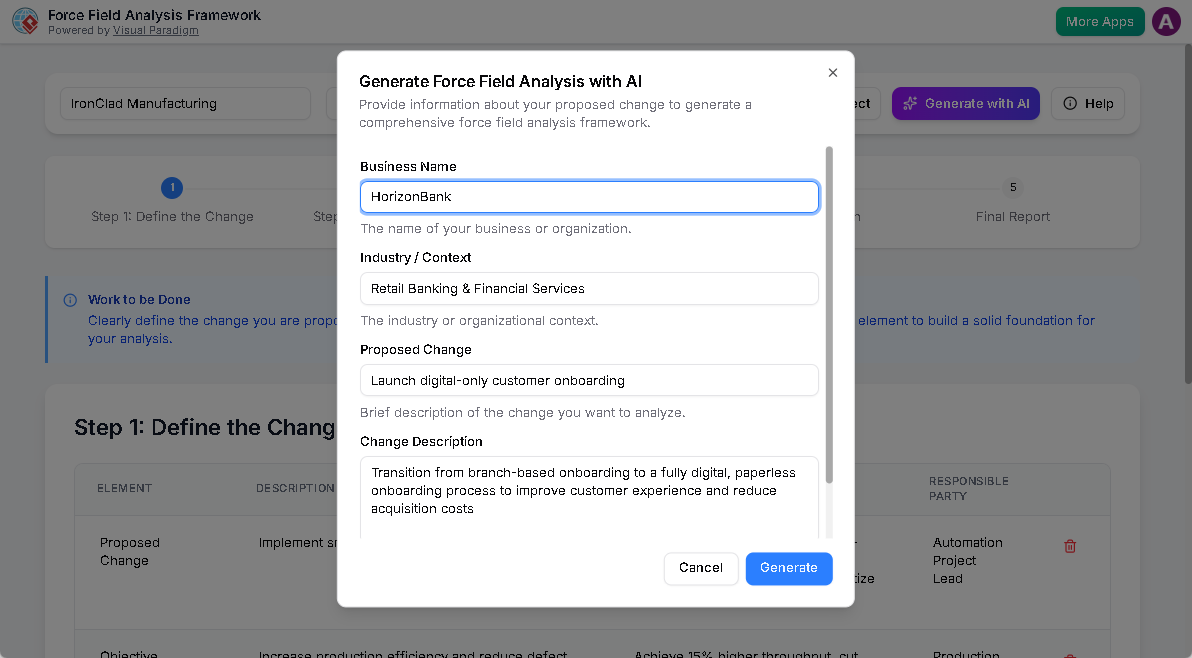
For HorizonBank, the goal is to transition from a branch-based onboarding process to a fully digital, paperless one. This initial step is crucial as it sets the foundation for the entire analysis. The tool guides the user to be specific about objectives, scope, and responsible parties, ensuring a solid foundation for the subsequent analysis. This structured approach helps prevent ambiguity and ensures that all stakeholders are aligned on the core initiative.
Step 2: Identifying Driving Forces
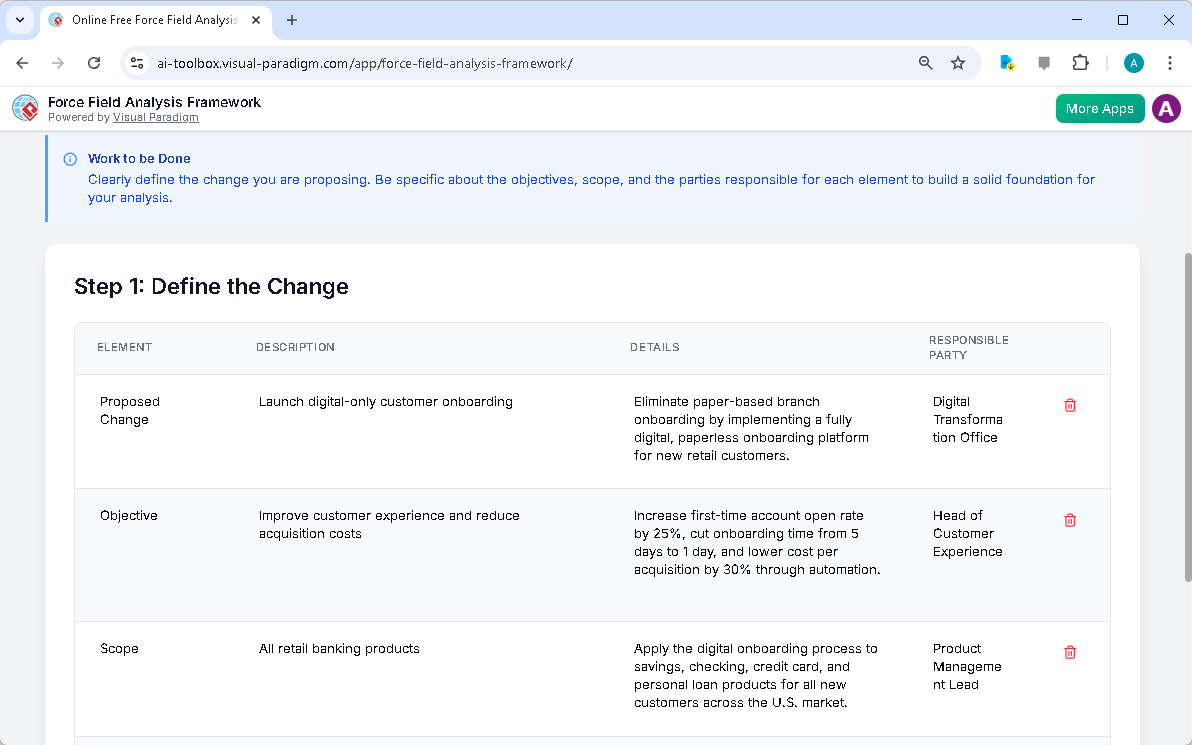
Once the change is defined, the analysis moves to identifying the forces that will push it forward. Image 2 shows the results of the AI-generated analysis for the “Driving Forces” step. The tool presents a dynamic table where each force is listed with a description, a strength rating (1-5), evidence, and a responsible party. For HorizonBank, the AI identifies powerful drivers like “Customer Demand for Digital Experience” (rated 5) and “Competitive Pressure from Fintech” (rated 4). These forces are quantified, allowing the user to see at a glance which factors are most potent. This quantitative approach helps prioritize efforts and focus on the most impactful areas for support.
Step 3: Uncovering Restraining Forces
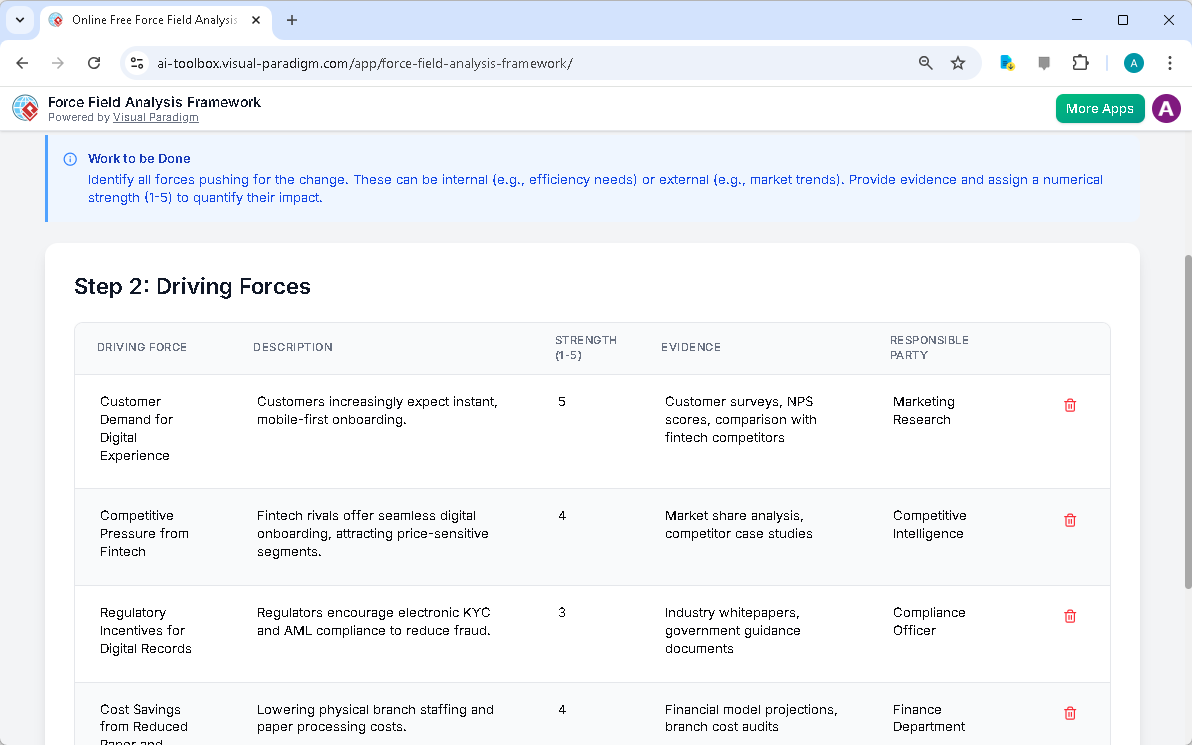
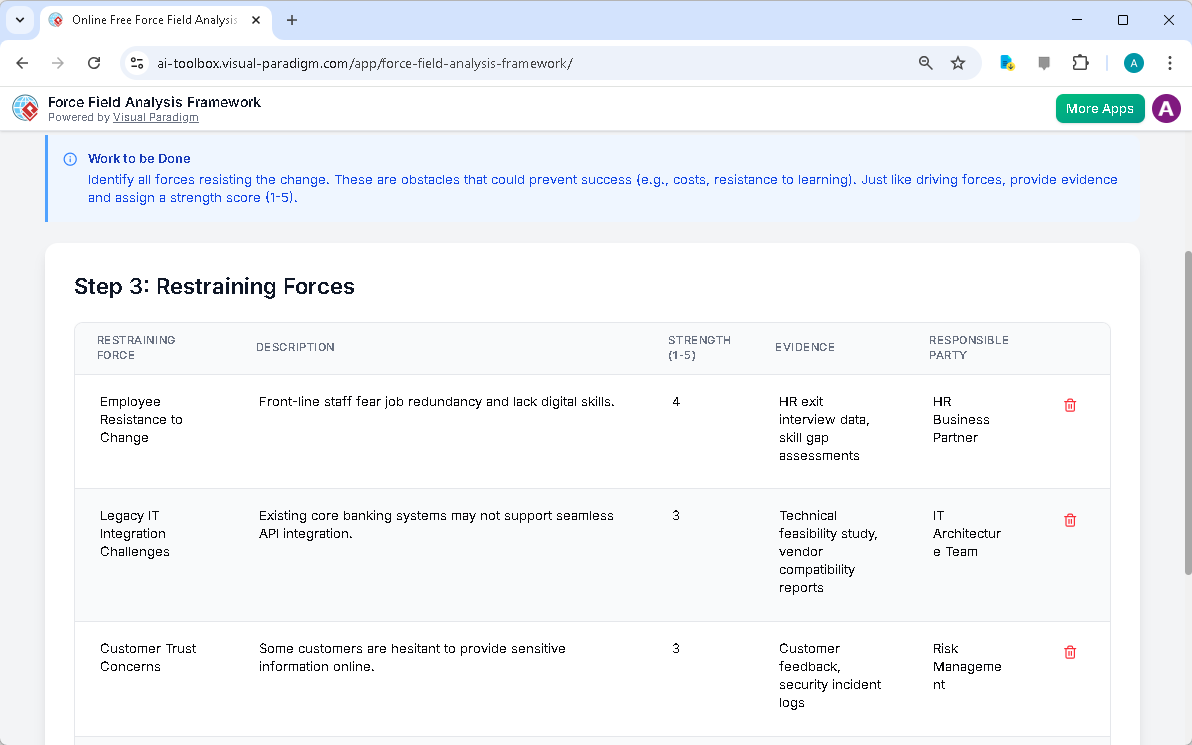
Equally important is understanding the forces that will resist the change. Image 3 illustrates the “Restraining Forces” section. Here, the AI identifies potential obstacles such as “Employee Resistance to Change” and “Legacy IT Integration Challenges,” each assigned a strength rating. This step is vital for proactive risk management. By quantifying these restraining forces, the organization can anticipate and plan for resistance. The AI provides evidence for each force, such as “HR exit interview data” for employee resistance, which adds credibility to the analysis. This structured approach ensures that no significant barrier is overlooked.
Step 4: Developing a Strategic Action Plan
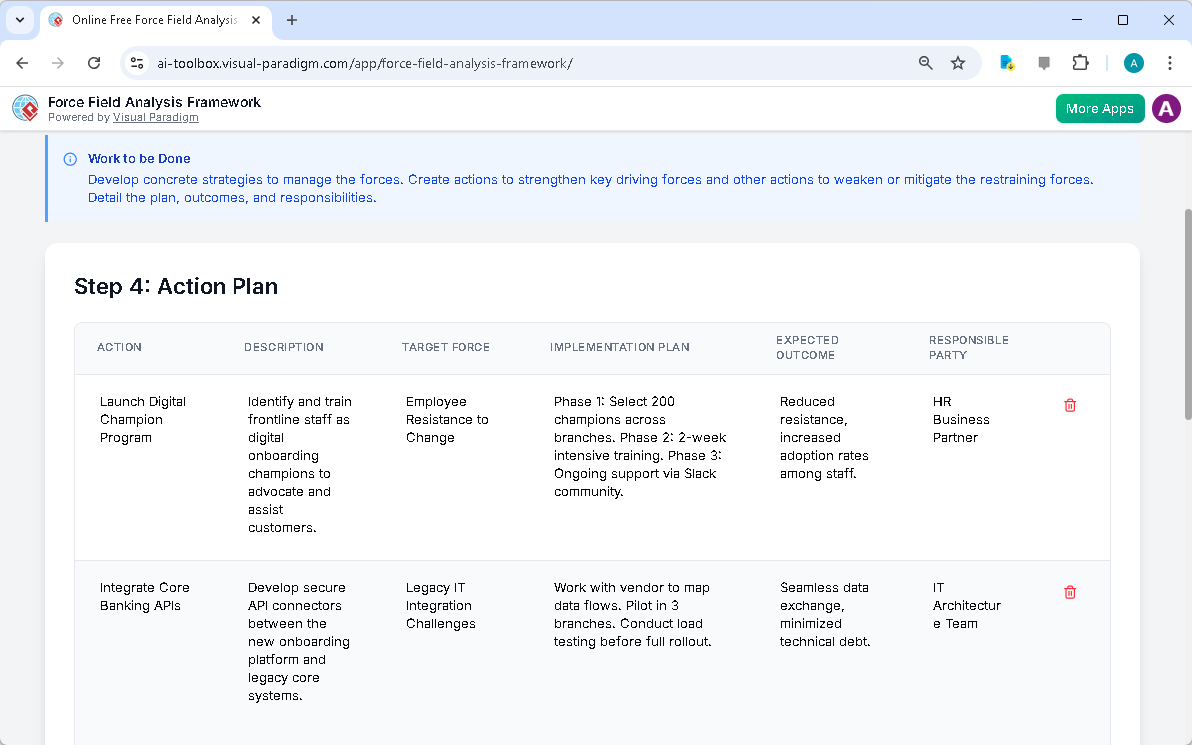
With a clear understanding of both driving and restraining forces, the focus shifts to action. Image 4 displays the “Action Plan” step, where the user develops concrete strategies. The tool provides a table to detail actions, their descriptions, target forces, implementation plans, expected outcomes, and responsible parties. For HorizonBank, the AI suggests actions like “Launch Digital Champion Program” to combat employee resistance and “Integrate Core Banking APIs” to address technical challenges. This step transforms the analysis into a roadmap, providing a clear path forward with defined responsibilities and timelines.
Step 5: Generating a Professional Final Report
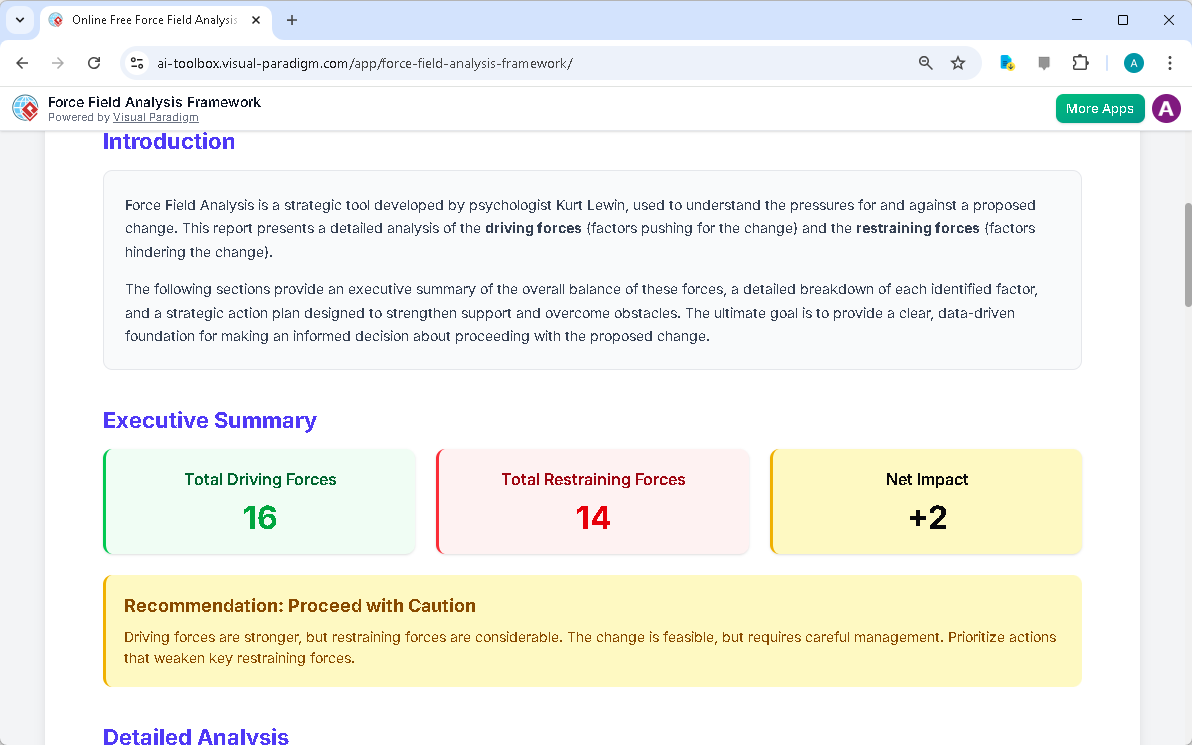
The final step is to consolidate all the analysis into a professional report. Image 5 shows the “Final Report” screen. This report provides an executive summary, a detailed breakdown of forces, and a strategic action plan. It includes a clear visual summary, showing the total driving forces (16), total restraining forces (14), and a net impact of +2, indicating that the change is feasible but requires careful management. The report offers a clear recommendation: “Proceed with Caution,” highlighting the need to prioritize actions that weaken key restraining forces. This final document is ready to be printed or saved as a PDF, making it an effective tool for communicating with stakeholders.
Conclusion: A Data-Driven Path to Change Success
The Force Field Analysis Framework, powered by Visual Paradigm’s AI, offers a powerful, structured methodology for managing organizational change. As demonstrated in the HorizonBank example, the tool streamlines the process from initial definition to final reporting. By leveraging AI to generate a comprehensive first draft, users can save significant time and effort. The structured 5-step workflow ensures a thorough analysis, while the ability to quantify forces and develop detailed action plans provides a clear, data-driven foundation for decision-making. This AI-powered change management tool is an essential asset for project managers, business leaders, and consultants who need to navigate the complexities of change with confidence and precision.
Try the AI-Powered Force Field Analysis Framework Today
Ready to transform your approach to change management? Experience the power of this AI-powered change management tool firsthand. Try the AI-Powered Force Field Analysis Framework now to analyze your next strategic initiative. Start your analysis today.
Related Links
-
Force Field Analysis Tool: Perform Force Field Analysis fast. Creating force field model has never been easier. Visual Paradigm force field analysis tool provides a wide range of unique templates and features to help you create beautiful and professional force field diagrams in minutes.
-
Visual Paradigm AI vs. General LLMs: Comprehensive Modeling Guide: Visual Paradigm AI (VP AI ): A specialized AI engine integrated directly into the Visual Paradigm software suite.VP AI Advantage: Visual Paradigm ’s AI is constrained by a built-in rules engine. It validates outputs against official specifications before presenting them to the user.
-
Visual Paradigm’s AI Strategic Analysis Tool for Force Field Analysis: 12 Sept 2025 · Visual Paradigm helps you list each of these, describe them, and even assign a strength score. This step transforms vague ideas into concrete …
-
Force Field Analysis Framework – Visual Paradigm AI: Use our free Force Field Analysis framework to evaluate driving and restraining forces of change. Build clarity, assess risks, and create actionable …
-
Free AI Force Field Analysis Tool for Change Management – Visual …: This intelligent wizard helps you identify the forces pushing for and resisting change, allowing you to develop effective strategies for successful …
-
Force Field Analysis Framework | A Change Management Tool – Visual Paradigm: The Force Field Analysis Framework is a strategic web-based tool used to understand the pressures for and against a proposed change.
-
How It Works – Force Field Analysis Framework – Visual Paradigm AI: This free tool is designed to guide you through a proven four-step workflow, turning your real-world insights into a concrete action plan. But before you even …