


System modeling requires precision. When architects and developers map out complex software structures, the relationships between components define how the system behaves, scales, and survives changes. Two specific relationship types often cause confusion within Composite Structure Diagrams: Aggregation and Composition. While they both represent part-whole relationships, the distinctions dictate ownership, lifecycle management, and dependency strength.
Understanding these nuances is not merely academic. It influences how memory is managed, how data is persisted, and how tightly coupled different subsystems become. This guide provides a deep dive into these structural concepts, moving beyond basic definitions to explore their practical implications in system design.
🏗️ The Foundation: Composite Structure Diagrams
A Composite Structure Diagram illustrates the internal structure of a classifier. It shows how the classifier is divided into nested components and how these components interact with one another through ports and connectors. Within this internal landscape, the way parts are attached to the whole matters significantly.
Imagine a complex assembly. You have a central unit, and you attach smaller units to it. Sometimes, if the central unit is destroyed, the smaller units remain. Other times, if the central unit is destroyed, the smaller units cease to exist. This distinction is the core of the difference between Aggregation and Composition.
- Composite Structure Diagrams focus on the internal architecture.
- Part-Whole Relationships define how these internal pieces connect.
- Ownership determines who is responsible for the lifecycle of the parts.
🤝 Aggregation: The Weak Part-Whole Relationship
Aggregation represents a relationship where one object (the whole) contains or references another object (the part), but the part can exist independently. It is often described as a “shared” or “weak” relationship. In this scenario, the lifecycle of the part is not strictly bound to the lifecycle of the whole.
🔍 Key Characteristics of Aggregation
- Independence: The part can exist without the whole.
- Shared Ownership: The part might belong to multiple wholes simultaneously.
- Weak Coupling: Changes to the whole do not necessarily impact the existence of the part.
- Directional: Often represented as a line with an open diamond at the whole end.
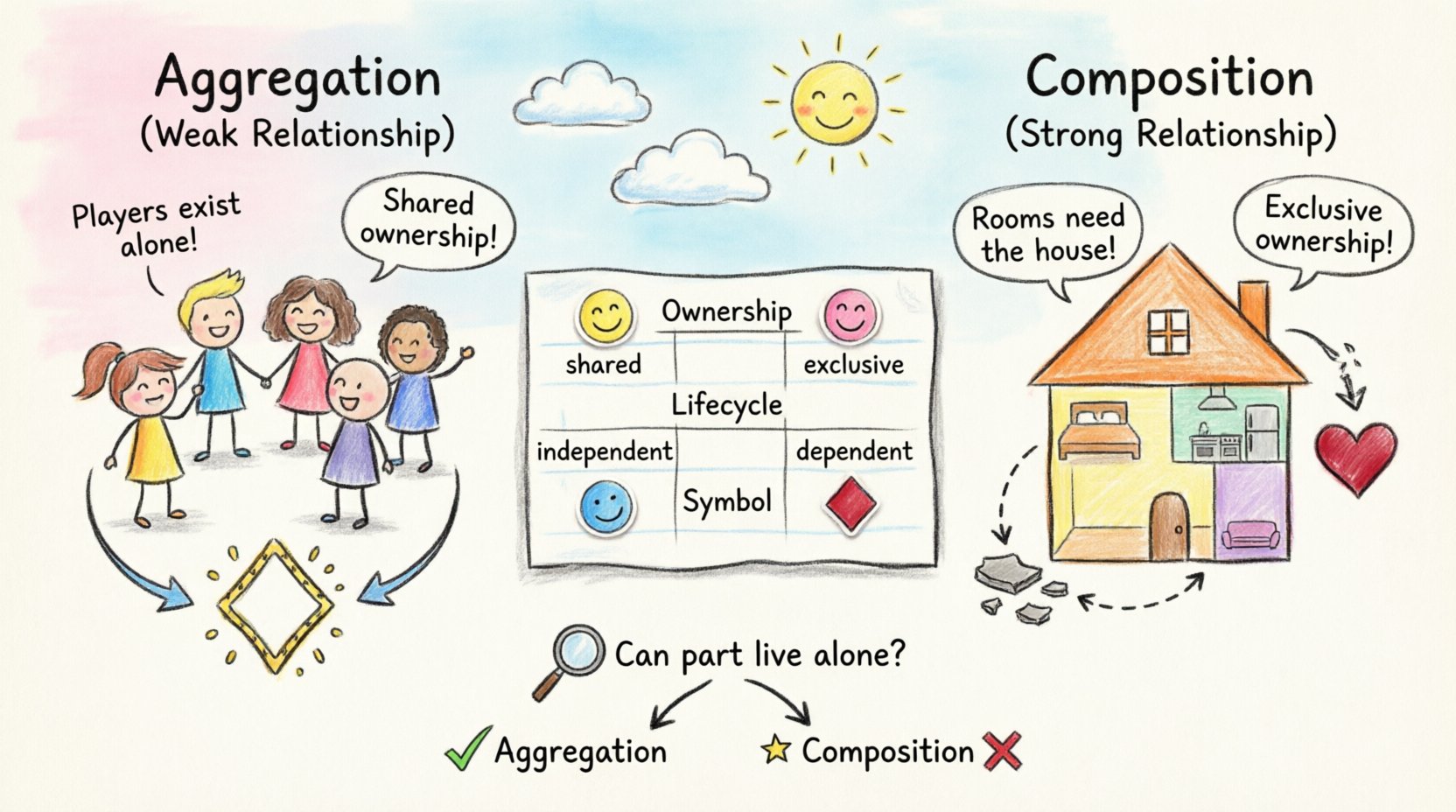
Consider a scenario involving a University and its Departments. A Department exists within the University structure. However, if the University shuts down a specific building, the Department object itself might persist in the database or memory for archival purposes, or it might be reassigned to a different administrative unit. More accurately, consider a Team and its Players. If a Team dissolves, the Players still exist as individuals. They can join another Team. The Players are not owned exclusively by the Team in a strict lifecycle sense.
🧩 Implementation Implications
When modeling Aggregation, you acknowledge a dependency, but not a creation dependency. The code or logic that manages the “whole” does not need to instantiate the “part.” The part may be injected, passed as an argument, or retrieved from a shared pool. This reduces the complexity of initialization logic.
Key points regarding implementation:
- No Constructor Dependency: You do not need to create the part inside the whole’s constructor.
- Reference Passing: The whole holds a reference (pointer or ID) to the part.
- Garbage Collection: Destroying the whole does not automatically trigger the destruction of the part.
💥 Composition: The Strong Part-Whole Relationship
Composition represents a stronger form of aggregation. It implies exclusive ownership. The part is an integral component of the whole, and its lifecycle is strictly bound to the lifecycle of the whole. If the whole is destroyed, the parts are destroyed with it.
🔍 Key Characteristics of Composition
- Dependency: The part cannot exist without the whole.
- Exclusive Ownership: A part belongs to only one whole at a time.
- Strong Coupling: The creation and destruction of the whole dictate the creation and destruction of the part.
- Directional: Represented as a line with a filled diamond at the whole end.
Think of a House and its Rooms. A Room is defined by the existence of the House. If the House is demolished, the Rooms cease to exist as functional entities within that context. You cannot move a Room from one House to another without fundamentally altering its identity. Similarly, consider a Car and its Engine. While an engine can be removed for repair, in the context of the Car’s existence, the specific engine instance is integral. If the Car is scrapped, that specific engine configuration is effectively gone.
🧩 Implementation Implications
When modeling Composition, the whole is responsible for the existence of the part. This usually translates to instantiation within the whole.
- Constructor Dependency: The whole typically creates the part during its initialization.
- Resource Management: The whole must ensure resources allocated to the part are released when the whole is destroyed.
- Lifecycle Synchronization: The part cannot be shared across multiple wholes.
⚖️ Aggregation vs. Composition: A Detailed Comparison
To clarify the distinctions, we can look at these concepts side-by-side. The following table breaks down the operational differences relevant to system architecture and diagramming.
| Feature | Aggregation | Composition |
|---|---|---|
| Ownership | Shared or weak | Exclusive |
| Lifecycle | Independent | Dependent |
| Creation | External to the whole | Internal to the whole |
| Destruction | Whole dies → Part lives | Whole dies → Part dies |
| Association | Multi-way association possible | Strict one-way ownership |
| Symbol | Open Diamond (◇) | Filled Diamond (◆) |
| Analogy | Team & Players | House & Rooms |
🛠️ Visual Notation in Composite Structure Diagrams
In a Composite Structure Diagram, these relationships are visualized using specific connectors between the classifier’s internal parts. The notation helps developers and architects quickly understand the structural constraints without reading code.
- The Connector: A straight line linking the container part to the contained part.
- The Diamond (Aggregation): An unfilled diamond on the side of the container indicates Aggregation. It signals that the relationship is a “has-a” relationship without strict ownership.
- The Diamond (Composition): A filled diamond on the side of the container indicates Composition. It signals a “part-of” relationship with strict ownership.
While the visual symbols are standard, the interpretation depends on the semantic meaning assigned during the design phase. A filled diamond implies a contract: “I am responsible for this part’s life.”
🔄 Lifecycle Management and Ownership Rules
One of the most critical aspects of these relationships is how they affect the lifecycle of objects. This is particularly relevant in memory management, database transactions, and resource disposal.
🗑️ Destruction Scenarios
When the container object is removed from memory or the system:
- Composition Scenario: The system recursively destroys all composed parts. If you have a Document with Pages, deleting the Document deletes all Pages. The system does not attempt to save the Pages elsewhere.
- Aggregation Scenario: The system removes the reference to the part. The part remains in the system state. The system must ensure the part is not orphaned in a way that breaks data integrity, but the part itself is not destroyed.
🔁 Reassignment Possibilities
Composition forbids reassignment. A part cannot be moved from one whole to another without being recreated or reconstituted. Aggregation allows reassignment. A resource (like a Printer) can be aggregated by multiple Computers. If Computer A is turned off, the Printer remains available for Computer B.
🌍 Real-World Scenarios for Structural Modeling
To ground these concepts, let us examine abstract scenarios often found in enterprise systems.
Scenario A: The Order Processing System
In an order management system, an Order contains Order Items.
- Relationship: Composition.
- Reasoning: An Order Item usually has no meaning without an Order. You do not typically sell a single item independently of the order context in this specific model. If the Order is cancelled (destroyed), the Order Items associated with it are deleted from the active context.
Scenario B: The Employee Directory
A Department contains Employees.
- Relationship: Aggregation.
- Reasoning: Employees exist independently of the Department. They may be on leave, transferred, or terminated. If a Department is restructured, the Employee objects persist. The relationship is a collection, not an ownership.
Scenario C: The Financial Portfolio
A Portfolio holds Stocks.
- Relationship: Aggregation.
- Reasoning: A Stock exists in the market regardless of which Portfolio holds it. A single Stock instance might be referenced by multiple Portfolio objects. Destroying a Portfolio does not destroy the Stock data.
🚧 Common Pitfalls and Misinterpretations
Designers frequently conflate these two concepts, leading to tight coupling where loose coupling was intended, or vice versa. Here are common errors to avoid.
- Assuming Composition implies Data Persistence: Composition defines a lifecycle relationship in the model. It does not guarantee database cascade deletes unless the underlying implementation enforces it. However, the model should reflect the intent.
- Using Composition for Shared Resources: If two components need to share a single instance of a resource (like a Database Connection Pool), Composition is incorrect. Use Aggregation. Composition prevents sharing.
- Ignoring the “Part” Definition: A “Part” in a Composite Structure Diagram is a specific instance. If you are modeling the class itself, you are modeling Class Association. Ensure you are distinguishing between the class definition and the instance relationship.
- Overusing Composition: Composition creates strong dependencies. This can make refactoring difficult. If you compose a Module into a Main Application, and you need to swap that Module, you must rebuild the Main Application’s structure. Aggregation allows for more flexibility.
📈 Impact on System Design and Maintenance
Choosing between Aggregation and Composition affects the long-term maintainability of the software. It influences how teams interact with the codebase.
🔒 Coupling and Cohesion
Composition increases cohesion within the container. The container becomes responsible for the internal logic of the part. This is generally good for encapsulation. However, it increases coupling. The container cannot function correctly without the part.
Aggregation decreases cohesion. The container relies on the part, but the part has its own independent existence. This can lead to looser coupling, making it easier to test components in isolation.
🧪 Testing Strategies
Unit testing is impacted by these choices.
- Composition: When testing the whole, you often test the part implicitly. Mocking the part might require recreating the whole’s state. You might need to test the lifecycle logic (creation/destruction).
- Aggregation: You can inject a mock or stub easily. The part is external. This facilitates independent testing of the part’s logic separate from the container’s logic.
📝 Guidelines for Decision Making
When you encounter a part-whole relationship during design, ask these specific questions to determine the correct relationship type.
- Does the part make sense without the whole?
If yes, lean toward Aggregation. If no, lean toward Composition. - Can the part belong to multiple wholes?
If yes, Aggregation is required. Composition forbids multiple owners. - Who is responsible for the part’s creation?
If the whole creates it, Composition is likely. If an external manager creates it, Aggregation is likely. - What happens if the whole is deleted?
If the part must be deleted, use Composition. If the part must survive, use Aggregation.
🔗 Interplay with Other Diagram Types
Composite Structure Diagrams do not exist in isolation. These relationships often appear in Class Diagrams as well.
- Class Diagrams: Use Aggregation and Composition to define class attributes and associations. The notation is identical.
- Sequence Diagrams: Lifecycle relationships manifest as creation messages. Composition might show a “create” message from the container to the part within the sequence.
- Deployment Diagrams: Physical nodes might aggregate software artifacts. If a Server hosts an Application, is it Aggregation or Composition? Usually Aggregation, as the server might host multiple apps, and the app can move.
🧠 Nuances in Object-Oriented Design
In modern programming languages, these concepts map to specific patterns.
Dependency Injection
Dependency Injection is a technique that naturally supports Aggregation. You inject a dependency into a constructor or setter. The container does not own the dependency. This promotes testability and flexibility.
Value Objects vs. Entities
In Domain-Driven Design, Value Objects are often composed into Entities. They have no identity of their own and exist only within the context of the Entity. This is a classic Composition relationship. Entities that reference other Entities often do so via Aggregation (e.g., a Customer aggregates many Orders).
🛡️ Safety and Data Integrity
Choosing Composition can offer a safety net for data integrity. By binding the lifecycle, you ensure that orphaned data does not accumulate. For example, if a “Session” composes a “User Context,” closing the session ensures the context is cleared. Using Aggregation here might leave stale data in memory or the database.
However, Aggregation provides safety against accidental destruction. If a “Report Generator” aggregates a “Data Source,” shutting down the generator should not wipe the Data Source. The Data Source must survive the transient failure of the Generator.
🔍 Analyzing Existing Models
When reviewing legacy diagrams, you may find ambiguity. How do you interpret an unclear relationship?
- Look for Lifecycle Logic: Check the code or database triggers. Does deleting A delete B? That indicates Composition.
- Look for Sharing: Does B appear in multiple A’s? That indicates Aggregation.
- Check Naming Conventions: Sometimes “Manager” implies Aggregation (managing existing resources), while “Builder” implies Composition (creating resources).
🎯 Summary of Structural Integrity
The choice between Aggregation and Composition is a fundamental architectural decision. It defines the boundaries of responsibility and the flow of existence within your system. Aggregation allows for flexibility and sharing, treating parts as independent entities that can be grouped. Composition enforces strict boundaries, ensuring that parts are integral to the whole and cannot survive its destruction.
By applying these concepts rigorously within Composite Structure Diagrams, you create models that accurately reflect the runtime behavior of your software. This clarity reduces technical debt, simplifies onboarding for new developers, and provides a solid foundation for system evolution.
Always verify your design choices against the lifecycle requirements of your components. A well-drawn diagram with the correct diamond notation saves hours of debugging and architectural confusion later in the development lifecycle.