
Entering a new market is a high-stakes endeavor. It requires precision, foresight, and a robust understanding of the external environment. Yet, statistics suggest that a significant majority of market entries stumble within the first three years. One primary culprit is the misapplication of the PEST analysis framework. While the model itself is standard, the execution often falters due to superficial data collection and poor interpretation.
This guide examines the critical errors organizations make during environmental scanning. We focus on the mechanics of Political, Economic, Social, and Technological factors. The goal is to provide a clear, authoritative look at why data interpretation matters more than data collection.
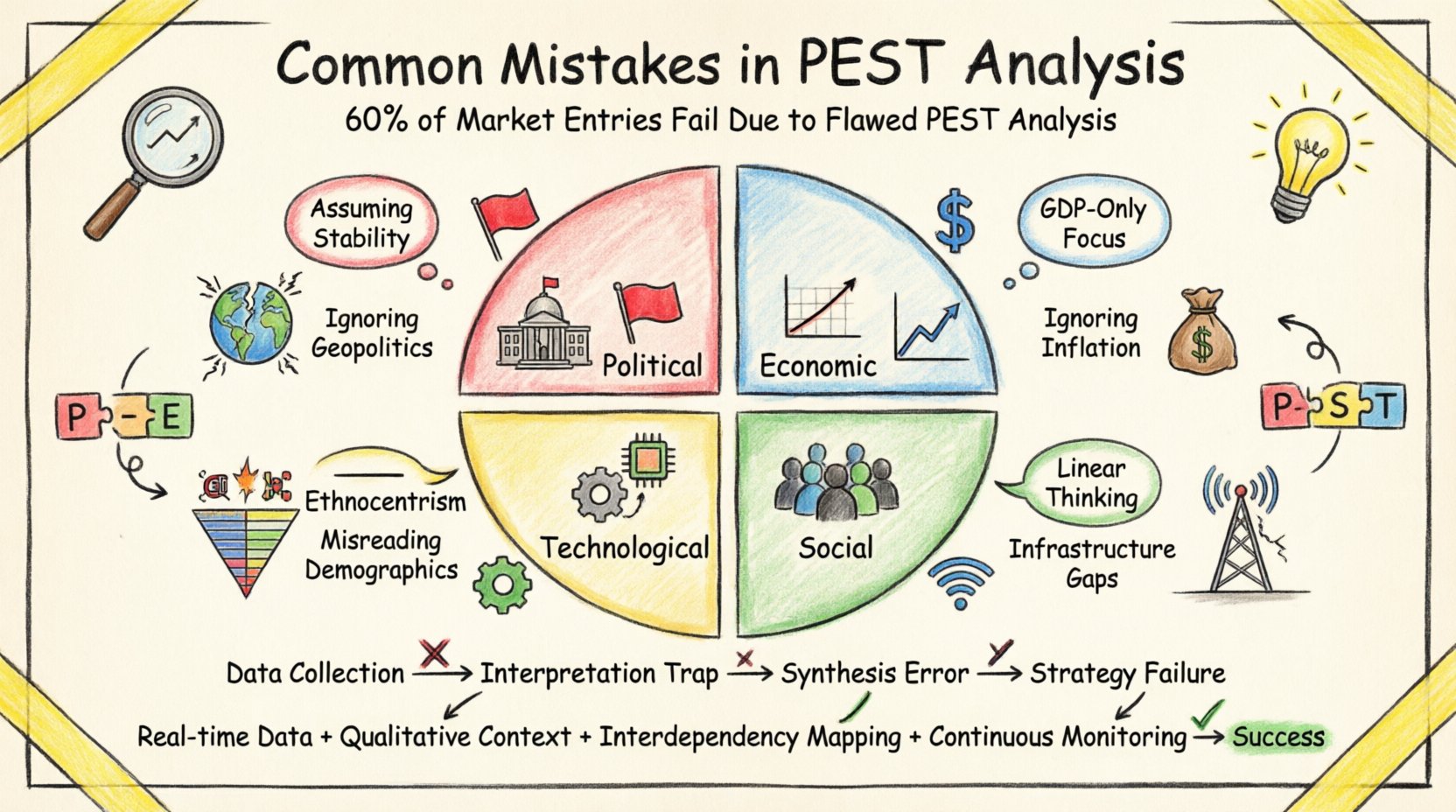
📊 Understanding the PEST Framework
PEST analysis is a strategic tool used to identify and analyze the macro-environmental factors that influence an organization. It stands for:
- Political
- Economic
- Social
- Technological
When conducted correctly, this framework helps decision-makers understand the external forces at play. However, it is not a crystal ball. It is a snapshot of current conditions. The failure point usually occurs when teams treat the output as a static prediction rather than a dynamic starting point for strategy.
Many organizations skip the nuance. They gather data, plug it into a template, and move forward. This approach ignores the volatility of global markets. It assumes stability where there is chaos. The 60% failure rate in market entries often traces back to this lack of depth.
⚠️ The Data Interpretation Trap
Collecting data is easier than interpreting it. The most common mistake is falling into the trap of confirmation bias. Teams often look for data that supports a pre-existing decision rather than data that challenges it.
1. Relying on Outdated Sources
Market conditions change rapidly. Using data from three years ago to plan a launch today is a fundamental error. Economic indicators shift, political landscapes realign, and technology evolves at an exponential rate.
- Impact: Strategies based on old data miss current risks and opportunities.
- Correction: Prioritize real-time data feeds and continuous monitoring systems.
2. Ignoring Qualitative Context
Numbers tell only part of the story. A 5% GDP growth rate looks positive on paper. However, if that growth is driven by a sector that is about to collapse due to regulatory changes, the metric is misleading.
- Impact: Overestimating market stability.
- Correction: Combine quantitative metrics with qualitative insights from local experts.
🏛️ Political Factors: The Volatility Blindspot
Political factors encompass government policies, trade restrictions, tax laws, and labor laws. These are often the most volatile elements of the PEST framework.
The Mistake: Assuming Stability
Many analysts assume that a stable government today means a stable government tomorrow. This assumption ignores the risk of regime change, policy shifts, or sudden trade wars.
- Example: A company expands operations based on current tax incentives. Two years later, the new administration revokes those incentives.
- Result: Profit margins shrink unexpectedly, rendering the project unviable.
The Mistake: Overlooking Geopolitical Tensions
Global supply chains are sensitive to international relations. Ignoring diplomatic tensions can lead to logistical nightmares.
- Key Consideration: Sanctions, embargoes, and trade barriers.
- Key Consideration: Intellectual property protection laws.
💰 Economic Factors: The Misread Indicators
Economic factors include exchange rates, inflation rates, economic growth, and interest rates. These directly impact purchasing power and operational costs.
The Mistake: Focusing Solely on GDP
Gross Domestic Product is a broad measure. It does not account for income distribution or regional disparities. A high GDP might mask a wealthy elite and a struggling working class.
- Impact: Targeting the wrong demographic for a mass-market product.
- Correction: Analyze disposable income levels and purchasing parity.
The Mistake: Neglecting Inflation and Currency Fluctuation
Costs rise with inflation. Revenue might be stable, but profit margins erode if costs outpace price increases. Currency fluctuation can wipe out savings or increase debt burdens overnight.
- Risk: Hedging strategies are often overlooked in initial planning.
- Risk: Pricing models fail to account for currency volatility.
👥 Social Factors: The Cultural Nuance Gap
Social factors involve demographic trends, cultural barriers, lifestyle changes, and population growth. These are often misunderstood because they require deep cultural immersion.
The Mistake: Ethnocentrism
Ethnocentrism occurs when a company applies its home country’s cultural norms to a new market. This leads to marketing failures and product rejection.
- Example: Color symbolism, language nuances, and local taboos.
- Correction: Conduct focus groups with local consumers before launch.
The Mistake: Misreading Demographics
Age distribution is a critical social factor. An aging population requires different products than a youth-heavy demographic.
- Key Consideration: Urbanization rates.
- Key Consideration: Education levels and literacy rates.
📱 Technological Factors: The Disruption Underestimation
Technological factors include automation, research and development activity, and the rate of technological change. This area is often the most dynamic.
The Mistake: Linear Thinking
Many planners assume technology improves linearly. In reality, technology improves exponentially. Disruptive innovations can render current infrastructure obsolete.
- Impact: Investing in legacy systems that will be outdated in 18 months.
- Correction: Assess the technology lifecycle and adoption curves.
The Mistake: Ignoring Infrastructure Gaps
A high-tech product requires high-tech infrastructure. If a region lacks reliable internet or electricity, advanced technology is useless.
- Key Consideration: Internet penetration rates.
- Key Consideration: Mobile device adoption vs. desktop usage.
🧩 The Synthesis Error: Connecting the Dots
Even with accurate data for each category, the analysis fails if the factors are not synthesized correctly. This is where strategic insight is required.
For instance, a technological advancement (T) might be enabled by a political shift (P). If you analyze them in isolation, you miss the synergy.
- Interdependency: Political decisions often drive economic outcomes.
- Interdependency: Social trends often dictate technological adoption.
Without understanding these interdependencies, the PEST analysis becomes a checklist rather than a strategic map.
🛠️ Correcting the Framework: A Structured Approach
To avoid the pitfalls mentioned above, organizations must adopt a rigorous approach to data interpretation. The table below outlines common errors and their corresponding corrective actions.
| Factor | Common Mistake | Impact on Strategy | Corrective Action |
|---|---|---|---|
| Political | Assuming regulatory stability | Compliance failures, fines | Engage local legal counsel; monitor policy trends |
| Economic | Ignoring inflation volatility | Margin erosion | Build contingency funds; dynamic pricing models |
| Social | Applying home culture norms | Brand rejection, low adoption | Hire local consultants; conduct cultural audits |
| Technological | Overlooking infrastructure limits | Operational downtime | Verify infrastructure capabilities before deployment |
🔍 Data Sources and Verification
The quality of your PEST analysis depends entirely on the quality of your sources. Relying on a single source is a recipe for error.
Primary vs. Secondary Data
- Secondary Data: Reports from government agencies, industry bodies, and news outlets. This is accessible but often generalized.
- Primary Data: Interviews, surveys, and direct observation. This is specific but time-consuming to gather.
A robust strategy utilizes both. Use secondary data to identify trends and primary data to validate specific hypotheses.
Verification Protocols
Every piece of data should be verified against at least two independent sources. This reduces the risk of relying on biased or outdated information.
- Check Dates: Ensure the publication date is recent.
- Check Authority: Is the source reputable?
- Check Bias: Who funded the research?
🔄 Continuous Monitoring
A PEST analysis is not a one-time activity. It is a living document. Markets evolve, and so must the analysis.
Setting up triggers for review is essential. For example, if inflation hits a certain threshold, the economic section of the analysis should be re-evaluated immediately.
- Frequency: Quarterly reviews are standard for stable markets.
- Frequency: Monthly reviews are necessary for volatile markets.
This agility allows organizations to pivot before a crisis becomes a catastrophe.
🧠 Cognitive Biases in Analysis
Even with good data, human error remains. Cognitive biases can distort the interpretation of the PEST framework.
Survivorship Bias
Looking only at successful market entries and ignoring the failures. This leads to an overly optimistic view of market potential.
Recency Bias
Giving too much weight to recent events. A recent political scandal might overshadow a long-term structural issue.
Confirmation Bias
Seeking evidence that supports a decision already made. This is the most dangerous bias in strategic planning.
To mitigate these biases, encourage dissenting opinions within the planning team. Assign a “devil’s advocate” to challenge the findings of the PEST analysis.
🌐 Global vs. Local Nuances
For multinational corporations, the challenge is balancing global consistency with local specificity.
- Global Factors: Climate change, global supply chain shifts, international trade agreements.
- Local Factors: Local labor laws, specific consumer preferences, regional economic policies.
A global PEST analysis often misses the local details that make or break a specific market entry. A hybrid approach is recommended. Conduct a global scan for macro trends, then drill down into local scans for each target region.
📉 The Cost of Failure
The 60% failure rate statistic is not arbitrary. It represents capital, time, and reputation lost. When data interpretation is flawed:
- Capital Allocation: Funds are wasted on unviable projects.
- Opportunity Cost: Resources are tied up in failed ventures instead of profitable ones.
- Brand Reputation: Entering a market and failing quickly damages the brand’s credibility globally.
Investing in better analysis processes is not a cost; it is an insurance policy against these outcomes.
🚀 Moving Forward: Strategic Imperatives
To improve market entry success rates, organizations must treat PEST analysis as a critical discipline rather than a box-checking exercise.
- Prioritize Accuracy: Verify data before using it for decision-making.
- Embrace Complexity: Acknowledge that factors are interconnected.
- Stay Agile: Update the analysis regularly to reflect new realities.
- Challenge Assumptions: Question the status quo and the underlying premises of the data.
By addressing the common mistakes outlined in this guide, organizations can significantly reduce the risk of market entry failure. The difference between success and failure often lies not in the strategy itself, but in the accuracy of the environmental scan that supports it.
🔗 Final Thoughts on Implementation
Implementation requires commitment. It requires moving away from intuition and toward evidence-based planning. While the PEST framework is decades old, its application remains vital in the modern economy.
Success comes from understanding the environment deeply. It comes from recognizing that data is a tool, not a truth. When used with rigor and critical thinking, PEST analysis provides a solid foundation for growth. When used carelessly, it offers a false sense of security.
Ensure your team is equipped with the skills to interpret this data correctly. Training on data literacy and strategic analysis is essential for long-term resilience.