
Strategic planning is the backbone of organizational growth. Leaders constantly seek frameworks to dissect complex environments and make informed decisions. Two methodologies dominate this landscape: the PEST Analysis and the SWOT Analysis. While both aim to clarify direction, they operate on different axes of scope and focus. Choosing the right instrument depends on the specific directive at hand. This guide explores the mechanics, applications, and synergies of both frameworks to determine their role in corporate strategy. 📊
Understanding the PEST Analysis Framework 🔍
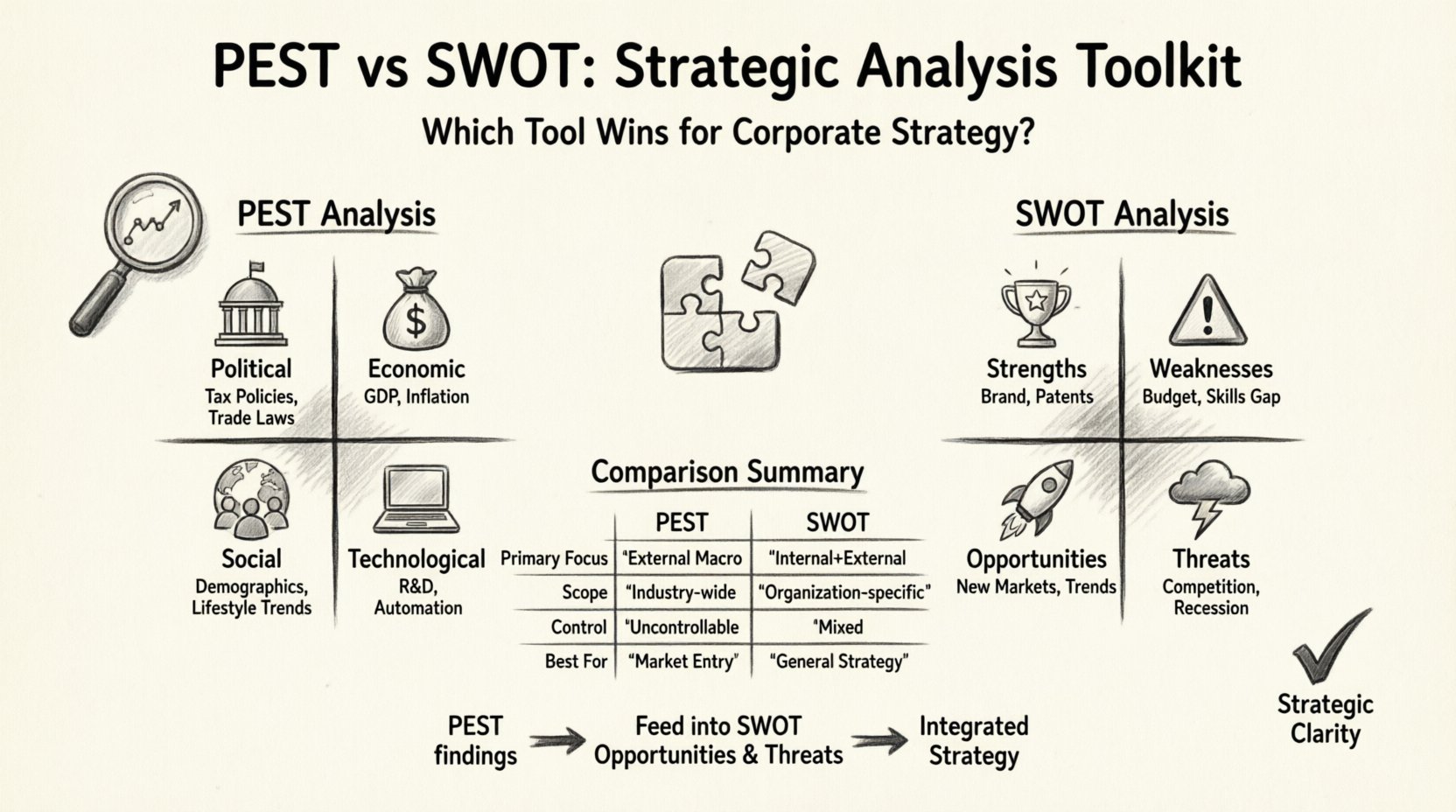
The PEST Analysis is a strategic tool used to evaluate the external macro-environmental factors that can impact an organization. It stands for Political, Economic, Social, and Technological. This framework is particularly useful when entering new markets, launching new products, or assessing long-term viability against external shifts.
1. Political Factors 🏛️
Political elements involve government influence on the industry. These are often regulatory in nature and can change rapidly. Key considerations include:
- Tax Policies: How do corporate tax rates affect profitability?
- Trade Restrictions: Are there tariffs or quotas impacting supply chains?
- Labor Laws: What are the compliance requirements for hiring and wages?
- Political Stability: Is the region safe for long-term investment?
- Environmental Regulations: Are there new compliance costs regarding waste or emissions?
2. Economic Factors 💰
Economic conditions dictate the purchasing power of customers and the cost of capital. These factors fluctuate with market cycles.
- Economic Growth: Is the GDP expanding or contracting?
- Interest Rates: How does borrowing cost influence expansion plans?
- Exchange Rates: Does currency fluctuation impact import/export margins?
- Inflation: Are raw material costs rising faster than revenue?
- Disposable Income: Can customers afford premium offerings?
3. Social Factors 🌍
Social factors relate to the cultural and demographic aspects of the target market. Understanding human behavior is critical for product-market fit.
- Population Growth: Is the market expanding or shrinking?
- Age Distribution: Is the workforce aging or youthful?
- Lifestyle Trends: Are consumers shifting toward sustainability or convenience?
- Health Consciousness: Is there a demand for wellness-focused products?
- Education Levels: Does the workforce have the skills required for automation?
4. Technological Factors 💻
Technological changes can render products obsolete or create new channels for distribution. This factor is often the most volatile.
- R&D Activity: Is innovation happening faster than adoption?
- Automation: Can processes be optimized through machinery or AI?
- Internet Access: Is digital connectivity widespread enough for e-commerce?
- Software Accessibility: Are necessary tools affordable and scalable?
- Disruption Risks: Is a competitor using tech to undercut pricing?
Understanding the SWOT Analysis Framework ⚖️
The SWOT Analysis examines internal and external factors. It provides a holistic view by combining the organization’s internal capabilities with external possibilities. It stands for Strengths, Weaknesses, Opportunities, and Threats.
1. Strengths (Internal) 🏆
Strengths are attributes that give the organization an advantage over others. These are within the control of the management team.
- Brand Reputation: Do customers trust the name?
- Patented Technology: Are there proprietary assets?
- Financial Resources: Is there cash flow for investment?
- Expertise: Does the team possess unique skills?
- Efficiency: Are processes lean and cost-effective?
2. Weaknesses (Internal) ⚠️
Weaknesses are attributes that place the organization at a disadvantage. Like strengths, these are internal and controllable.
- Limited Budget: Is capital constrained?
- Outdated Infrastructure: Is hardware or software obsolete?
- Skills Gap: Are key roles unfilled or underqualified?
- High Debt: Does leverage restrict flexibility?
- Geographic Limitations: Is presence restricted to a small region?
3. Opportunities (External) 🚀
Opportunities are external chances to improve performance. These are not under direct control but can be capitalized on.
- New Markets: Can expansion occur in untapped regions?
- Competitor Failure: Is a rival struggling or exiting?
- Regulatory Changes: Do new laws favor the business model?
- Emerging Trends: Are consumer habits shifting in your favor?
- Partnerships: Can alliances open new distribution channels?
4. Threats (External) ⛈️
Threats are external elements that could cause trouble for the business. These require mitigation strategies.
- Market Saturation: Is the market too crowded?
- Economic Downturns: Could a recession reduce demand?
- Changing Consumer Preferences: Are tastes shifting away from the product?
- Supply Chain Disruptions: Are suppliers vulnerable?
- Legal Challenges: Are lawsuits or compliance risks looming?
Head-to-Head Comparison 🥊
While both tools serve strategic planning, they address different layers of the business ecosystem. The following table outlines the structural differences.
| Criteria | PEST Analysis | SWOT Analysis |
|---|---|---|
| Primary Focus | External Macro Environment | Internal & External Factors |
| Scope | Industry-wide, Market-level | Organization-specific |
| Control | Zero Control (Uncontrollable) | Internal (Controllable) / External (Uncontrollable) |
| Time Horizon | Long-term Trends | Short-term to Medium-term |
| Output | Environmental Context | Strategic Positioning |
| Best Used For | Market Entry, Risk Assessment | General Strategy, Project Planning |
When to Deploy Each Framework 🗓️
Selecting the correct tool requires understanding the specific strategic question being asked. Using the wrong lens can lead to flawed data interpretation.
Use PEST When:
- Entering a New Region: You need to understand the local landscape before investing.
- Long-term Planning: You are forecasting trends 5 to 10 years out.
- Assessing Risk: You need to identify external variables that could disrupt operations.
- Policy Advocacy: You need to understand how government shifts might affect the sector.
Use SWOT When:
- Annual Review: You need a snapshot of current organizational health.
- Competitive Analysis: You want to compare your position against rivals.
- Resource Allocation: You need to decide where to invest internal capital.
- Problem Solving: You need to identify why a specific initiative is failing.
Integrating PEST and SWOT for Maximum Impact 🤝
Using these tools in isolation limits their effectiveness. The most robust strategies emerge when PEST data feeds directly into the SWOT matrix. This integration creates a comprehensive view of the strategic landscape.
The Integration Process 🔄
- Conduct PEST Analysis First: Gather data on external forces. Identify the macro trends affecting the industry.
- Map to Opportunities and Threats: Translate PEST findings into the SWOT “O” and “T” sections. For example, a new trade tariff (Political) becomes a Threat. A demographic shift (Social) becomes an Opportunity.
- Assess Internal Capacity: Evaluate if the organization has the Strengths to seize the Opportunities or the Weaknesses that amplify the Threats.
- Develop Actionable Strategies: Create plans that leverage internal strengths to exploit external opportunities (SO Strategies) and use strengths to minimize external threats (ST Strategies).
Example of Integration
Imagine a company analyzing the electric vehicle market.
- PEST Finding: Government subsidies for green energy are increasing (Political).
- SWOT Translation: This is an Opportunity.
- SWOT Finding: The company has a strong supply chain for batteries (Strength).
- Strategy: Expand production to capture subsidized demand.
Common Pitfalls in Strategic Analysis ⚠️
Even the best frameworks fail if executed poorly. Common errors can undermine the value of the analysis.
1. Vagueness and Generalization
Statements like “Economy is bad” or “Technology is good” are useless. Data must be specific.
- Bad: “Interest rates are high.”
- Good: “Interest rates have risen by 2% in the last quarter, increasing loan costs for capital expansion.”
2. Internal Bias
Teams often overestimate strengths and underestimate weaknesses. External factors are sometimes ignored to protect ego.
- Fix: Involve external consultants or diverse internal stakeholders to challenge assumptions.
3. Static Analysis
Strategy is not a one-time event. Markets change, and so must the analysis.
- Fix: Schedule regular reviews. Update the data quarterly or biannually.
4. Confusing Symptoms with Causes
Weaknesses might be the cause of a problem, not the symptom. Analysis must dig deep.
- Example: Low sales is a symptom. Lack of brand awareness is a weakness causing it. Low sales is not a weakness in itself.
5. Ignoring Interconnectivity
Factors rarely exist in isolation. A technological shift (PEST) might create a new weakness (SWOT) if the team cannot adapt.
- Fix: Look for correlations between the four quadrants of PEST and the four quadrants of SWOT.
Implementation Steps Without Software 🛠️
You do not need specialized platforms to conduct these analyses. A collaborative workshop approach often yields better results.
Step 1: Preparation 📝
- Define the objective clearly.
- Assemble a cross-functional team.
- Set the time frame (usually 1-2 days).
- Gather preliminary data (reports, financials, market research).
Step 2: Data Collection 📊
- Distribute tasks among team members.
- Assign specific PEST factors to specific people.
- Assign specific SWOT quadrants to different departments.
- Collect evidence, not opinions.
Step 3: Workshop Session 🗣️
- Present findings to the group.
- Discuss implications.
- Vote on the most critical factors.
- Reach consensus on the final list.
Step 4: Synthesis and Reporting 📄
- Create the final matrix or document.
- Highlight top 3 priorities.
- Distribute to key stakeholders.
- Schedule a follow-up review date.
Step 5: Execution Planning 🎯
- Translate insights into KPIs.
- Assign owners to strategic initiatives.
- Set deadlines for milestones.
- Monitor progress regularly.
Strategic Implementation Summary ✅
Both PEST and SWOT are essential components of a mature strategic planning toolkit. PEST provides the macro lens, ensuring the organization is not blindsided by external shifts. SWOT provides the micro lens, ensuring the organization understands its own capacity to act. Using PEST to inform the Opportunities and Threats of SWOT creates a robust strategy grounded in reality. Leaders who master this integration position their organizations to navigate uncertainty with confidence. The choice is not between one or the other, but rather how they work together to guide corporate directives. 🚀
Final Thoughts on Strategic Clarity 🧭
Strategy is not about predicting the future; it is about preparing for multiple futures. These frameworks provide the structure needed to organize information and reduce complexity. By rigorously applying PEST and SWOT, teams move from reactive decision-making to proactive planning. The tools themselves are simple, but the discipline required to use them correctly is what drives success. Organizations that treat these frameworks as living documents rather than static reports gain a significant competitive advantage. Start with data, validate with consensus, and execute with focus.