
Entering a new market is a high-stakes endeavor that demands precision, foresight, and a deep understanding of the external environment. Businesses often fail not because of internal weaknesses, but due to unforeseen external shifts. To mitigate these risks, organizations employ structured analytical tools. Among the most robust frameworks available for this purpose is the PEST Analysis. This method provides a macro-environmental scan that helps decision-makers identify opportunities and threats before committing resources.
This guide explores the mechanics, applications, and strategic value of PEST Analysis. It serves as a foundational resource for strategists, entrepreneurs, and analysts looking to validate market entry strategies without relying on guesswork.
🔍 What Is PEST Analysis?
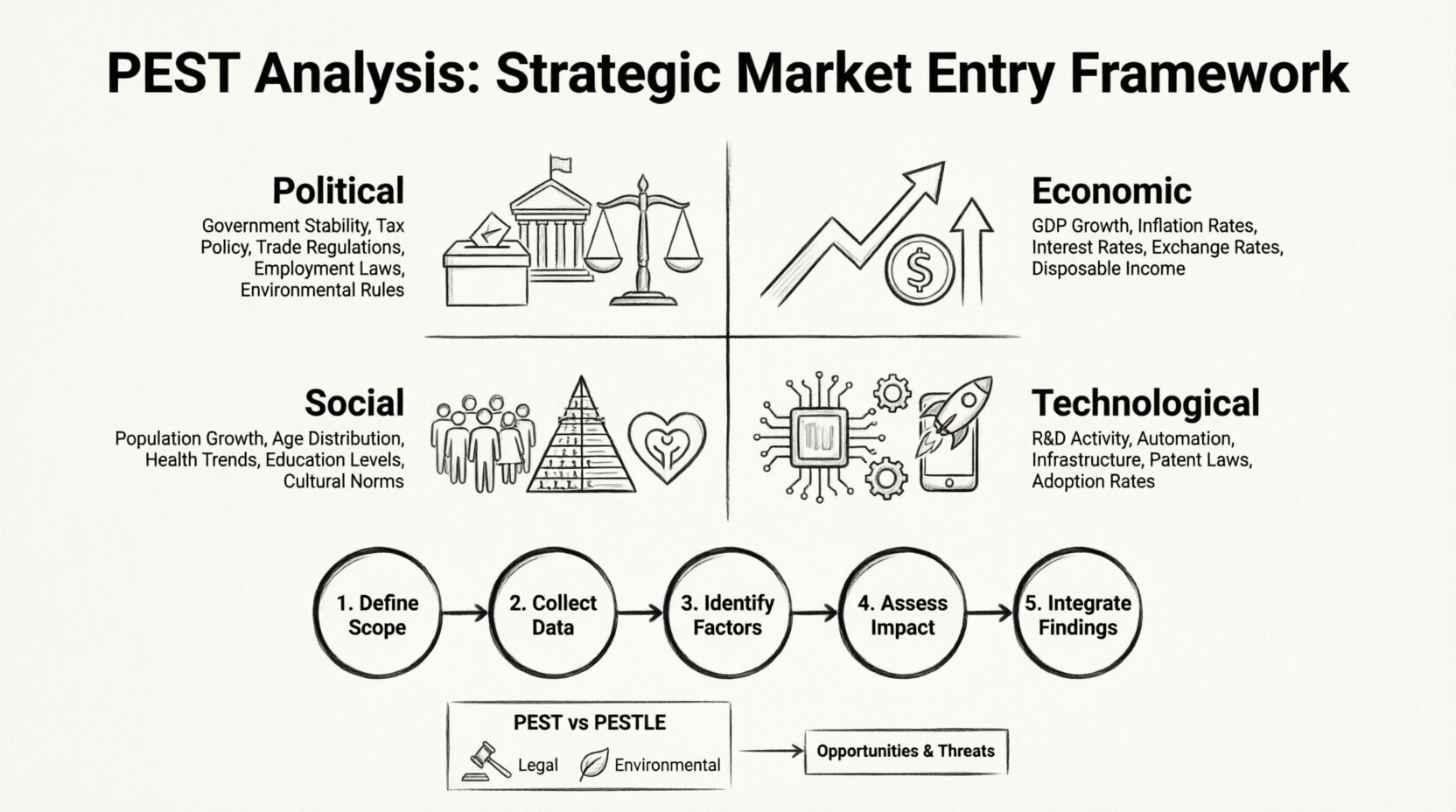
PEST Analysis is an acronym that stands for Political, Economic, Social, and Technological factors. It is a strategic tool used to understand the external macro-environmental factors that can impact an organization. Unlike internal audits which focus on resources and capabilities, PEST looks outward.
- Political: Government policies, trade restrictions, tax laws, and political stability.
- Economic: Economic growth rates, exchange rates, inflation, and interest rates.
- Social: Cultural aspects, demographic changes, population growth, and lifestyle trends.
- Technological: R&D activity, automation, technology incentives, and the rate of technological change.
When applied correctly, this framework transforms vague market intuition into concrete data points. It allows teams to anticipate regulatory hurdles or shifting consumer behaviors before they become critical issues.
🏛️ Deep Dive: Political Factors
Political factors refer to the influence of government actions on the business environment. These are often the most rigid constraints a company faces. Ignoring political realities can lead to operational shutdowns or financial penalties.
Key Considerations
- Government Stability: Is the regime stable? Frequent elections or civil unrest can disrupt supply chains and investment security.
- Tax Policy: Corporate tax rates, import duties, and incentives for specific industries directly affect profit margins.
- Trade Regulations: Tariffs, quotas, and trade embargoes determine the cost of entering a market.
- Employment Laws: Minimum wage requirements, union regulations, and labor rights impact operational costs.
- Environmental Regulations: Policies regarding carbon emissions, waste disposal, and resource usage.
For example, a company planning to enter a market with strict environmental compliance laws must factor in the cost of green technology. Conversely, a market offering tax holidays for foreign direct investment might be more attractive for initial capital expenditure.
💰 Deep Dive: Economic Factors
Economic conditions determine the purchasing power of potential customers and the cost of capital for the business. These factors are fluid and can change rapidly based on global events.
Key Considerations
- GDP Growth: Indicates the overall health of the economy and potential market size.
- Inflation Rates: High inflation erodes consumer spending power and increases input costs.
- Interest Rates: Affects borrowing costs for expansion and the discount rate used in financial modeling.
- Exchange Rates: Currency volatility can turn a profitable venture into a loss if the local currency depreciates against the operating currency.
- Disposable Income: The amount of money households have available for spending on non-essential goods and services.
Understanding the economic cycle is crucial. Entering a market during a recession requires a different pricing strategy than entering during an expansion phase. Businesses must analyze whether the target market is emerging, mature, or in decline.
👥 Deep Dive: Social Factors
Social factors relate to the human element of the market. This includes demographics, cultural norms, and consumer attitudes. Even a perfect product can fail if it does not align with the social fabric of the region.
Key Considerations
- Population Growth: Rapid growth may indicate a future labor surplus and increased consumer base.
- Age Distribution: An aging population requires different products than a youth-dominated demographic.
- Health Consciousness: Trends in wellness and fitness can drive demand for specific sectors.
- Education Levels: Higher education levels often correlate with higher demand for specialized services and technology.
- Cultural Barriers: Language, religious beliefs, and social taboos must be respected to avoid reputational damage.
Localization is a key outcome of this analysis. Marketing messages that work in one culture may be offensive or ineffective in another. Social analysis helps tailor the value proposition to resonate with local values.
📡 Deep Dive: Technological Factors
Technological factors encompass the innovation landscape. In the modern era, this is often the most dynamic component of the analysis. Technology can disrupt entire industries overnight.
Key Considerations
- R&D Activity: The level of innovation within the industry determines the pace of product obsolescence.
- Automation: The availability of automated solutions can reduce labor costs and improve efficiency.
- Infrastructure: Internet penetration, logistics networks, and energy reliability are prerequisites for many modern business models.
- Patent Laws: Intellectual property protection encourages innovation but can restrict technology transfer.
- Adoption Rates: How quickly does the market adopt new technologies? Early adopters differ from laggards.
A business might find that a technology mature in its home market is still in the experimental phase in the target market. This gap represents either a risk or a first-mover advantage.
📊 Comparing Frameworks: PEST vs. PESTLE
While PEST is widely used, variations exist to add depth. The most common extension is PESTLE, which adds Legal and Environmental factors. Understanding the distinction helps in selecting the right tool for the specific industry.
| Factor | PEST Focus | PESTLE Addition |
|---|---|---|
| Political | Government intervention, stability | Includes in Political |
| Economic | Growth, inflation, exchange | Includes in Economic |
| Social | Demographics, culture | Includes in Social |
| Technological | Innovation, infrastructure | Includes in Technological |
| Legal | General policy | Specific laws, compliance, liability |
| Environmental | General policy | Sustainability, climate change, waste |
For industries heavily regulated by specific laws (like pharmaceuticals or finance), PESTLE is often more appropriate. For general market entry, PEST provides a sufficient high-level overview.
⚙️ The Process: Conducting a PEST Analysis
Executing a PEST Analysis requires a structured approach. It is not enough to list factors; they must be evaluated for relevance and impact. The following steps outline the workflow.
- Define the Scope: Clearly articulate the market or product being analyzed. A global analysis differs from a regional one.
- Collect Data: Gather information from government reports, industry publications, news outlets, and economic databases. Ensure data sources are credible and current.
- Identify Factors: Brainstorm potential factors within the four categories. Do not limit yourself to obvious ones; look for underlying trends.
- Assess Impact: Rate each factor based on its potential impact on the business (High, Medium, Low) and the likelihood of occurrence.
- Integrate Findings: Feed the results into the strategic planning process. Adjust business models, pricing, or entry timelines based on the findings.
Data Collection Strategies
- Government Publications: Census data, central bank reports, and trade ministry updates.
- Industry Reports: Market research firms often publish detailed sector-specific analyses.
- News Aggregation: Monitoring local and international news for political shifts or economic news.
- Stakeholder Interviews: Speaking with local partners, distributors, or employees who understand the ground reality.
🛑 Common Pitfalls to Avoid
Even experienced strategists make mistakes when applying this framework. Being aware of these common errors ensures the analysis remains robust.
- Static View: Treating the analysis as a one-time event. Markets change; the analysis should be a living document reviewed regularly.
- Generic Data: Using global averages instead of local data. National trends may not apply to specific regions within a country.
- Ignoring Interconnections: Factors often overlap. A political decision (Tax) directly impacts the Economic factor (Inflation). Analysts must look for these correlations.
- Overlooking Weak Signals: Focusing only on current loud issues and missing subtle long-term shifts, such as slow demographic changes.
- Lack of Actionability: Producing a list of factors without linking them to specific strategic decisions.
🔗 Integration with Other Tools
PEST Analysis is rarely used in isolation. It serves as the external input for other strategic frameworks. The most common integration is with SWOT Analysis.
- Strengths & Weaknesses: These are internal factors.
- Opportunities & Threats: These are external factors.
The output of the PEST Analysis directly populates the Opportunities and Threats sections of a SWOT matrix. For instance, a favorable economic trend identified in PEST becomes an Opportunity in SWOT. A restrictive political regulation becomes a Threat.
This linkage ensures that external scanning translates into internal strategic planning. It prevents the disconnect between market intelligence and operational execution.
🌍 Real-World Application Examples
To understand the practical utility, consider how different industries utilize this framework.
Case Study 1: Retail Expansion
A retail chain planning to expand into Southeast Asia might analyze:
- Political: Stability of local governments and ease of foreign ownership.
- Economic: Rising disposable income in urban centers.
- Social: Preference for mobile shopping over brick-and-mortar stores.
- Technological: High smartphone penetration and mobile payment adoption.
This leads to a strategy focused on mobile-first e-commerce platforms rather than immediate large-scale physical store openings.
Case Study 2: Manufacturing Sector
A manufacturing firm considering a new plant might analyze:
- Political: Labor laws and trade tariffs on raw materials.
- Economic: Cost of labor compared to current locations.
- Social: Availability of skilled workforce and community acceptance.
- Technological: Infrastructure reliability for heavy machinery and logistics.
This analysis might reveal that while labor costs are low, infrastructure reliability is a threat, prompting an investment in backup power systems or a different location.
📈 Strategic Implementation Considerations
Once the analysis is complete, the focus shifts to execution. The insights gathered must drive tangible changes in the business plan.
- Risk Mitigation: Develop contingency plans for high-impact threats identified in the analysis.
- Market Positioning: Adjust branding and messaging to align with social and cultural findings.
- Financial Planning: Update financial models to reflect economic realities like inflation and currency fluctuation.
- Compliance: Ensure all operational processes meet the political and legal requirements identified.
Strategic agility is key. The market environment is dynamic. A plan that works today may need adjustment next year as the PEST factors shift. Regular reviews keep the strategy relevant.
📝 Final Considerations
Strategic market entry is complex. It involves navigating a web of external forces that can make or break a venture. The PEST Analysis provides the structure needed to untangle this web. By systematically examining Political, Economic, Social, and Technological factors, organizations gain a clearer picture of the landscape.
It is not a crystal ball, but a compass. It does not predict the future with certainty, but it illuminates the path forward. When combined with internal analysis and market research, it forms a powerful toolkit for sustainable growth. Businesses that invest time in this rigorous external scanning process are better positioned to adapt to change and capitalize on emerging opportunities.
For any organization serious about expansion, mastering this framework is not optional. It is a prerequisite for informed decision-making. The cost of skipping this step often far exceeds the effort required to conduct the analysis.